
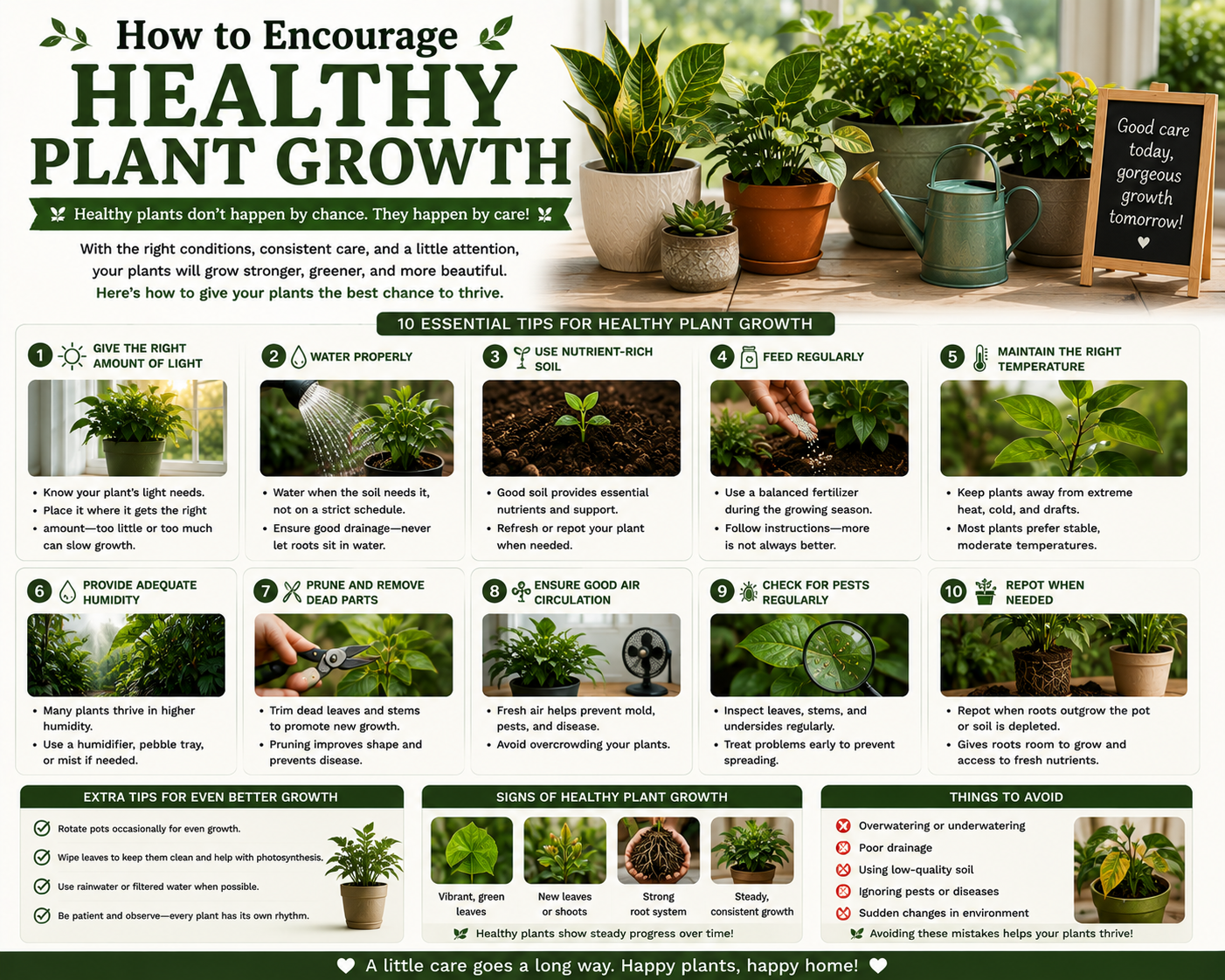
Every plant owner wants the same thing: vibrant, healthy plants that grow steadily, look their best, and reward the care invested in them with lush foliage, abundant flowers, or productive harvests. The principles that drive healthy plant growth are not mysterious or complicated, but they do require consistent application and a willingness to observe your plants closely enough to understand what they specifically need at each stage of their development. Healthy plant growth is not the result of any single intervention — it is the cumulative outcome of getting multiple fundamental factors right simultaneously and maintaining them consistently over time.
The Foundation of Healthy Growth: Getting the Basics Right
Healthy plant growth begins with the four non-negotiable fundamentals: appropriate light, correct watering, adequate nutrition, and suitable soil. When all four of these are in alignment with a plant’s specific needs, growth follows naturally and vigorously. When any one of them is significantly off, growth slows, stops, or produces the weak, elongated, pale, or distorted characteristics that indicate a plant struggling against an inadequate environment. The most powerful thing you can do to encourage healthier growth in any plant is to systematically assess and correct each of these four fundamentals before reaching for any more complex or supplemental solutions.
Light is the driver of growth in the most fundamental sense — it is the energy source that powers every biological process in the plant, from photosynthesis to root expansion to flowering. A plant receiving insufficient light cannot grow at its natural rate regardless of how perfectly you manage watering, feeding, and soil conditions. If your plant is growing very slowly, producing small leaves, or developing pale coloring, moving it to a brighter position is almost always the most impactful single change you can make before investigating any other potential cause.
How root health determines growth above ground
The condition of a plant’s root system determines the quality and vigor of everything that grows above the soil surface, yet roots are invisible and easy to overlook. A plant with a healthy, well-developed root system efficiently absorbs water and nutrients and transports them to leaves, stems, and growing tips at a rate that supports active, vigorous growth. A plant with damaged, constricted, or rotted roots struggles to sustain even basic functions, let alone active new growth. If your plant looks healthy but is not growing despite good light, appropriate watering, and regular feeding, removing it from its pot and inspecting the root system is the most direct way to identify whether a root problem is limiting its performance.
Feeding for Optimal Growth
Plants growing in containers cannot access new nutrient sources the way plants in open ground can, and the nutrients present in potting mix are depleted progressively with each watering session. A consistent fertilizing routine during the active growing season is the single most effective way to sustain the vigorous, healthy growth that well-cared-for plants are capable of. Without adequate nutrition, growth slows, new leaves emerge smaller and paler than established ones, flowering diminishes, and the plant gradually loses the vitality that makes it attractive and productive.
Choose a fertilizer appropriate to the growth stage and goal of your specific plants. A fertilizer high in nitrogen promotes leafy, vegetative growth and is ideal for foliage plants and any plants you want to bulk up quickly. A fertilizer higher in phosphorus supports root development and flowering — use it for flowering plants approaching their blooming season and for newly established plants whose root systems you want to encourage. A fertilizer high in potassium improves overall plant health, disease resistance, and the quality of fruit — essential for fruiting edible plants in the productive phase of their season. Applying the right fertilizer at the right time multiplies its effectiveness compared to using a generic balanced feed indiscriminately throughout the year.
Pruning and Training to Direct Growth Energy
Strategic pruning is one of the most effective and underused tools for encouraging healthy, vigorous growth. When you remove spent flowers before they set seed, the plant redirects the energy it would have invested in seed production into new vegetative growth and further flower production. When you pinch out the growing tip of a young plant, the growth hormone that was concentrated in that tip is redistributed to the lateral buds immediately below the cut, stimulating the production of multiple new growing shoots in place of the single original one — a technique that produces bushier, more productive plants with more flowers and greater overall vitality.
Regular removal of dead, damaged, or crossing stems keeps the plant’s energy focused on productive growth rather than maintenance of non-functional tissue. For many plants, an annual hard pruning — cutting back significantly at the beginning of the growing season — resets the growth energy and stimulates a flush of fresh, vigorous new growth that is far more productive and attractive than the old, woody, tired growth it replaces.
- Deadhead flowering plants regularly to redirect energy from seed production to new growth
- Pinch out growing tips on young plants to encourage bushy, multi-stemmed growth
- Remove dead, damaged, and crossing stems to keep growth energy focused productively
- Time major pruning for early spring when the plant’s natural growth surge provides maximum recovery energy
- Use clean, sharp tools for all pruning to minimize tissue damage and disease risk at cut surfaces
The Role of Repotting in Healthy Growth
A plant that has outgrown its container cannot grow at its natural rate, however well-managed all other aspects of its care are. Root-bound plants — those whose roots have filled the available pot space and have no room for further expansion — are limited in the water and nutrients they can absorb, restricted in their ability to produce the new root growth that drives above-ground vigor, and subject to a level of physical constriction that produces measurable physiological stress. Recognizing when a plant needs repotting and acting on that signal promptly is one of the most direct interventions available for restoring healthy growth to a plant that has stalled.
After repotting into a larger container with fresh potting mix, most plants respond within two to four weeks with a noticeable surge of new root and above-ground growth as they explore the additional root space and draw on the fresh nutrient supply in the new potting mix. This growth response is one of the most satisfying outcomes in plant care — a formerly stagnant plant that suddenly produces multiple new leaves in rapid succession after being given the additional space it needed to express its natural growth potential.
Common Mistakes to Avoid
- Using more fertilizer than recommended to accelerate growth — Excess fertilizer causes salt buildup in the soil that burns roots and actually reduces growth. Always follow recommended application rates and dilute to half strength if in any doubt.
- Pruning at the wrong time of year — Heavy pruning during autumn and winter removes tissue at the time when the plant has the least energy to recover. Spring pruning takes advantage of the natural growth surge and produces the fastest, most vigorous response.
- Ignoring root health because it is not visible — The quality of root growth determines the quality of everything above ground. Check root health when growth stalls without obvious cause and repot when root-binding is confirmed.
- Moving plants frequently in an attempt to optimize their conditions — Plants that are constantly relocated never fully adjust to any particular environment. Stability, once the right conditions are found, allows plants to establish and grow without the perpetual stress of adjustment.
- Confusing dormant rest with decline and attempting to force growth through intervention — A plant in healthy dormancy needs minimal care and no stimulation. Attempting to force growth during natural dormancy weakens the plant and disrupts the biological cycle that prepares it for vigorous growth in the following season.
Frequently Asked Questions
Q: Why is my plant not growing even though I feed and water it regularly?
A: Stalled growth despite adequate watering and feeding is most commonly caused by one of four things: insufficient light, a root-bound pot that limits further root expansion, old and compacted potting mix that restricts root function, or a natural dormancy period during which the plant is simply resting rather than actively growing. Work through these possibilities systematically — assess and improve light first, then check the root system, refresh the potting mix if it is more than two years old, and consider whether the timing of your growth expectations aligns with the plant’s natural seasonal cycle.
Q: Does talking to plants actually help them grow?
A: The evidence on this topic is more interesting than you might expect. Several studies have found that plants exposed to sound vibrations — including human voices — show measurable growth improvements compared to plants in complete silence. The proposed mechanism involves vibrations stimulating the stomata to open more readily, improving gas exchange and photosynthesis efficiency. While the effect is relatively modest, the more practically important benefit of talking to your plants is that it requires you to spend time with them — close enough to notice the earliest signs of stress, pests, or care needs that a distant glance from across the room would miss entirely.
Q: How long should it take to see growth after repotting?
A: Most plants take two to four weeks after repotting before visibly resuming active growth. During this initial period, the root system is exploring and establishing itself in the new potting mix — activity that is happening below the soil surface and is not yet reflected in above-ground growth. Patience during this establishment phase is important. Watering sparingly and avoiding fertilizing for the first two to three weeks after repotting allows the roots to recover from any disturbance before being stimulated to perform at full capacity.