
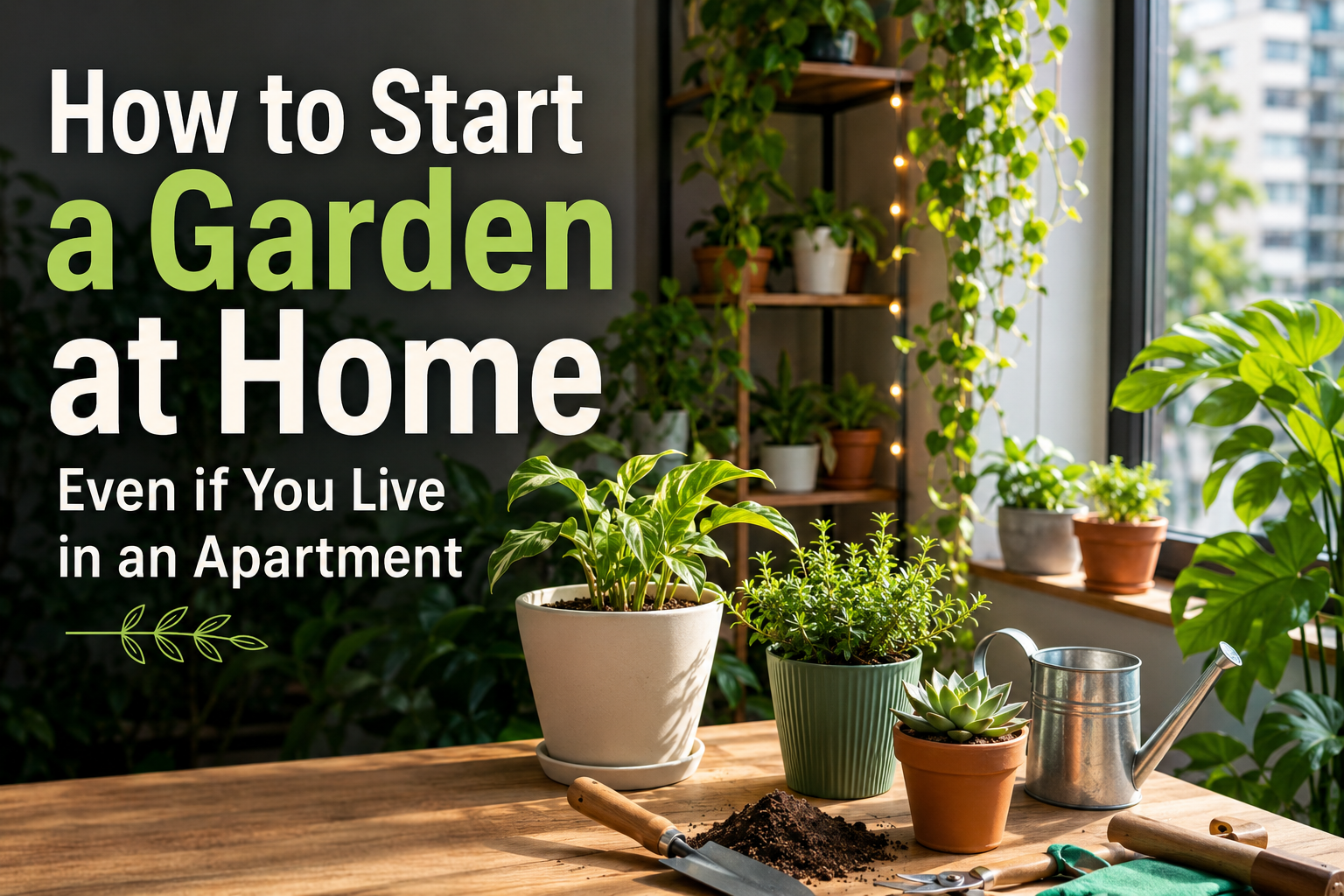
Many people dream about having a beautiful garden but believe it is only possible with a large backyard and years of experience. The truth is that anyone can start gardening at home, even in a small apartment with nothing more than a windowsill and a handful of pots. With the right planning, a few basic tools, and a genuine willingness to observe and learn, you can create a living green space that improves your home, your daily routine, and your sense of wellbeing in ways that go far beyond decoration.
Understand Your Space Before Buying a Single Plant
The most important step in starting a home garden is one that happens before you buy anything: observing your available space carefully and honestly. Every plant has different requirements, and the most reliable way to set yourself up for success is to understand what your specific environment actually offers before choosing what to grow in it.
Walk through your apartment or house at different times of day and notice where sunlight enters, how long it stays, and how intense it is. Some areas may receive direct sunlight for six or more hours — a genuinely bright position that suits sun-loving plants. Other areas may receive soft, indirect light for part of the day, and some may remain shaded for most of it. Note which windows face south or west, where the brightest counters and shelves are, and whether any outdoor spaces like balconies or terraces are available. This light mapping exercise takes no more than a day and provides the foundation for every planting decision that follows.
Making the most of a small or limited space
Small spaces are not a barrier to gardening — they simply require more deliberate thinking about how space is used. Balconies, windowsills, kitchen corners, and shelves positioned near windows can all support healthy, thriving plants when matched with varieties suited to those specific conditions. Vertical growing — using wall-mounted shelves, hanging planters, and stacked pot stands — multiplies the available growing area dramatically without consuming any additional floor space. Some of the most beautiful and productive home gardens in existence occupy fewer than two square meters of actual floor area.
Choose the Right Plants for Your Level and Environment
One of the most common and discouraging mistakes beginners make is choosing plants that require advanced knowledge or very specific conditions to thrive. Starting with forgiving, adaptable plants that tolerate the small care inconsistencies every beginner inevitably makes builds confidence, develops observational skills, and creates the foundation from which a more ambitious collection naturally grows.
Low-maintenance plants that adapt well to indoor environments and tolerate imperfect conditions include snake plants, pothos, peace lilies, succulents, spider plants, aloe vera, and culinary herbs like basil and mint. Each of these varieties rewards basic attentive care with steady growth and attractive appearance, and most will communicate their needs clearly enough — through drooping, color change, or visible soil conditions — that beginners can learn to read and respond to them before serious problems develop. If you want to combine practicality with beauty, herbs are a particularly satisfying starting point: they grow quickly, produce tangible harvests for the kitchen, and are widely available as young plants at minimal cost.
Understanding Light: The Most Important Variable in Plant Care
Light is the primary driver of plant health, and understanding what different light levels mean in practical terms is one of the most valuable things a beginning gardener can learn. Without appropriate light, even a well-watered, well-fed plant in excellent soil will struggle — because light is the energy source that powers every biological process from photosynthesis to root development.
Plants fall broadly into three light categories, and matching your plant choices to the light your home genuinely offers dramatically increases your rate of success. Full sun plants — rosemary, lavender, most succulents, and many culinary herbs — need at least six hours of direct sunlight daily and belong on your brightest south or west-facing windowsills. Partial shade plants like peace lilies, pothos, and Chinese evergreens prefer indirect light or a mix of sun and shade and perform well a meter or two from a bright window. Low-light plants — snake plants, ZZ plants, and cast iron plants — are the right choice for rooms with limited natural light and the most forgiving options for beginners whose spaces are less than ideally bright.
What to do when natural light is insufficient
If your home genuinely lacks the natural light that your chosen plants need, a grow light is a practical and affordable solution that expands your growing possibilities significantly. Modern LED grow lights are energy-efficient, increasingly affordable, and designed to blend discreetly with home interiors. Position a grow light thirty to sixty centimeters above your plants and run it for twelve to fourteen hours per day to compensate for limited natural light — a straightforward setup that makes it possible to grow a healthy, diverse plant collection in almost any indoor environment.
Choosing the Right Pots and Containers
The container a plant lives in affects its health far more than most beginners realize. A beautiful decorative pot means nothing if it traps water at the root level and creates the conditions for root rot — which is precisely what happens when a pot has no drainage holes. Every pot that will serve as a permanent home for a living plant must have drainage holes at its base, without exception. Excess water must be able to escape freely after watering, or the roots will eventually suffocate in saturated soil regardless of how carefully you water.
Beyond drainage, the material and size of a pot both influence how quickly soil dries between waterings — a variable that directly affects how frequently you need to water and how much margin for error your watering routine has. Terracotta pots are porous and allow moisture to evaporate through their walls, making them ideal for drought-tolerant plants like succulents and Mediterranean herbs. Plastic and glazed ceramic pots retain moisture longer, suiting moisture-loving plants that dry out too quickly in terracotta. Choose a pot size that allows two to five centimeters of space between the root ball and the pot wall — enough room for root expansion without the excess soil volume that retains more moisture than small roots can draw from.
- Always use pots with drainage holes — this is non-negotiable for long-term plant health
- Choose terracotta for drought-tolerant plants and plastic or ceramic for moisture-loving varieties
- Match pot size to root ball size — avoid oversized pots that hold more moisture than roots can use
- Use hanging pots, wall shelves, and vertical stands to multiply your growing space in small apartments
- Place a saucer under every pot and empty it after watering to prevent standing water damage
Mastering the Art of Watering
Overwatering is the single most common cause of plant death in home gardens, and it is almost always the result of too much care rather than too little. The instinct to water frequently — to check in on your plants daily and add water whenever the soil surface looks dry — produces chronically saturated root zones that deprive roots of oxygen and create the conditions for the root rot that silently kills plants before any visible above-ground symptoms appear. Understanding how to water correctly, rather than how often, is the most transformative early skill a beginning gardener can develop.
The most reliable watering method is simple and requires no tools: press a finger one to two inches into the soil before every watering session. If the soil feels moist at that depth, the plant does not need water — wait another day or two and check again. If it feels dry, water thoroughly and deeply, soaking the entire root ball until water flows freely from the drainage holes at the base of the pot. This single habit — checking before watering rather than watering on a schedule — prevents the vast majority of overwatering incidents and teaches you, over the course of a few weeks, exactly how quickly each plant in your collection consumes its available moisture.
Reading the warning signs your plant gives you
Plants communicate their watering status clearly once you know what to look for. Overwatered plants typically show yellowing leaves that feel soft and waterlogged, a sour or musty smell from the soil, soil that remains dark and cold long after watering, and wilting that does not improve after additional water is given — because the roots are too damaged to function. Underwatered plants show dry, cracked soil pulling away from the pot edges, brown crispy leaf tips and edges, and a wilting or drooping posture that recovers quickly after thorough watering. The critical distinction between the two conditions is always in the soil — check it first before responding to any wilting symptom.
Choosing the Right Soil for Your Plants
Soil does far more than simply anchor a plant in its pot. It is the medium through which roots access water, oxygen, and nutrients — and its structure, drainage capacity, and nutritional content directly determine how well a plant grows in the medium and long term. Never use outdoor garden soil in indoor pots: it compacts severely in containers, drains poorly, and often introduces pests, weed seeds, and pathogens that create ongoing problems in an enclosed growing environment.
Use potting mixes specifically formulated for container growing, and where possible choose a mix suited to your specific plant type. A standard all-purpose potting mix works well for most tropical foliage plants and herbs. A cactus and succulent mix provides the fast-draining, gritty medium that drought-tolerant plants need. Adding a proportion of perlite — roughly twenty to thirty percent by volume — to any potting mix improves its drainage and aeration and dramatically reduces the risk of overwatering for most plant types. You can also enrich your potting mix with organic additions like worm castings, which improve both nutrition and soil biology at minimal cost.
Starting Small and Building Gradually
The temptation to buy many plants at once — especially when surrounded by beautiful options at a garden center — is one of the most reliable paths to early discouragement in home gardening. A large collection of plants acquired simultaneously gives you no time to understand the specific needs and behaviors of each one, makes identifying the causes of problems significantly harder, and creates a maintenance burden that quickly becomes overwhelming for someone still developing the fundamental skills of plant observation and care.
Start with two or three plants and give each one your full attention. Learn how quickly each one dries out between waterings. Notice how it responds to the light in its chosen position. Observe what new growth looks like and how often it appears. This focused attention with a small number of plants builds the observational fluency that makes caring for a larger collection straightforward rather than stressful. Once you feel genuinely comfortable with your initial plants — watering correctly, reading their signals accurately, maintaining their health consistently — add one or two more and repeat the process. Gradual expansion produces collections that are consistently well-maintained rather than collections that are constantly recovering from a care deficit.
Basic Maintenance That Keeps Plants Thriving
Beyond watering and light management, a few simple maintenance habits performed consistently keep home garden plants looking their best and catch problems early enough to address them before they become serious. Pruning — removing dead leaves, spent flowers, and damaged stems — redirects the plant’s energy toward healthy new growth and keeps the overall appearance tidy and intentional. Regular rotation — turning pots a quarter turn every week or two — ensures all sides of the plant receive equal light exposure and encourages the even, symmetrical growth that makes plants look genuinely beautiful from every angle.
Pest inspection is perhaps the most important maintenance habit for any indoor plant collection. Check the undersides of leaves — where most pest species feed and shelter — as well as stem joints and the soil surface during every weekly care session. Catching a pest infestation in its earliest stages, when populations are small and plants are not yet significantly damaged, makes treatment straightforward and highly effective. A fully established infestation discovered weeks later is a significantly more serious and time-consuming problem. Early detection through consistent inspection is by far the most efficient pest management strategy available to any home gardener.
Cleaning leaves for better health and appearance
Indoor plants accumulate household dust on their leaf surfaces over time, and this dust acts as a physical barrier that reduces the amount of light reaching the chlorophyll-containing cells inside the leaf. In an already low-light indoor environment, this reduction matters — a dusty leaf absorbs meaningfully less light than a clean one. Wipe the leaves of your plants gently with a soft, damp cloth every two to three weeks, using lukewarm water and supporting the underside of each leaf as you wipe. This simple task keeps foliage photosynthesizing at full capacity, improves the plant’s overall appearance, and provides an opportunity to check the leaf surfaces closely for any early signs of pest activity.
Turning Plant Care Into a Daily Ritual
The most successful home gardeners share one characteristic above all others: they have made plant care a consistent, intentional part of their daily or weekly routine rather than a reactive response to visible problems. A brief daily check — walking past your plants in the morning, glancing at the soil surface, noticing the posture of the leaves, picking off any dead growth — takes no more than a few minutes and builds the observational familiarity with each plant that makes problems visible at their earliest and most manageable stage.
Many people find this daily plant interaction genuinely calming — a small pocket of attentive, sensory-present activity in a day that is otherwise dominated by screens, schedules, and abstract demands. The repetitive, outcome-oriented nature of plant care — the satisfaction of a plant that was drooping yesterday standing upright today because of something you did — provides a concrete sense of competence and nurturing that contributes meaningfully to daily wellbeing. Gardening at home is ultimately less a task to be completed and more a practice to be cultivated, and the rewards it produces grow steadily alongside the plants it involves.
Common Mistakes to Avoid
- Buying plants before assessing your light conditions — Light is the most important variable in plant care and the hardest to modify. Always assess your available light first and choose plants that genuinely suit it rather than the most beautiful options available.
- Watering on a fixed schedule without checking the soil — Water consumption varies by season, temperature, pot size, and plant type. Always check the soil before watering rather than following a rigid timetable that ignores what your plants are actually communicating.
- Using pots without drainage holes — No matter how carefully you water, a pot without drainage will eventually trap enough moisture at the root level to cause rot. Every pot needs drainage holes without exception.
- Starting with too many plants simultaneously — A small, well-maintained collection teaches more and produces more satisfaction than a large collection under constant stress from a care deficit. Start with two or three plants and expand only when you feel genuinely comfortable with those first choices.
- Giving up after the first plant failure — Every gardener loses plants, and plant failure is information rather than defeat. Investigate what went wrong, adjust your approach, and try again with the knowledge that every setback has taught you something a success could not.
Frequently Asked Questions
Q: How much does it cost to start a home garden from scratch?
A: Starting a small home garden can be done for very little initial investment. Two or three plants from a garden center or supermarket, a small bag of potting mix, and a few basic pots represent the core outlay, which can be kept to a modest budget. The most economical approach is to begin with cuttings or divisions from friends and family — most plant owners are happy to share propagation material — or to grow from seed, which reduces plant acquisition costs to almost nothing. Expand slowly and invest more as your interest and confidence grow.
Q: What are the absolute best plants for a first-time home gardener?
A: The pothos and the snake plant are the two most universally recommended first plants for beginners. Both tolerate low light, irregular watering, and dry indoor air with composure, grow steadily enough to provide visible feedback on your care, and are widely available at low cost. For beginners who want an edible component, adding a pot of mint or chives provides the additional reward of harvesting something from your garden — a motivational factor that many new gardeners find keeps them engaged through the early learning curve.
Q: How do I know if my plant is healthy or struggling?
A: A healthy plant has firm, richly colored leaves that hold their shape without drooping, produces regular new growth at its growing tips, and has soil that transitions predictably from moist after watering to dry after the appropriate interval for that plant type. A struggling plant shows its distress through pale or yellowing leaves, a limp or drooping posture, stopped or distorted new growth, unusual smells from the soil, or visible pest activity on the leaf surfaces. Any change from the plant’s established normal appearance is worth investigating — catching problems early is always easier and more successful than addressing them once they have become severe.