
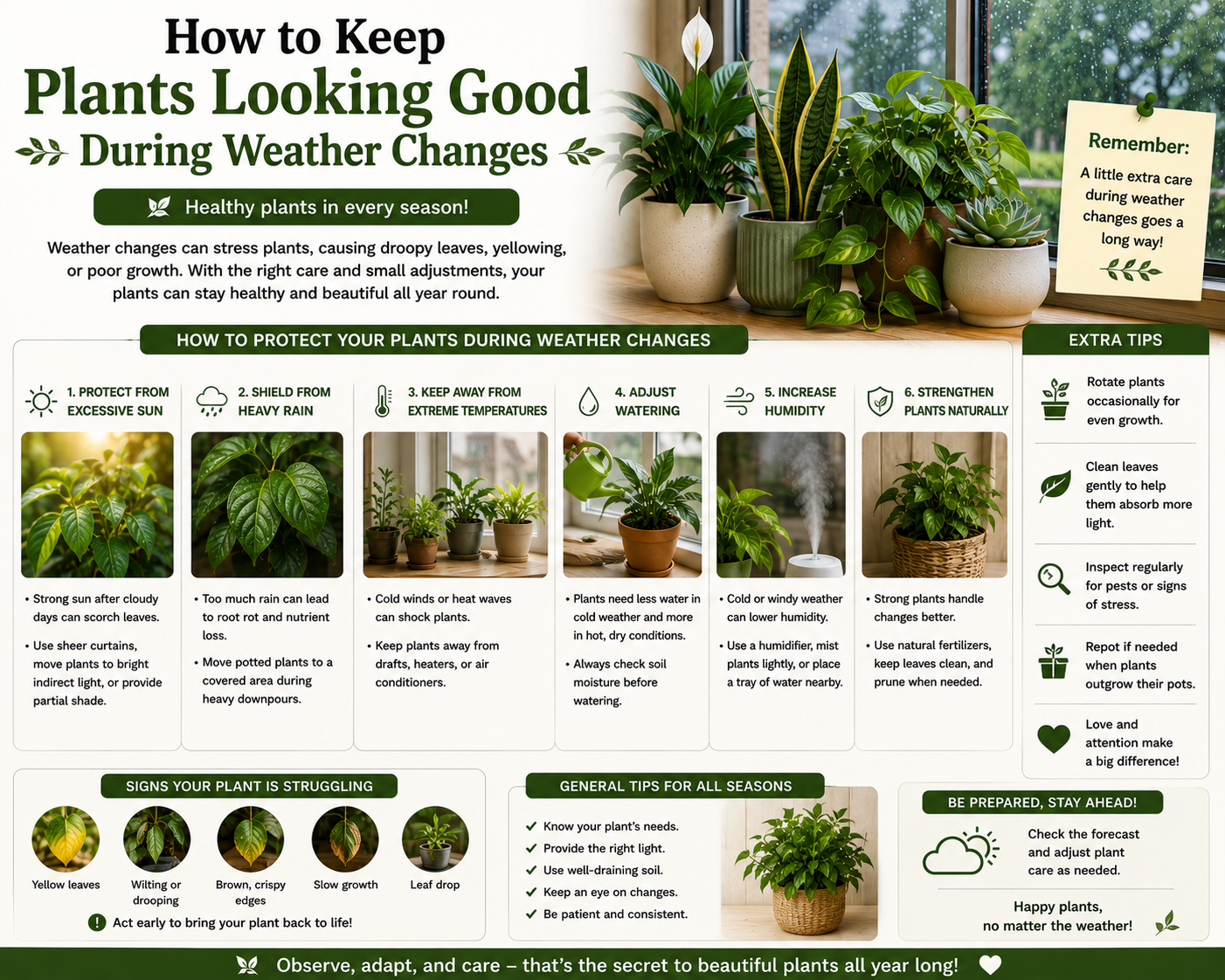
Plants are fundamentally creatures of their environment, and weather changes — whether the gradual seasonal shifts of spring into summer or the abrupt temperature drops of an early autumn frost — affect them profoundly. Indoor plants are not immune to these effects despite being sheltered from the elements: changing day length, fluctuating indoor temperatures, shifting humidity levels, and altered light quality all register in the biology of houseplants and require adjustments to how you care for them. Learning to anticipate these changes and respond to them proactively is what separates plant collections that look consistently beautiful throughout the year from those that struggle through the seasonal transitions.
How Seasonal Changes Affect Your Plants
The most significant environmental change that affects both indoor and outdoor plants across the seasons is light. In summer, days are long, sunlight is intense, and plants photosynthesize at their maximum rate, driving vigorous growth, flowering, and fruiting. As autumn approaches, day length shortens progressively and the angle of the sun drops, delivering softer, less intense light for fewer hours each day. By midwinter, many indoor plants are receiving a fraction of the light they enjoyed in midsummer — a change that affects their water consumption, growth rate, and nutrient needs in ways that demand corresponding adjustments to your care routine.
Temperature fluctuations between seasons affect plants at the root level as much as at the foliage level. Outdoor plants experience this directly through changing soil temperatures. Indoor plants face it more subtly through drafts from windows and doors, the activation of central heating in autumn, and the operation of air conditioning in summer — all of which create localized temperature changes that can stress plants positioned too close to these sources of fluctuating warm or cold air.
Understanding plant dormancy and semi-dormancy
Many houseplants enter a period of reduced growth or semi-dormancy in winter, even when grown indoors at relatively stable temperatures. This is an internal biological response to reduced light levels rather than to cold temperatures alone — the plant’s growth hormones respond to the decreasing day length by slowing metabolic activity, reducing water consumption, and pausing or stopping new leaf production. Recognizing this dormancy period as natural and healthy rather than a sign of problems prevents one of the most common winter care mistakes: responding to slow growth with increased watering and feeding that the plant has no capacity to use.
Transitioning Plants From Summer to Autumn
The period from late summer to early autumn is when the most important seasonal care adjustments need to be made. As temperatures begin to drop and day length shortens, most houseplants’ growth naturally slows. Begin reducing watering frequency gradually during this period, checking soil moisture more carefully before each watering session and allowing the soil to dry more thoroughly between sessions than you would have during the summer growing season. Stop fertilizing entirely by early to mid-autumn — feeding a plant that is slowing toward dormancy pushes it to produce soft, weak growth at exactly the wrong time of year.
If you have moved houseplants outdoors for the summer, bring them back inside well before the first autumn frost is forecast. Do not wait for the temperature to drop — the shock of a sudden cold night can cause significant leaf drop and stress that takes weeks to recover from. Inspect every plant carefully for pests before bringing it indoors, as outdoor plants are significantly more likely to be hosting insects that will then spread to your indoor collection. A brief treatment with insecticidal soap or neem oil before the move indoors provides effective preventive protection.
Keeping Plants Healthy Through Winter
Winter presents the greatest challenges for plant health indoors. The combination of reduced light, dry air from central heating, cold drafts from windows, and reduced plant metabolism creates conditions where errors in care are particularly costly and slow to recover from. The overarching principle for winter plant care is restraint: water less, feed not at all, prune minimally, and disturb your plants as little as possible while the season passes.
Position plants to take maximum advantage of the reduced winter light. Move light-hungry plants as close to south or west-facing windows as possible, clean their leaves thoroughly with a damp cloth to remove any dust that would further reduce light absorption, and consider supplementing with a grow light for plants that show signs of struggling — pale, yellowing new growth and cessation of growth entirely are the clearest indicators that a plant is not receiving enough light to sustain itself through the winter months.
- Reduce watering frequency as growth slows in autumn and winter
- Stop fertilizing from early autumn until new growth resumes in spring
- Move plants closer to windows to maximize access to reduced winter light
- Clean leaves regularly to maximize light absorption through dusty winter air
- Keep plants away from cold drafts near single-pane windows and exterior doors
- Avoid placing pots directly on cold stone or tile floors — use cork mats or wooden boards underneath
Spring Transition: Waking Plants Up Gradually
As days lengthen and temperatures rise in spring, plants respond with a surge of new growth that is exciting to watch but requires a thoughtful reintroduction of care rather than an immediate return to full summer watering and feeding. Begin increasing watering frequency gradually as you observe the plant producing new growth — the emergence of fresh leaves is the most reliable signal that the root system has become active again and is capable of processing increased water and nutrient supply effectively.
Resume fertilizing in early spring once you see the first clear signs of new growth, beginning with a half-strength dose of balanced liquid fertilizer and building to full strength over two to three feeding sessions. This gradual reintroduction prevents overwhelming a root system that has been largely inactive for several months. Spring is also the ideal time to repot plants that have become root-bound, refresh potting mix that has become compacted, and prune back any dead or damaged growth that accumulated over winter — the plant’s natural growth surge gives it the energy to recover from these interventions quickly and effectively.
Common Mistakes to Avoid
- Continuing summer-level watering into autumn and winter — As growth slows seasonally, water consumption drops significantly. Maintaining summer watering frequencies into winter is one of the most reliable ways to cause root rot in otherwise healthy plants.
- Placing plants near radiators for warmth in winter — The warm, intensely dry air immediately around a radiator is deeply harmful to most plants. The warmth does not compensate for the desiccating effect on foliage.
- Bringing outdoor plants inside too late in autumn — A single cold night below the minimum tolerance temperature of a tender plant can cause damage that takes months to recover from. Bring plants in early rather than waiting for the first frost warning.
- Repotting plants in autumn or winter — Repotting is best done in spring when plants have the energy and growth momentum to recover quickly. Repotting in dormant seasons subjects roots to stress and cold at the time when they are least equipped to respond.
- Overreacting to leaf drop in autumn — Some leaf drop as conditions change is entirely normal, particularly for plants that naturally respond to seasonal day length changes. Assess whether the remaining growth looks healthy before concluding that something is seriously wrong.
Frequently Asked Questions
Q: Why do my indoor plants look worse in winter even when I maintain the same care routine?
A: Indoor plants receive significantly less light in winter even without any change in their position, because shorter days and a lower sun angle deliver less total light energy through windows. The dry air produced by central heating further stresses moisture-loving plants. Reduce watering frequency to match the plant’s reduced consumption, clean leaves to maximize light absorption, and consider supplementing with a grow light for light-hungry varieties.
Q: Is it normal for plants to drop leaves when I bring them indoors in autumn?
A: Yes, some leaf drop when transitioning from outdoors to indoors is normal and temporary. The change in light levels, humidity, and temperature triggers the plant to shed leaves it can no longer efficiently support in the new, lower-light conditions. This adjustment period typically lasts two to four weeks, after which the plant stabilizes. Minimize the shock by bringing plants indoors gradually — a few days in a sheltered outdoor spot, then a shaded indoor spot, then their final position — rather than moving them directly from full outdoor sun to an indoor position.
Q: How do I protect outdoor plants from an unexpected late frost in spring?
A: For established plants in the ground, covering them overnight with horticultural fleece, old bedsheets, or newspaper before a forecast frost provides meaningful protection by trapping ground heat around the plant. For potted plants, moving them to a sheltered spot — against a south-facing wall, under a porch roof, or inside an unheated greenhouse — provides the most reliable protection. Never use plastic sheeting directly on plant foliage, as condensation on the inside of plastic in contact with leaves can cause frost damage even when the air temperature barely drops below freezing.