
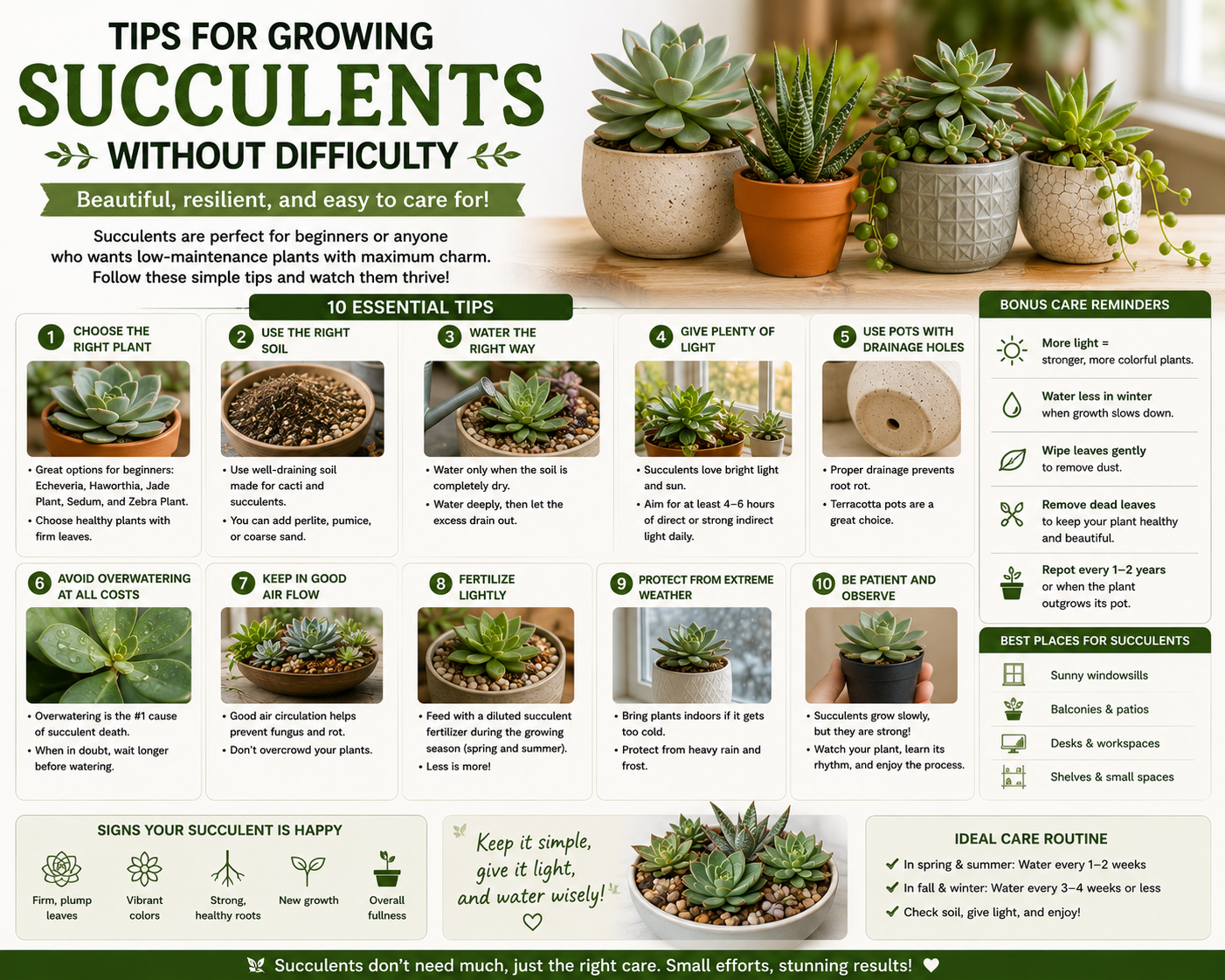
Succulents have a well-deserved reputation as the perfect plants for beginners, busy people, and anyone who has ever felt they do not have a natural gift for keeping plants alive. Their remarkable ability to store water in their thick, fleshy leaves and stems makes them extraordinarily tolerant of the irregular watering and occasional neglect that defeat less resilient plants. They come in an astonishing diversity of shapes, sizes, colors, and textures, from the rosette-forming elegance of Echeveria to the geometric perfection of Haworthia and the sculptural drama of Aloe. And with a clear understanding of their few genuine requirements, they are genuinely among the easiest plants to grow and maintain successfully over the long term.
Understanding What Succulents Actually Need
The key to growing succulents successfully is understanding that their care requirements are almost the opposite of what most houseplants need. Where many common houseplants want consistent moisture, frequent watering, and rich, moisture-retentive soil, succulents want infrequent, thorough watering followed by complete drying periods, fast-draining sandy or gritty soil, and as much bright light as you can provide. Getting these fundamentals right from the beginning makes everything else about succulent care straightforward and largely self-managing.
Succulents evolved in environments characterized by intense sunlight, mineral-poor soils with excellent drainage, and rainfall patterns of feast and famine — periods of drought punctuated by heavy rain that drains away quickly before it can saturate the root zone for extended periods. Mimicking these conditions in your home or garden is the central goal of succulent care, and once you achieve it, the plants essentially take care of themselves between your occasional interventions.
The biggest misconception about succulents
The most damaging misconception about succulents is that they need almost no water at all. While they are extraordinarily drought tolerant, succulents do need regular watering during their active growing season to thrive rather than merely survive. A completely waterless succulent will not die immediately, but it will gradually deplete its water reserves, shrink, wrinkle, and lose its plump, vibrant appearance. The correct approach is not to water rarely but to water thoroughly and then wait until the soil and the plant itself have dried completely before watering again — a cycle that typically takes one to three weeks depending on conditions.
Getting the Soil Right
Soil choice is the single most important factor in successful succulent growing. Standard all-purpose potting mix retains far too much moisture for succulents — its moisture-retentive properties are specifically designed for plants that want consistently moist soil, which is the exact opposite of what succulents need. Using standard potting mix for succulents almost always leads to root rot within one to two seasons, particularly in the lower-light, less-evaporative conditions of most indoor environments.
The ideal succulent growing medium drains immediately and completely when watered, leaving no moisture pooling around the roots after the initial watering has passed through. You can achieve this with a purpose-made cactus and succulent potting mix, which is widely available and formulated with a high proportion of grit and sand. Alternatively, mix standard potting soil with forty to fifty percent coarse perlite or horticultural grit to create a fast-draining blend. The resulting mix should feel loose, gritty, and light rather than dense and earthy — if a handful clumps together when squeezed, it retains too much moisture and needs more grit amendment.
Light Requirements for Healthy Succulents
Most succulents need significantly more light than the average indoor environment provides, and insufficient light is the second most common cause of succulent problems after overwatering. A succulent in too little light does not simply slow its growth — it etiolates, producing long, stretched stems with widely spaced leaves as it reaches desperately toward whatever light source it can find. Etiolated succulents lose their compact, rosette form and the rich coloring that makes them so visually striking, becoming pale, leggy, and structurally fragile.
The ideal position for most succulents indoors is a south or west-facing windowsill that receives several hours of direct sunlight each day. If your home cannot provide this, a grow light positioned close above the plants and running for twelve to fourteen hours per day is an excellent and increasingly affordable solution. Outdoors, most succulents thrive in full sun once gradually acclimatized — move them from indoor conditions to outdoor shade for a week before exposing them to full sun, as the dramatic increase in light intensity can bleach or scorch leaves that have been growing in indoor conditions.
- Place succulents in the brightest spot available — a south or west-facing windowsill is ideal
- Supplement with a grow light if natural light is insufficient to maintain compact, colorful growth
- Rotate pots a quarter turn every week or two for even, symmetrical growth
- Acclimatize gradually when moving from indoors to full outdoor sun
- Watch for etiolation — stretched, pale growth reaching toward the light — as the key sign of insufficient light
Mastering the Watering Cycle
The correct watering approach for succulents follows a simple principle: water thoroughly, then wait completely. When you water, pour slowly and steadily until water runs freely from the drainage holes at the base of the pot, ensuring the entire root ball receives moisture. Then do not water again until the soil is completely dry throughout — not just the surface, but all the way down to the bottom of the pot. In the active growing season of spring and summer, this typically means watering every one to two weeks. In autumn and winter, many succulents enter a semi-dormant period and can go three to four weeks or longer between waterings with no ill effects.
The best tool for assessing succulent soil moisture is a simple wooden chopstick or skewer inserted to the bottom of the pot. Leave it there for thirty seconds, then withdraw it — if it comes out with any moist soil clinging to it, the plant does not need water. If it comes out clean and dry, it is time to water. This simple test removes all guesswork and is far more reliable than trying to judge moisture from the appearance of the soil surface, which can look dry while the deeper soil remains significantly moist.
Common Mistakes to Avoid
- Using standard potting mix without adding drainage amendment — Standard potting mix retains too much moisture for succulents. Always use cactus mix or add significant quantities of perlite or grit before planting.
- Misting succulents instead of properly watering them — Misting wets the surface without reaching the root zone and keeps the aerial parts of the plant perpetually damp, encouraging rot at leaf bases and potential fungal disease. Always water at the soil level.
- Growing succulents in containers without drainage holes — Without drainage, water inevitably accumulates at the bottom of the container where roots reach and begin to rot. Drainage holes are non-negotiable for succulents.
- Placing succulents in low-light positions because they look decorative there — Succulents placed away from windows quickly etiolate and lose their attractive compact form. Always prioritize appropriate light over decorative positioning.
- Fertilizing succulents too heavily or too frequently — Succulents evolved in nutrient-poor soils. Heavy fertilizing produces rapid, soft, weak growth that is susceptible to rot and pests. Feed once in spring with a balanced fertilizer diluted to half strength, and once more in early summer at most.
Frequently Asked Questions
Q: Why are my succulents turning mushy at the base?
A: Mushiness at the base of a succulent almost always indicates root rot caused by overwatering or poor drainage. Remove the plant from its pot immediately and inspect the roots — trim away all mushy, discolored tissue back to firm, healthy material, allow the plant to air dry for a day or two, then repot in completely dry, gritty succulent mix. Water very sparingly for the first three to four weeks to allow the root system to heal.
Q: Can succulents survive outdoors in winter?
A: This depends entirely on the species and your climate. Some succulents, particularly Sempervivum species, are remarkably frost-hardy and can survive outdoor winters in temperate climates. Most popular succulent genera — Echeveria, Kalanchoe, Aloe, and Crassula — are frost-tender and must be brought indoors or given frost protection when temperatures drop below freezing. Always check the specific cold hardiness of your succulent variety before leaving it outdoors through winter.
Q: How do I propagate succulents at home?
A: Most succulents propagate readily from leaf cuttings or offsets. For leaf propagation, gently twist a healthy, plump leaf from the stem with a clean, twisting motion that removes the entire leaf base. Place it on dry succulent mix in indirect light and mist very lightly every few days. Within two to four weeks, tiny rosettes will emerge from the leaf base. For species that produce offsets — small plants growing at the base of the mother plant — simply separate them with a clean knife once they have developed their own root system and pot them individually.