
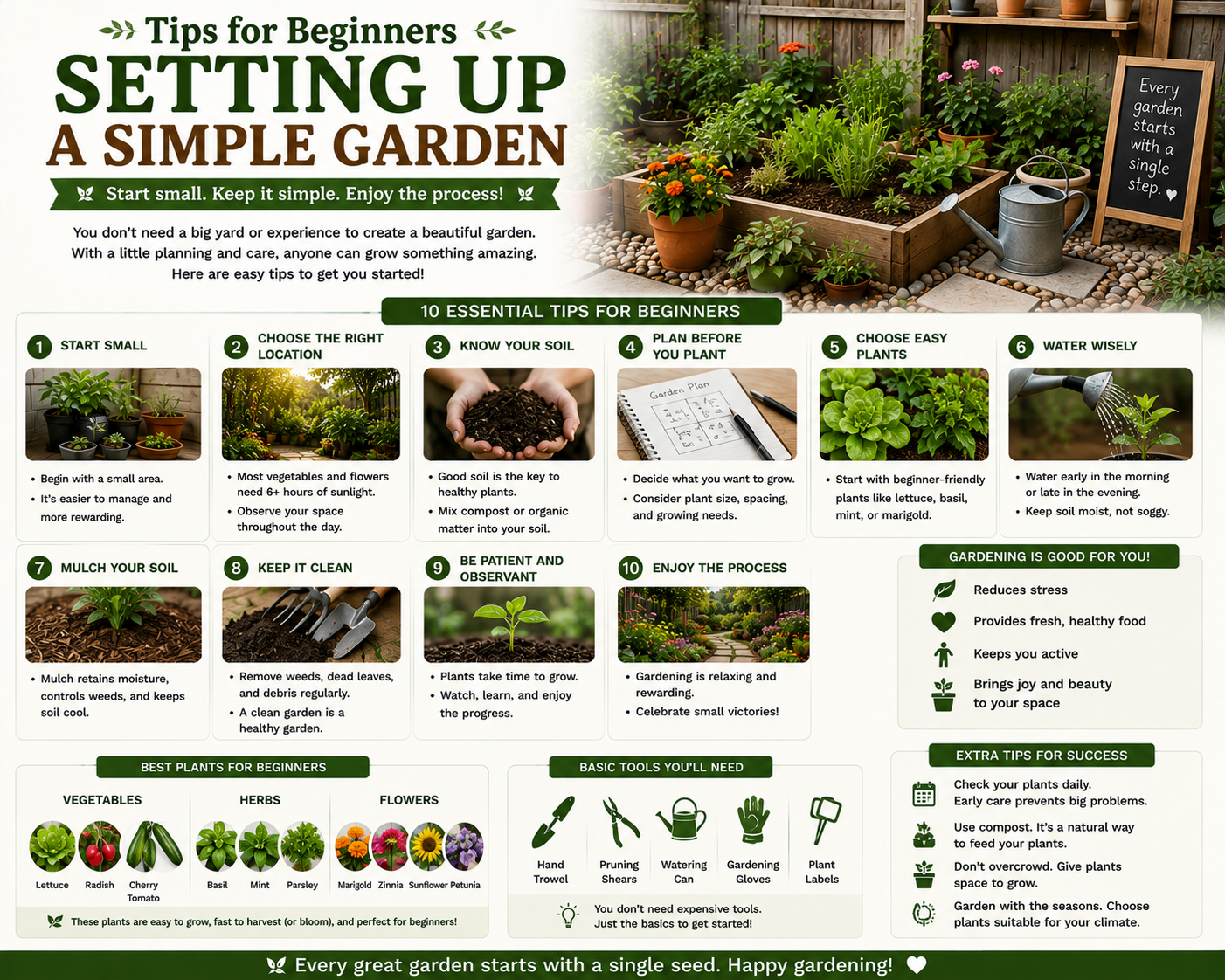
Setting up your first garden is one of the most exciting and occasionally overwhelming undertakings in home improvement. The possibilities seem limitless, the information available is sometimes contradictory, and the gap between a beautiful garden and where you are starting from can feel enormous. But the reality of gardening is kinder than it first appears: the fundamental skills are learnable, the most basic tools and techniques are effective, and even modest, unpretentious first gardens teach you more in a single season than years of reading about plants ever could. This guide cuts through the complexity and gives you a clear, practical framework for setting up your first simple garden with confidence.
Defining What You Actually Want From Your Garden
The most important question to answer before you do anything practical is: what do you want your garden to give you? A garden that produces fresh vegetables and herbs for the kitchen requires a completely different design and plant selection than one that creates a beautiful outdoor room for relaxing and entertaining. A low-maintenance garden that largely takes care of itself is designed very differently from one that you want to spend time actively tending and developing every weekend. A garden for children needs different planting and structures than one designed as a private adult retreat.
There is no wrong answer to this question, but without a clear answer, you risk creating a garden that does none of these things well. Take a piece of paper and write down, honestly, the three most important things you want from your garden — fresh food, beautiful flowers, a private outdoor space, a play area for children, a wildlife habitat, or simply somewhere green and calming to look at from the window. These priorities shape every decision that follows and keep you on track when the temptation to add one more exciting plant or one more elaborate feature threatens to make your first garden more ambitious than your time, budget, and experience can realistically support.
The value of starting with a simple design
The most successful first gardens are invariably the simplest ones. A single raised bed filled with vegetables, a border of easy-care perennials running along a fence, or a small patio area with a thoughtful arrangement of pots — any one of these is a completely achievable, genuinely satisfying first garden project that builds the skills and confidence needed for more ambitious future developments. Complexity, in a first garden, is the enemy of success. Start with one clear, achievable project rather than attempting to transform an entire space at once, and let the garden grow in scope and ambition as your experience grows alongside it.
Preparing the Soil: The Most Important First Step
Whatever style of garden you are creating, soil preparation is the single most impactful investment of time and effort you can make at the beginning. Plants grown in well-prepared, fertile, well-draining soil consistently outperform identical plants grown in poor, compacted, or nutrient-depleted soil regardless of how well cared for in all other respects. Spending time and money on soil improvement before planting transforms the performance of everything that follows and is the single highest-return activity in any new garden project.
For a new garden bed, begin by removing all existing weeds, including their roots — pulling up the visible portion without removing the root system simply delays the problem for a week or two. Once cleared, dig the soil to at least thirty centimeters depth to break up any compaction and improve aeration. Incorporate a generous layer of garden compost or well-rotted manure — a five to ten centimeter layer worked into the top thirty centimeters of soil dramatically improves structure, drainage, and fertility simultaneously. For raised beds, fill with a mixture of quality topsoil and compost in a roughly sixty-forty ratio for an immediately productive growing medium.
Choosing Your First Plants
For a first garden, the overarching principle in plant selection is proven performance over novelty. Choose plants with established reputations for ease, productivity, and visual impact rather than unusual varieties that may be more demanding or unpredictable. For vegetable gardens, courgettes, salad leaves, climbing beans, cherry tomatoes, and radishes are among the most reliable and rewarding first crops. For a flower border, classic hardy perennials like lavender, echinacea, rudbeckia, hardy geranium, and salvia provide season-long color with minimal care and come back year after year without replanting.
Buying young plants from a nursery rather than growing from seed gives you a faster start and reduces the skill demands of your first season. Seeing results quickly — harvesting your first radish six weeks after planting, watching your first courgette swell from a tiny fruit to harvestable size in just days — provides the motivational momentum that keeps beginners engaged and enthusiastic through the inevitable setbacks and learning-curve moments every first garden involves.
- Choose proven, easy-care varieties rather than novelty or challenging plants
- Start with a small number of plant types and grow them well rather than attempting great variety
- Buy young plants from a nursery for a faster start in your first season
- Read every plant label before buying and only select plants that suit your actual conditions
- Include at least some fast-growing varieties that produce visible results quickly
Essential Tools for a First Garden
A beginning gardener does not need a shed full of specialized tools to establish a productive, beautiful garden. In reality, three to four well-chosen, quality tools are sufficient for the vast majority of tasks involved in setting up and maintaining a simple garden. A sturdy hand trowel is the most universally useful gardening tool — used for planting, transplanting, weeding, and soil cultivation in confined spaces. A garden fork or spade is needed for larger soil preparation and digging tasks. A watering can or garden hose is essential for establishing new plants. A pair of quality pruning shears handles harvesting, deadheading, and light pruning across the entire garden.
Buy the best quality tools you can afford rather than the cheapest available. A well-made stainless steel hand trowel with a comfortable handle will last for decades and make every task easier and more enjoyable than a cheap tool that bends, rusts, or breaks within a season. The difference in cost between the cheapest and the best basic garden tools is modest, and the difference in experience and longevity is significant. Clean and dry your tools after each use to maintain their condition and prevent rust from shortening their working life.
Common Mistakes to Avoid
- Attempting to create too large or too complex a garden in the first season — A small, well-executed first garden teaches more and delivers more satisfaction than an ambitious, partially finished one. Start with a single, achievable project and expand deliberately in subsequent seasons.
- Skipping soil preparation to get to the exciting planting stage faster — Soil preparation is the most important work in any new garden. Plants in well-prepared soil consistently outperform those in unprepared soil regardless of all other care.
- Buying plants before assessing the garden’s growing conditions — Light, drainage, and exposure determine what will and will not thrive in your specific garden. Assess these conditions first and let them guide your plant selection rather than falling in love with plants that are unsuited to what your garden actually offers.
- Underestimating the time demands of watering in the first season — Newly planted gardens need consistent watering until plants establish their root systems, which typically takes four to eight weeks. Drought stress in newly planted specimens causes long-term performance reduction even after normal watering resumes.
- Not labeling plants after planting — The variety name that you are certain you will remember is always the one you forget within six weeks. Label every plant at planting time with its common and botanical name. This simple habit becomes invaluable when plants perform unexpectedly well or poorly and you want to know exactly what to seek out or avoid in the future.
Frequently Asked Questions
Q: How much should I expect to spend setting up a first garden?
A: A simple but well-executed first garden — a single raised bed with vegetables and herbs, or a small border of perennials — can be established for relatively modest outlay if you prioritize soil improvement and a small number of well-chosen plants over elaborate structures and large quantities of plants. The most significant costs in most first gardens are quality soil and compost, a small number of key tools, and the initial plant purchase. Growing some plants from seed rather than buying established specimens reduces the plant cost dramatically.
Q: When is the best time of year to start a garden?
A: Spring is the ideal time to start most gardens — the combination of warming temperatures, increasing day length, and the natural growth momentum of the season means plants establish quickly and the results of your work become visible within weeks. In warmer climates, autumn planting is also highly productive, particularly for perennials and shrubs that benefit from establishing their root systems through the cooler, moister months before facing their first summer. Avoid planting during the hottest part of summer or the coldest part of winter when establishment conditions are most challenging.
Q: How do I deal with weeds in a new garden?
A: Weeds are an inevitable part of every garden, and accepting this rather than hoping to eliminate them entirely makes the management task feel less daunting. The most effective weed management strategy is to clear the ground thoroughly before planting — removing roots as well as tops — and then apply a two to three centimeter layer of mulch over the soil surface after planting. Mulch suppresses germinating weed seeds by blocking their access to light, dramatically reducing the frequency and volume of weeding needed throughout the growing season. Check and remove any weeds that do establish before they flower and set seed, and the overall weed population will decrease progressively over successive seasons.