
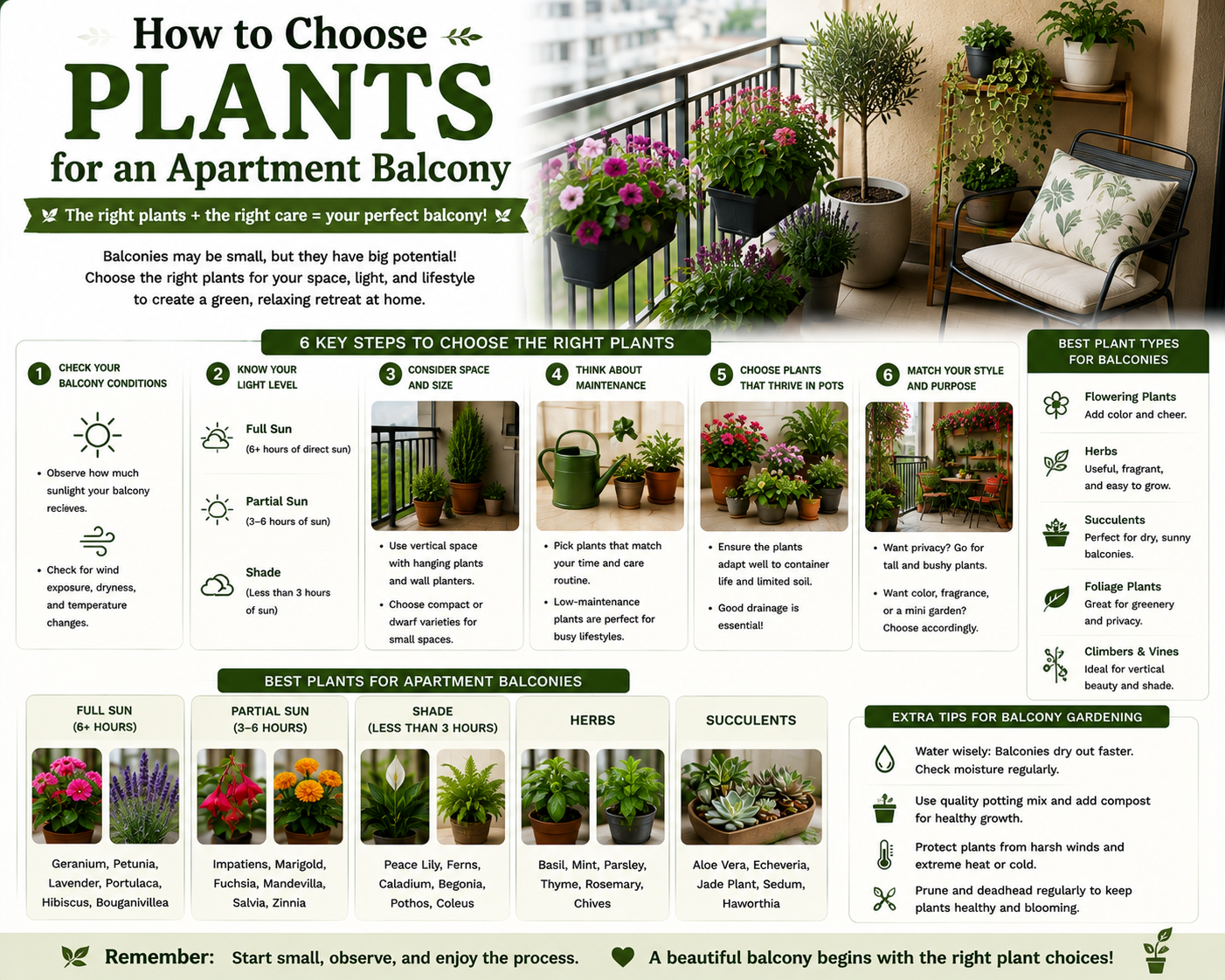
An apartment balcony is one of the most rewarding spaces to transform with plants — a small outdoor room that, with the right planting, can become a genuine green sanctuary above the city. But balconies also present a unique set of growing conditions that differ significantly from both indoor environments and open gardens: wind exposure, potential full sun or full shade depending on orientation, limited floor space, weight restrictions, and the need for all planting to be done in containers. Understanding these conditions and choosing plants that work with them rather than against them is the foundation of a successful balcony garden.
Assessing Your Balcony’s Conditions
Before buying a single plant, spend several days observing your balcony at different times of day to understand exactly what conditions it offers. Note how many hours of direct sunlight it receives and at what times — a balcony in full morning sun is a very different environment from one that receives afternoon sun, which is significantly more intense and warming. Assess the degree of wind exposure — high-floor balconies and those on exposed corners of buildings often experience wind that is significantly stronger than at ground level, which dries out plants rapidly, damages delicate foliage, and makes tall or top-heavy plants difficult to manage.
Check with your building management if you are uncertain about weight restrictions for your balcony. Wet soil is surprisingly heavy — a large pot filled with standard potting mix can weigh fifty kilograms or more when freshly watered — and the cumulative weight of a full balcony garden can be considerable. Using lightweight potting mixes specifically formulated for balcony and container gardens, along with lightweight pots made from fibreglass or recycled plastic rather than terracotta or ceramic, dramatically reduces the total weight while maintaining plant quality.
Understanding orientation and its implications
Your balcony’s orientation — the direction it faces — is the single most important environmental variable determining which plants will thrive there. A south-facing balcony receives the most sun and warmth throughout the day, making it suitable for sun-loving plants like lavender, pelargoniums, succulents, herbs, and most vegetables. A north-facing balcony receives little or no direct sun and is better suited to shade-tolerant plants like ferns, hostas, begonias, and Japanese forest grass. East-facing balconies receive gentle morning sun — ideal for a wide range of plants including many vegetables and flowering perennials. West-facing balconies receive warm afternoon sun that suits most sun-loving species but may be too intense for some.
Wind-Tolerant Plants for Exposed Balconies
Wind is the most challenging environmental condition unique to balcony growing, and choosing wind-tolerant plants is essential for exposed locations. Plants with delicate, large, or thin leaves suffer most in windy conditions — the constant movement tears leaf tissue, accelerates moisture loss, and makes growth difficult to sustain. The plants best suited to windy balcony conditions are those with small, tough, or narrow leaves, flexible stems that bend rather than breaking in the wind, and strong root systems that anchor them firmly in their containers.
Ornamental grasses are among the finest wind-tolerant balcony plants, moving gracefully rather than fighting against the wind and providing months of elegant, textural interest. Lavender, rosemary, thyme, and other Mediterranean herbs with small, waxy, or needle-like leaves tolerate wind with composure. Sempervivum and Sedum species are excellent low-growing choices that hug their containers and are virtually undisturbed by wind. For flowering impact in exposed positions, pelargoniums are remarkably wind-tolerant and produce abundant blooms throughout summer.
- Ornamental grasses — move beautifully in wind, provide year-round texture and interest
- Lavender and rosemary — tough, aromatic, wind-resistant Mediterranean herbs
- Pelargoniums — vibrant flowering annuals with good wind tolerance and low water needs
- Sempervivum — low-growing, tough, wind-resistant succulents in extraordinary variety
- Heuchera — colorful foliage perennial, tolerates wind and a wide range of conditions
- Climbing roses — trained against a wall or railing, sheltered from direct wind impact
- Thyme and oregano — low-growing, wind-tolerant culinary herbs with decorative appeal
Maximizing Space on a Small Balcony
Space management is critical on a small balcony where every square foot of floor and wall surface is valuable. Vertical growing is the most effective strategy for maximizing plant volume in a limited footprint — wall-mounted planters, railing-attached pot holders, vertical garden panels, and tiered shelving all allow you to create a lush, abundant planting without consuming all available floor space. Training climbing plants up a trellis fixed to the balcony wall or railing adds significant greenery with minimal pot footprint and provides additional privacy screening as a practical bonus.
Multi-purpose plants that provide both beauty and utility are particularly valuable on small balconies. An herb garden in a railing planter delivers fresh flavors for cooking and decorative greenery simultaneously. A climbing sweet pea trained up a balcony railing produces masses of fragrant flowers from a single small pot. A compact dwarf fruit tree in a large container on a sunny balcony offers blossom in spring, fruit in summer, and attractive foliage from a single planting. These multi-functional choices maximize the return on the limited space and container volume available.
Watering and Maintenance Considerations
Balcony plants in containers dry out significantly faster than plants in open ground, and the wind exposure common on balconies accelerates this further. A consistent and reliable watering strategy is essential for maintaining a thriving balcony garden. During summer, daily watering checks — and often daily watering for smaller containers in sunny, windy positions — are necessary and should be factored into your decision about how large and ambitious a balcony garden you take on.
A drip irrigation system connected to a timer is one of the most valuable investments a balcony gardener can make. Even a simple system supplying drip emitters to each container and running for twenty minutes morning and evening can maintain a large balcony garden through summer heat waves without daily manual intervention. These systems are increasingly affordable, straightforward to install without plumbing knowledge, and represent a genuine quality-of-life improvement for anyone who wants an abundant balcony garden without being tied to daily watering duties.
Common Mistakes to Avoid
- Choosing plants without assessing the balcony’s wind exposure — Wind on a high-floor or exposed balcony can devastate plants with delicate foliage. Always assess wind conditions before choosing plants for an exposed outdoor space.
- Using too-heavy pots and potting mix without checking weight restrictions — Wet terracotta pots filled with standard potting mix are very heavy. Use lightweight alternatives and check building regulations or management guidelines regarding balcony weight limits.
- Underestimating how quickly balcony containers dry out in summer — Exposed containers in warm, sunny, windy conditions can need watering daily. Plan your watering strategy realistically before committing to a large balcony garden.
- Planting tall, top-heavy plants in small containers — Wind can topple tall plants in small containers. Use large, stable pots with ballast stones in the base for tall specimens in exposed positions.
- Ignoring the needs of neighbors below when watering — Water draining from balcony containers can damage plants and property on balconies below. Always use saucers under containers or drip-free watering to prevent water falling from your balcony.
Frequently Asked Questions
Q: Can I grow vegetables on an apartment balcony?
A: Yes, provided your balcony receives at least four to six hours of direct sunlight daily. Cherry tomatoes, salad leaves, herbs, radishes, courgettes, peppers, and climbing beans all perform well in containers on sunny balconies. Choose compact or dwarf varieties specifically bred for container growing, use large containers with excellent drainage, water consistently, and fertilize regularly throughout the growing season for the best results.
Q: How do I create privacy on my balcony using plants?
A: The most effective approach is to train climbing plants up a trellis or wire frame fixed to the balcony railing or wall. Fast-growing climbers like climbing roses, jasmine, clematis, passion flower, and screening bamboo in large containers all create effective, beautiful living screens within one to two growing seasons. For immediate privacy before plants establish, a combination of trellis panels with climbing plants is more effective than relying on bushy container plants alone.
Q: What should I do with my balcony plants in winter?
A: Hardy plants like ornamental grasses, Sempervivum, heucheras, and many shrubs can remain outdoors on a balcony through winter in most temperate climates. Tender plants like pelargoniums, succulents, citrus trees, and tropical species need to be brought indoors before the first frost or given frost protection with horticultural fleece. Reduce watering for all balcony plants in winter as growth slows, and stop feeding entirely until growth resumes in spring.