
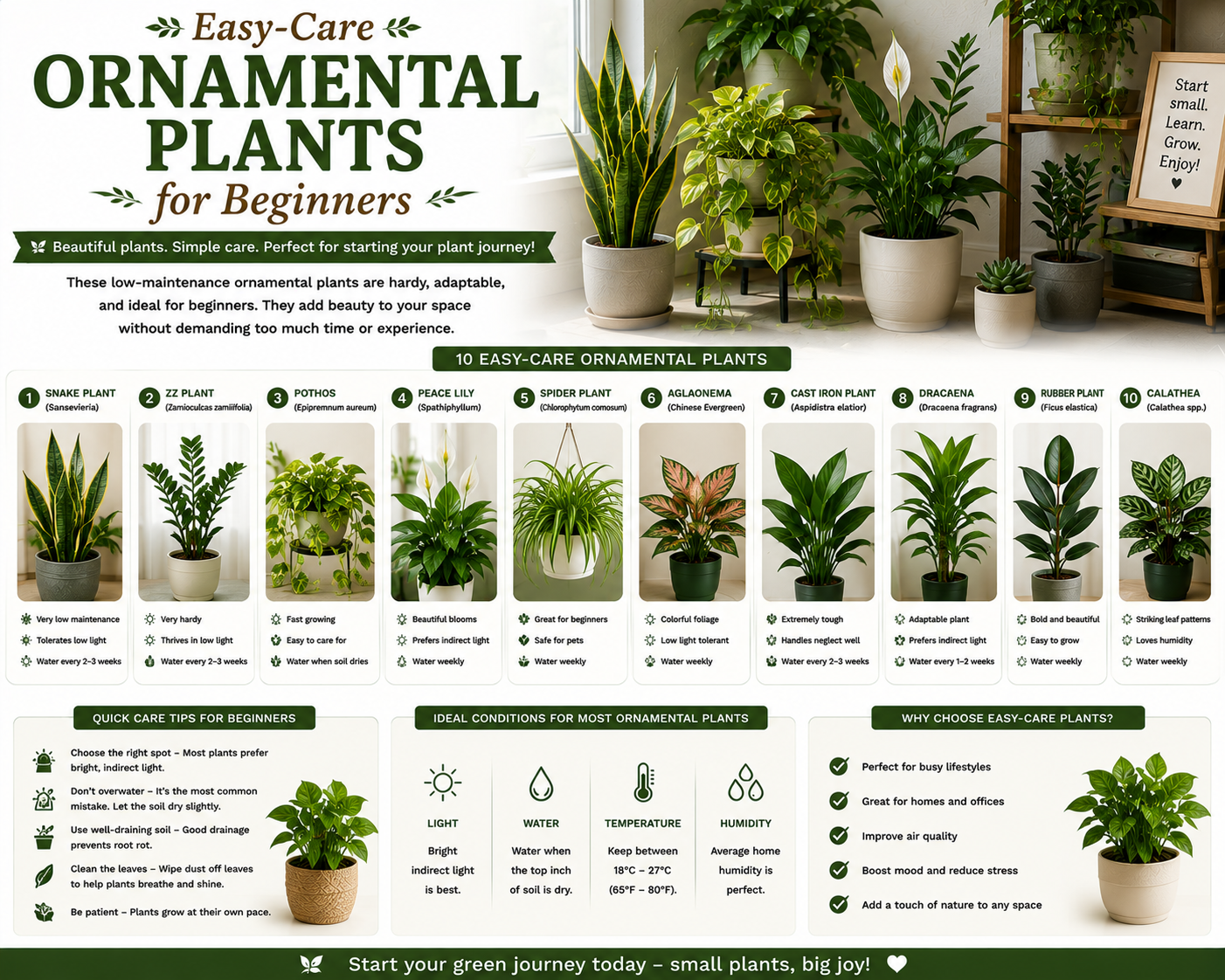
The ornamental plant world can feel overwhelming when you are just beginning. The sheer variety of species available, the conflicting care advice you find in different sources, and the memory of past plants that did not survive can make the prospect of building a beautiful, healthy plant collection feel more daunting than exciting. But the truth that experienced plant owners universally discover is that a relatively small group of ornamental plants are genuinely, reliably easy to grow — beautiful, rewarding, and forgiving enough to thrive even in the hands of someone still learning. Starting with these plants builds confidence, develops observational skills, and creates the foundation from which a more diverse and ambitious collection naturally grows.
What Makes an Ornamental Plant Truly Easy-Care
Not all plants marketed as easy care deserve the description equally. Some plants labeled easy are simply less demanding than the most difficult species available, while still requiring more attention and specific conditions than a genuinely beginner-friendly plant. A truly easy-care ornamental plant tolerates a wide range of light conditions rather than requiring precise placement, can survive missed waterings without permanent damage, performs well in standard potting mix without specialist amendment, and recovers readily from the occasional care mistake that every beginner makes during the learning process.
The best easy-care ornamental plants also have one additional quality that is rarely mentioned explicitly but makes a significant practical difference: they communicate their needs clearly and early enough that you can respond before serious damage occurs. A plant that droops visibly when it needs water, that changes leaf color when light is insufficient, or that shows clear surface symptoms when overwatering is becoming problematic gives you the feedback you need to learn and adjust, rather than declining silently until the damage is irreversible.
The importance of starting with plants you genuinely love
The psychological dimension of plant selection is more important than most gardening guides acknowledge. You are significantly more likely to notice, care for, and persist with a plant that you find genuinely beautiful than one you chose primarily because it was described as indestructible. The motivation to pay attention, to investigate when something looks wrong, and to put in the occasional extra effort that keeping any living thing healthy sometimes requires comes most naturally and reliably from genuine aesthetic appreciation. Choose easy-care plants that you find beautiful, that fit the style of your home, and that you would genuinely enjoy looking at every day.
The Best Easy-Care Ornamental Plants
The peace lily is one of the most rewarding easy-care ornamental plants available, combining genuine low-light tolerance with elegant white flower spathes that emerge reliably from the deep green, glossy foliage. It communicates its watering needs more clearly than almost any other houseplant — when the soil becomes too dry, the leaves droop dramatically and unmistakably, recovering completely within hours of thorough watering. This clear signaling makes overwatering virtually impossible for attentive beginners and allows even irregular plant owners to maintain a consistently healthy specimen. Peace lilies also tolerate the low humidity of most heated homes and are widely noted for their air-purifying qualities.
The Chinese evergreen, or Aglaonema, is another exceptional beginner choice. Its dramatic, patterned leaves in combinations of green, silver, pink, and red make it one of the most visually striking foliage plants available, and it achieves this striking appearance with a care profile that asks almost nothing of its owner. It tolerates low light, low humidity, and irregular watering with equanimity, and its slow growth rate means it remains attractively compact for years before requiring repotting or any significant management. The rubber plant offers similar ease with a completely different aesthetic — large, glossy, architectural leaves in deep green or burgundy that give it a bold, contemporary quality suited to modern interior styles.
- Peace lily — elegant white flowers, clear watering signals, tolerates low light and humidity
- Chinese evergreen — stunning patterned foliage, extremely adaptable, slow-growing
- Rubber plant — bold architectural leaves, easy care, tolerates varied conditions
- Dracaena — dramatic form, extensive variety, tolerates low light and irregular watering
- Tradescantia — fast-growing, trailing, beautiful purple and green foliage, incredibly forgiving
- Boston fern — lush, feathery fronds, beautiful in hanging baskets, tolerates shade
- Bromeliad — exotic, architectural, long-lasting flower, needs almost no care once established
- Kalanchoe — cheerful flowering succulent, bright colors, tolerates neglect between waterings
Easy-Care Ornamental Plants for Outdoor Spaces
For gardens and outdoor containers, the category of easy-care ornamental plants is similarly rich. Hardy geraniums — not to be confused with the tender pelargoniums commonly called geraniums in garden centers — are among the most reliable and rewarding perennial plants available for beginner garden borders. They spread gradually, suppress weeds effectively, produce abundant flowers in shades of pink, purple, blue, and white over a long season, and require almost nothing beyond an occasional trim after the first flush of flowers to encourage a second blooming. Divide them every few years to create more plants for free.
Hostas are equally celebrated for their ease and their extraordinary range of decorative foliage — available in virtually every shade of green, blue-green, yellow, and variegated combination imaginable, in sizes from tiny compact specimens to dramatic plants with leaves the size of dinner plates. They thrive in shade where most other ornamental plants struggle, tolerate neglect with dignity, and return reliably year after year from their underground crowns with no replanting required. Their one significant vulnerability is slug and snail damage to young emerging foliage in spring, which is easily managed with organic deterrents or by placing a ring of coarse grit around the crown.
Setting Up Easy-Care Plants for Long-Term Success
Even genuinely easy-care plants perform their best when set up correctly from the beginning. The most impactful setup decisions are choosing an appropriate pot with good drainage, using a quality potting mix suited to the plant type, and placing the plant in a location that provides at least the minimum light it needs rather than the most convenient decorative spot available. These decisions made correctly at the time of planting create the conditions for years of low-intervention success and prevent the slow, gradual decline that occurs when easy plants are placed in fundamentally wrong conditions and then blamed for their failure to thrive.
Common Mistakes to Avoid
- Assuming easy-care means zero care — Every plant needs some water, some light, and occasional attention. Easy-care means forgiving and adaptable, not maintenance-free. Ignoring plants entirely will eventually affect even the most resilient varieties.
- Choosing plants based on descriptions without seeing them in a space first — A plant that looks beautiful in photographs may not suit your home’s style or scale. If possible, see plants in person before buying and assess how they look in the kind of environment you are creating.
- Overcrowding easy-care plants together without regard for airflow — Easy-care plants are not immune to the fungal diseases and pest infestations that overcrowded, poorly ventilated growing conditions encourage. Allow appropriate space between plants even when individual varieties are highly resilient.
- Never repotting easy-care plants because they seem fine — Even slow-growing easy-care plants eventually become root-bound and need moving into a larger container. Check the drainage holes annually and repot when roots are clearly constrained.
- Giving up on easy-care plants after one poor season — A difficult season — unusual heat, an extended period of low light, an accidental pest introduction — can affect even the most resilient plants. Most will recover with restored normal conditions and do not represent permanent failure.
Frequently Asked Questions
Q: Which ornamental plant is truly the easiest to keep alive for an absolute beginner?
A: The pothos and the ZZ plant both have reasonable claims to this title. The pothos grows vigorously in almost any light condition, communicates its needs clearly, recovers quickly from neglect, and produces abundant trailing growth that looks beautiful within months of purchase. The ZZ plant is slower but essentially indestructible — it tolerates darkness, drought, and complete neglect for extended periods while maintaining an attractive appearance that requires virtually no intervention.
Q: Do easy-care ornamental plants flower?
A: Many do. Peace lilies, kalanchoe, bromeliads, and orchids — one of which, the Phalaenopsis or moth orchid, is much easier to grow than its exotic reputation suggests — all produce beautiful and long-lasting flowers alongside their ornamental foliage. Outdoor easy-care perennials like hardy geraniums, rudbeckia, echinacea, and salvia flower generously season after season with minimal intervention.
Q: Can easy-care plants be grown outdoors and indoors?
A: Many easy-care plants perform well in both environments given appropriate conditions in each. Snake plants, for example, thrive indoors in low-light conditions but also perform beautifully outdoors in warm climates with good drainage. Most tender houseplants benefit from spending summer outdoors where increased light and air circulation promote stronger, healthier growth than indoor conditions typically allow. Always acclimatize plants gradually when moving between indoor and outdoor environments to prevent shock from the sudden change in conditions.