
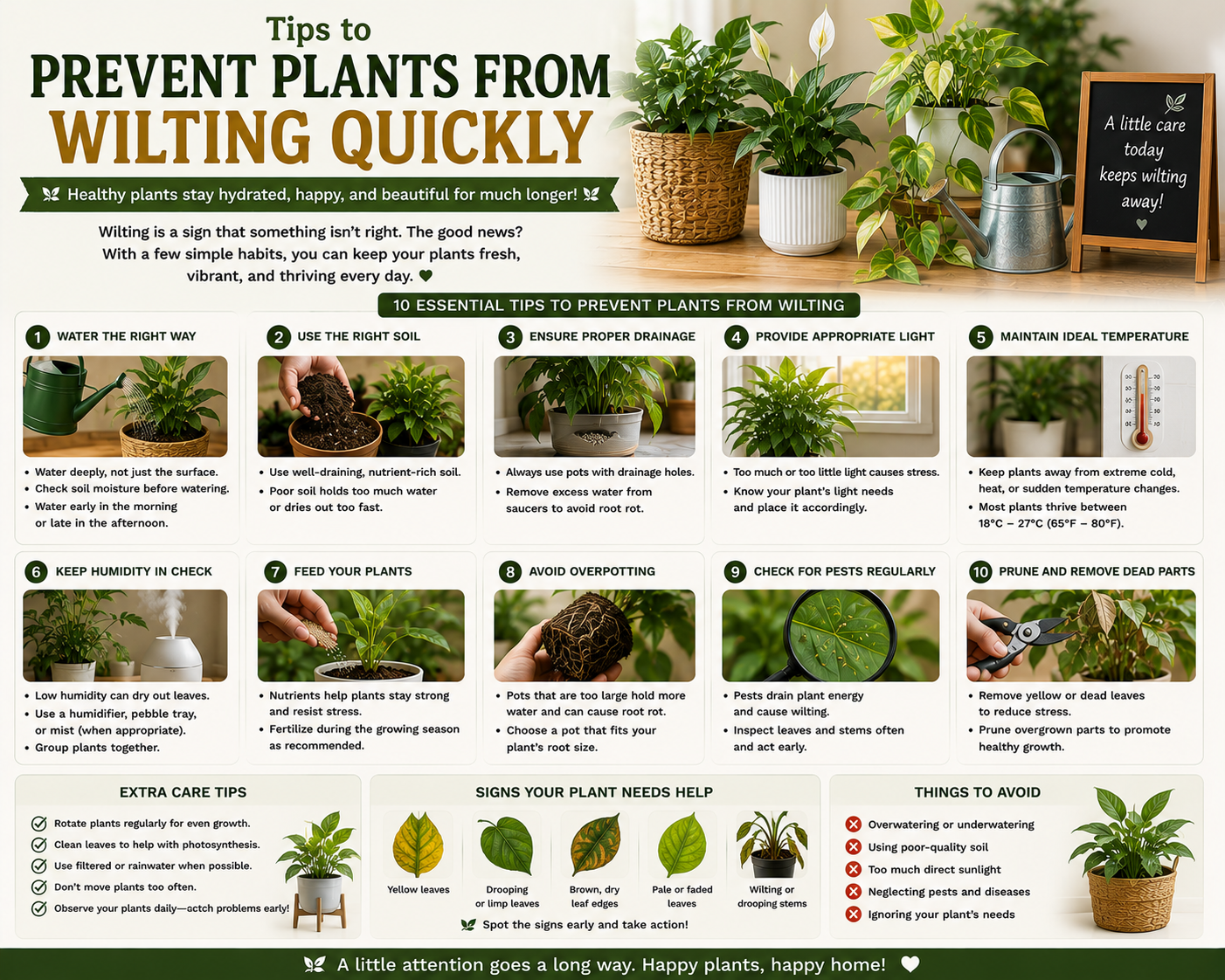
Few sights in plant care are more disheartening than a plant that wilts repeatedly, seeming to collapse within days of a thorough watering and never maintaining the fresh, upright, turgid appearance of a truly healthy specimen. Wilting is always a symptom rather than a condition in itself — it is the plant communicating that something in its environment or care routine is preventing it from maintaining adequate water pressure in its cells. Understanding what causes wilting, which factors make some plants wilt faster than others, and what practical steps prevent the problem is the key to maintaining plants that consistently look fresh and vibrant.
Understanding Why Plants Wilt
Plants maintain their upright structure through turgor pressure — the internal water pressure that keeps cells firm and rigid, supporting stems and holding leaves in their natural positions. When water loss through the leaves exceeds the rate at which roots can absorb and transport replacement water, turgor pressure drops and the plant wilts. This can happen through two very different mechanisms: underwatering, where insufficient water is available in the soil for the roots to absorb, or root dysfunction, where adequate water is present but damaged, suffocated, or constricted roots cannot transport it upward effectively.
Understanding which mechanism is causing your plant to wilt is essential because the responses to each are opposite. A plant wilting from underwatering needs water immediately. A plant wilting from root rot, root-binding, or oxygen deprivation in saturated soil needs the opposite — the water supply needs to be addressed at the root level, not increased. Always check the soil moisture before responding to wilting, and never water a plant that is already sitting in wet soil regardless of how dramatically it droops.
Environmental factors that accelerate wilting
Several environmental conditions dramatically increase the rate at which plants lose water through their leaves, making wilting more likely even when soil moisture is adequate. High temperatures increase the rate of transpiration — the evaporation of water from leaf surfaces — which can exceed the root system’s ability to supply replacement water during heat waves even in perfectly watered plants. Low humidity accelerates surface moisture loss from leaves, particularly in plants with large, thin leaf surfaces that have a high surface-to-volume ratio. Direct sun on plant foliage, particularly through glass that concentrates and intensifies light, generates heat that drives rapid transpiration and wilting in plants that are not fully adapted to those specific conditions.
Choosing the Right Pot and Soil to Prevent Wilting
The physical growing environment — the pot and potting mix — has a profound effect on how quickly a plant wilts between waterings. Small pots hold a limited water reservoir that is quickly exhausted, making plants in small containers much more vulnerable to rapid wilting during warm weather. Using the largest pot that is appropriate for the plant’s root system extends the time between necessary waterings and dramatically reduces the frequency of wilting episodes. Self-watering pots, which maintain a water reservoir at the base that the plant draws from as needed, almost eliminate the risk of wilting from underwatering for most plant types.
Potting mix composition determines how quickly soil dries between waterings. A potting mix with a high proportion of coco coir or peat retains moisture for longer periods than one with a high proportion of perlite or grit — making the right mix choice a function of the specific plant’s preferences. For plants that wilt quickly in standard mix, adding a greater proportion of moisture-retaining coco coir reduces drying speed. For plants that wilt due to root rot rather than underwatering, increasing the perlite proportion improves drainage and aeration, addressing the root dysfunction that prevents water uptake.
- Check soil moisture before every watering — wilting from root rot looks identical to wilting from drought
- Use the largest appropriate pot size to extend water reserves and reduce wilting frequency
- Consider self-watering pots for plants that wilt rapidly between standard watering sessions
- Match potting mix moisture retention to the plant’s specific water needs
- Move wilting-prone plants away from direct intense sun and heating vents that accelerate transpiration
- Group plants together to raise local humidity and reduce individual leaf moisture loss
Watering Techniques That Prevent Rapid Wilting
How you water is as important as how often you water in preventing rapid wilting. Light, frequent surface watering — adding a small amount of water to the top of the soil without saturating the root ball — is one of the most common watering mistakes and one that reliably produces plants that wilt quickly between sessions. Surface watering encourages roots to grow toward the soil surface in search of moisture, creating a shallow root system that dries out extremely quickly and has none of the deep-rooted resilience that makes plants tolerant of brief dry periods.
Thorough, deep watering that saturates the entire root ball and flows freely from the drainage holes encourages roots to grow deep into the pot in search of moisture — a deep root system that takes significantly longer to dry out completely and provides the plant with far greater resilience against brief dry spells. Water less frequently but more thoroughly each time, and you will notice that the time between waterings extends as the root system deepens and becomes more efficient at utilizing the available water in the soil.
Common Mistakes to Avoid
- Responding to wilting by immediately watering without checking the soil — Wilting caused by root rot or root-binding gets worse, not better, with additional watering. Always check the soil moisture before watering a wilting plant.
- Using light, frequent watering instead of deep, thorough watering — Shallow watering produces shallow root systems that wilt rapidly. Water thoroughly and less frequently to build deep, resilient root growth.
- Placing moisture-sensitive plants in positions with high heat or direct sun — Heat and direct sun accelerate transpiration dramatically. Move plants that wilt frequently to cooler, less intensely lit positions before addressing other potential causes.
- Allowing pots to sit in fully dried-out soil for extended periods — Completely dried potting mix becomes hydrophobic and repels water rather than absorbing it, meaning that watering after the soil has dried completely often fails to rehydrate the root ball evenly. Bottom-watering is the most reliable technique for rehydrating severely dried soil.
- Ignoring root-binding as a cause of wilting — A severely root-bound plant wilts rapidly because its enormous root mass exhausts the soil moisture very quickly. Check the drainage holes and soil surface for signs of root-binding if a plant wilts repeatedly despite attentive watering.
Frequently Asked Questions
Q: My plant wilts every afternoon but recovers overnight. Should I be concerned?
A: Afternoon wilting followed by overnight recovery is a relatively common phenomenon in plants exposed to intense afternoon sun or high temperatures, particularly in summer. It indicates that the rate of water loss through transpiration during the hottest part of the day temporarily exceeds the root system’s ability to supply replacement water — a situation that resolves itself as temperatures drop and transpiration slows in the evening. If the plant fully recovers each night and shows no other signs of stress, this pattern is not immediately dangerous but suggests the plant would benefit from some afternoon shade or increased watering during hot weather.
Q: Can a wilted plant recover fully?
A: A plant wilting from underwatering almost always recovers fully and rapidly — within a few hours of thorough watering, most plants regain full turgor pressure and return to their normal appearance. A plant wilting from root rot takes longer to recover, requires intervention at the root level, and may lose some foliage permanently during the recovery process, but can still make a full recovery if treated promptly. A plant that has been wilting from severe, prolonged drought stress may lose some older leaves permanently but will recover its growth momentum as the root system regenerates.
Q: Why does my plant wilt even though I water it every day?
A: Daily watering that still results in wilting is almost always a sign of root dysfunction rather than water shortage. The most likely causes are root rot from chronically overwatered soil that has suffocated the roots, a severely root-bound pot where the root mass is too large for the available soil volume to sustain, or a pot without drainage holes where water accumulates at the base and causes root damage despite the soil surface appearing appropriately moist. Remove the plant from its pot and inspect the roots directly to determine which of these causes is producing the wilting.