
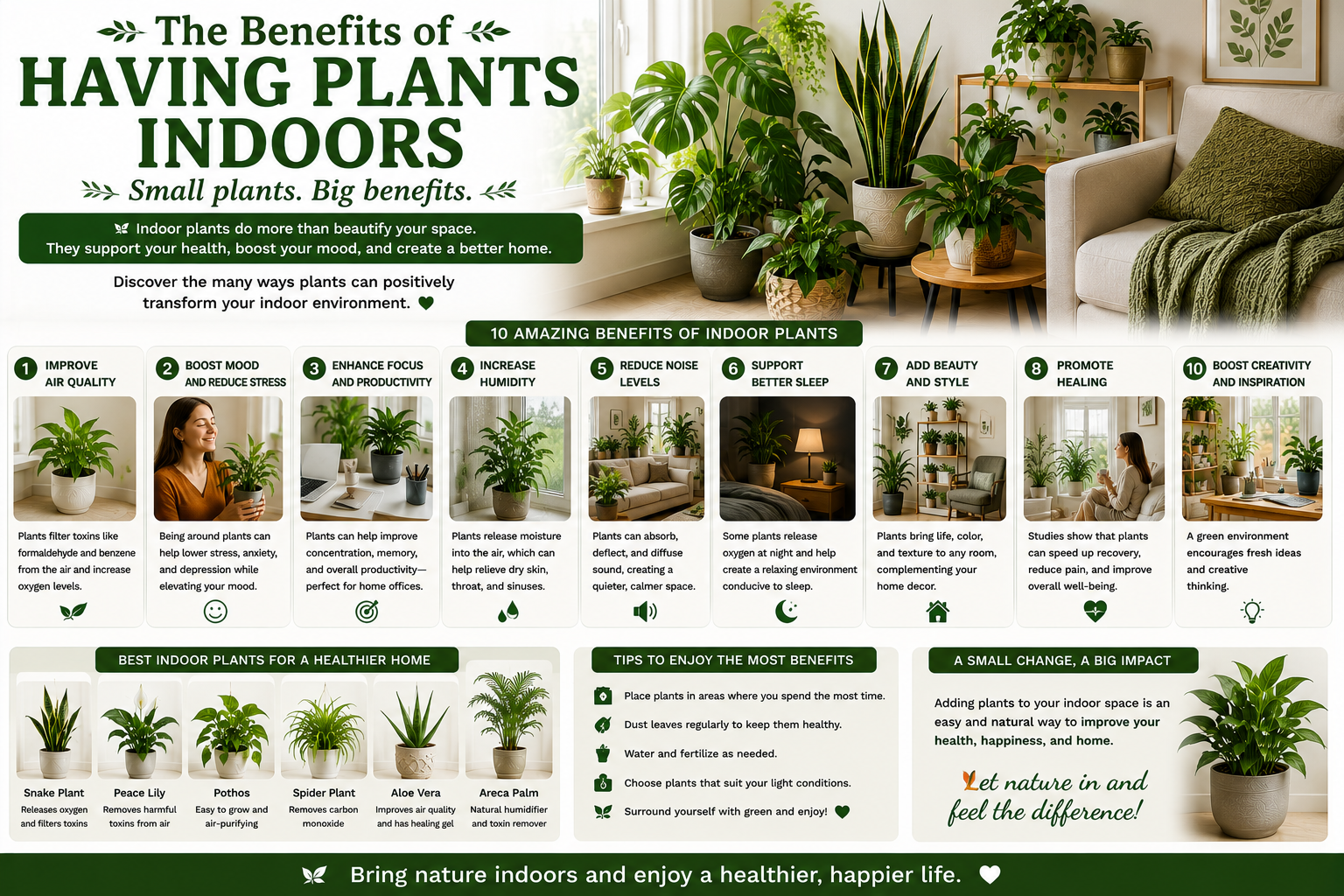
The impulse to bring plants indoors — to fill living spaces with greenery, to keep something alive and growing within the walls of a home — is one of the most universal and longstanding human tendencies. Across cultures, climates, and centuries, people have sought to maintain a connection with the natural world within their domestic spaces. In recent decades, researchers have begun to systematically investigate what plant lovers have always known intuitively: that living with plants genuinely improves human wellbeing in ways that go far beyond mere aesthetics. The benefits of indoor plants are real, measurable, and more diverse than most people realize.
Air Quality and the Role of Indoor Plants
The relationship between indoor plants and air quality has been the subject of significant research since NASA’s landmark 1989 clean air study, which demonstrated that certain houseplants could remove measurable quantities of volatile organic compounds — including formaldehyde, benzene, trichloroethylene, and xylene — from sealed test chambers. These compounds are emitted by common indoor materials including furniture, carpets, paints, cleaning products, and building materials, and are associated with health effects ranging from headaches and eye irritation to more serious respiratory concerns with prolonged exposure.
While subsequent research has found that the air-purifying effect of plants in real-world home environments is more modest than the NASA study’s sealed chamber results might suggest — because real homes exchange air with the outside environment continuously — the air quality contribution of indoor plants remains meaningful and real. Plants with high transpiration rates, large leaf surfaces, and active root systems with associated soil microbiota have the most significant air-purifying effects. Peace lilies, spider plants, snake plants, pothos, and rubber plants are among the most frequently cited high-performing air-purifying species and share the additional advantage of being among the easiest houseplants to grow successfully.
Humidity regulation in dry indoor environments
Beyond filtering airborne pollutants, indoor plants actively regulate humidity by releasing water vapor through transpiration. In winter, central heating creates intensely dry indoor air that contributes to respiratory irritation, dry skin, static electricity, and the desiccation of wooden furniture and musical instruments. A collection of actively transpiring plants — particularly moisture-loving tropical species — raises ambient humidity to levels that are more comfortable for human physiology and protective for sensitive household materials. This benefit is most significant and most appreciated during the heating season when outdoor air is dry and indoor humidity naturally falls to its lowest levels of the year.
Psychological and Mental Health Benefits
The psychological benefits of living with plants are perhaps the most robustly documented and practically significant of all the benefits research has identified. Multiple studies across different research groups and cultural contexts have found that the presence of plants in living and working environments is associated with reduced stress, lowered blood pressure and heart rate, improved mood, reduced feelings of anxiety and depression, and enhanced sense of calm and wellbeing. These effects appear to be relatively immediate — measurable within minutes of exposure to plant-filled environments — and do not diminish significantly with familiarity or habituation.
The mechanism behind these psychological benefits is not fully understood but is thought to involve the evolutionary theory of biophilia — the innate human tendency to seek connection with other living systems that developed over millions of years of human evolution in natural environments. Our nervous systems respond to the presence of plants with reduced stress-hormone production and increased parasympathetic nervous system activity, suggesting that at some fundamental biological level, being around plants signals to our bodies that we are in a safe, resource-rich environment. Whatever the mechanism, the practical result — that people feel better in spaces with plants than in identical spaces without them — is consistent and meaningful.
Cognitive and Productivity Benefits
Research conducted in office and educational environments has found that the presence of plants is associated with meaningful improvements in cognitive performance — including concentration, memory retention, creative thinking, and problem-solving ability. A study published in the Journal of Environmental Psychology found that participants performed significantly better on memory retention tasks in plant-filled environments than in equivalent environments without plants. Multiple workplace studies have found that employees in offices with natural elements including plants report higher job satisfaction, reduced sick days, and better self-rated productivity than those in plant-free environments.
For those who work or study from home — an increasingly significant portion of the population — the cognitive benefits of a plant-filled workspace are practically actionable and easily achieved. Even a small number of plants positioned near a home office desk or study space has been shown to improve the subjective experience of work and measurably reduce the mental fatigue associated with sustained cognitive effort. The presence of something living, growing, and visually interesting provides a natural focal point for the brief attentional breaks that research suggests are important for sustaining concentration and cognitive performance over extended work sessions.
- Plants remove volatile organic compounds from indoor air, improving air quality
- Transpiration raises indoor humidity to more comfortable and healthy levels
- Exposure to plants reduces stress hormones and lowers blood pressure
- Plant-filled environments are associated with improved mood and reduced anxiety
- Cognitive performance and concentration improve in spaces with plants
- Caring for plants provides a sense of responsibility, nurturing, and daily purpose
- Plants connect us with natural cycles of growth, season, and change in urban environments
The Therapeutic Benefits of Plant Care
Beyond the passive benefits of simply being around plants, the active practice of caring for them offers its own distinct set of therapeutic advantages. Horticultural therapy — the use of plant-related activities as a therapeutic intervention — is an established clinical practice with documented benefits for patients recovering from illness, managing chronic conditions, and dealing with mental health challenges. The focused, repetitive, outcome-oriented nature of plant care tasks — watering, repotting, pruning, propagating — produces a meditative state of engaged attention that researchers call flow, associated with reduced rumination, improved mood, and increased sense of accomplishment.
The act of successfully growing a plant from a cutting to an established specimen, or coaxing a plant back to health after an illness, also provides a concrete sense of competence and efficacy that contributes to self-esteem and confidence. Plant care is one of the rare activities in modern life that provides immediate, visible feedback on effort — a plant that was drooping last week is upright today because of something you did — and this feedback loop of effort and visible outcome is intrinsically rewarding in ways that extend well beyond the plants themselves.
Common Mistakes to Avoid
- Expecting plants to replace mechanical air purifiers for air quality improvement — The air-purifying effect of plants in real home environments is real but modest. Plants improve air quality meaningfully and consistently, but should be understood as a complement to good ventilation and air exchange rather than a replacement for it.
- Keeping plants that cause stress rather than reducing it — If a plant is too demanding for your current lifestyle and its decline produces guilt and anxiety rather than satisfaction, it is not improving your wellbeing. The psychological benefits of plants come from positive engagement, not from the obligation of maintaining something you find stressful.
- Underestimating the value of a small number of well-maintained plants — The benefits of indoor plants do not require a large collection. Even two or three well-chosen, beautifully maintained plants in prominent positions deliver meaningful psychological and environmental benefits. Quality and positioning matter more than quantity.
- Choosing plants purely for their air-purifying properties without considering care compatibility — A plant chosen for its air-purifying qualities but unsuited to your conditions or lifestyle will decline rather than thrive, and a declining plant provides none of the psychological or environmental benefits that a thriving one does. Choose plants that suit your conditions first and whose air quality benefits are a bonus.
- Ignoring the benefits of outdoor plants for indoor living — Plants visible through windows, positioned on balconies or terraces, or arranged in gardens contribute to the psychological benefits of nature exposure even when they are not strictly indoors. The view from an indoor space to a planted outdoor area has been shown to provide many of the same stress-reducing benefits as indoor plants themselves.
Frequently Asked Questions
Q: Which indoor plant provides the most air-purifying benefit?
A: Research consistently highlights the snake plant, peace lily, spider plant, pothos, and rubber plant as among the most effective air-purifying indoor plants for home environments. The snake plant is particularly valued because it performs gas exchange at night rather than during the day — making it a popular choice for bedrooms where nighttime air quality is most relevant.
Q: How many plants do I need to see measurable air quality improvements?
A: Research suggests that approximately one medium to large plant per nine to ten square meters of floor space provides meaningful air quality improvement in a well-maintained indoor environment. This translates to roughly two to three plants in an average-sized room. Increasing this density provides additional benefit, but the relationship is not linear — doubling the number of plants does not double the air quality improvement.
Q: Are there any risks or downsides to having many plants indoors?
A: For most people, a healthy plant collection presents no meaningful risks. The main considerations are: ensuring that plant species chosen are not toxic to children or pets who share the space; maintaining appropriate ventilation in heavily planted spaces to prevent excessive humidity buildup; and being aware that overwatered pots can attract fungus gnats, which are harmless but annoying. Consulting a list of pet-safe or child-safe plants before purchasing is good practice for households with young children or animals that tend to mouth plant material.