
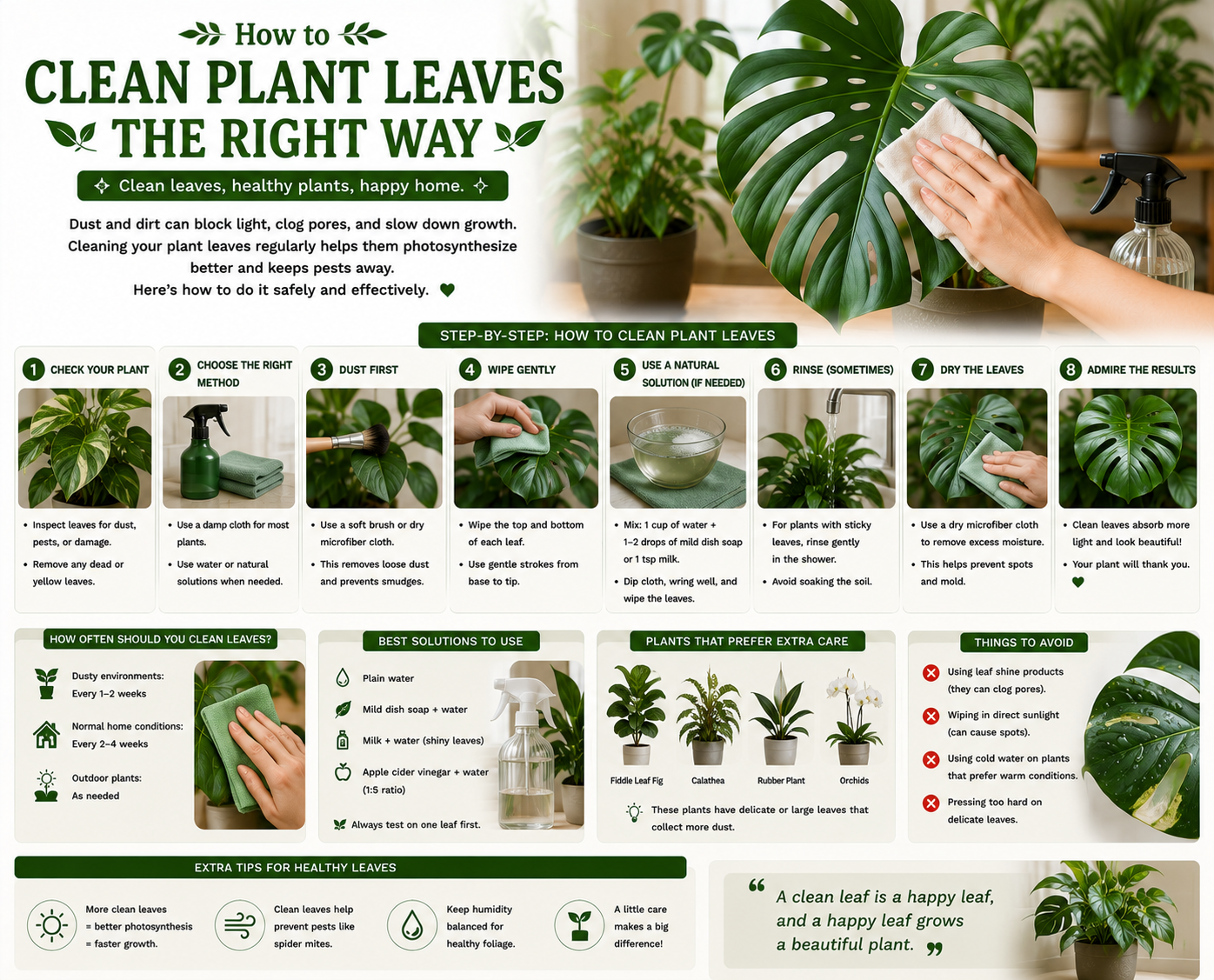
Cleaning plant leaves is one of those plant care tasks that many people overlook entirely, assuming it is either purely cosmetic or simply unnecessary. In reality, clean leaves are meaningfully healthier leaves — free of the dust, pollution particles, and residues that accumulate on leaf surfaces over time and progressively impair the plant’s ability to photosynthesize, breathe, and exchange gases with its surrounding environment. In indoor environments, where air circulation is reduced and airborne particles accumulate more readily than outdoors, regular leaf cleaning is a genuine contribution to plant health rather than merely an aesthetic indulgence.
Why Clean Leaves Matter for Plant Health
The leaves of a plant are its primary solar energy collectors — the surfaces through which sunlight is captured and converted into the chemical energy that drives every biological process in the plant. A thick coating of household dust on a leaf surface acts as a physical barrier that reduces the amount of light reaching the chlorophyll-containing cells inside the leaf, effectively dimming the plant’s energy supply below what clean leaves in the same light conditions would receive. In bright, sunny positions, this reduction may be negligible. In already low-light situations — a common condition for many indoor plants — it can be the difference between a plant that is photosynthesizing adequately and one that is chronically energy-deprived.
Beyond light absorption, the stomata — tiny pores on leaf surfaces through which gas exchange occurs — can become partially or fully blocked by accumulated dust and residue. Blocked stomata impair the plant’s ability to take in carbon dioxide for photosynthesis and to release oxygen and water vapor, reducing overall metabolic efficiency and making the plant more susceptible to the stresses that impaired respiration compounds. Regular cleaning keeps stomata clear and functional and restores the full gas-exchange capacity that a dusty leaf has gradually lost.
How often to clean plant leaves
The frequency of leaf cleaning depends on the environment in which the plant lives and the structure of its leaves. Plants in dusty urban environments, near roads, in kitchens, or in workshops accumulate surface residue significantly faster than plants in clean, well-ventilated spaces. As a general guideline, checking leaf cleanliness monthly and cleaning whenever a visible film of dust is present keeps most indoor plants in good condition. Large-leafed plants like rubber plants, monsteras, and fiddle-leaf figs accumulate dust most visibly and benefit most clearly from regular cleaning. Fine-leafed or textured plants that are more difficult to clean individually benefit most from a gentle rinse rather than individual leaf attention.
Cleaning Methods for Different Leaf Types
The most effective and widely applicable method for cleaning large, smooth-surfaced leaves is simple wiping with a soft, damp cloth. Use a clean, lint-free cloth — an old soft cotton t-shirt or a microfiber cloth is ideal — dampened with lukewarm water. Support the underside of the leaf gently with one hand while wiping the top surface with the cloth in a single smooth motion from the base of the leaf toward the tip, following the natural direction of the veins. Never rub vigorously or use circular motions, as this can stretch and damage leaf tissue. Wipe both the top and the underside of each leaf — the undersides harbor most pest activity and accumulate their own film of dust and residue.
For plants with many small or delicate leaves that would be impractical to wipe individually — ferns, tradescantia, baby plants, and small-leafed varieties — a gentle shower of lukewarm water is the most efficient and effective cleaning method. Place the plant in a shower or bathtub, spray gently with a lukewarm shower head from above, and allow it to drain completely before returning it to its position. This method also provides a thorough watering, removes dust from every leaf surface simultaneously, and is the closest approximation to the natural rain that keeps outdoor plant foliage clean. Avoid doing this for succulents, cacti, or plants with fuzzy leaves that trap and hold water against their surfaces.
- Wipe large smooth leaves individually with a soft damp cloth, supporting from underneath
- Use a gentle lukewarm shower for small-leafed or complex plants with many leaves
- Never use cold water directly on tropical plants — always lukewarm to avoid temperature shock
- Avoid commercial leaf shine products that clog stomata and damage natural leaf surfaces
- Clean both upper and lower leaf surfaces — the undersides require equal attention
- For fuzzy-leafed plants, use a very soft brush rather than damp cloth to avoid trapping moisture
What Not to Use on Plant Leaves
Commercial leaf shine products — sprays and solutions designed to produce a glossy finish on plant foliage — are marketed as a cosmetic enhancement but are generally harmful to plant health. These products typically coat the leaf surface with oils or silicone compounds that create a superficial shine but physically block the stomata they cover, impairing gas exchange and trapping heat on the leaf surface. Long-term use of leaf shine products on houseplants causes a progressive decline in photosynthetic efficiency that offsets any aesthetic benefit the shine provides. If you want naturally glossy leaves, clean them thoroughly with water — healthy, clean leaves are naturally lustrous without artificial enhancement.
Milk, mayonnaise, banana peels, and other home remedies occasionally recommended for cleaning and shining plant leaves are similarly counterproductive. While they may temporarily improve the appearance of a leaf, they leave organic residues on the surface that attract dust, encourage fungal growth, and ultimately create the dirty, dull leaf surface they were applied to improve. Plain lukewarm water is the only cleaning agent that leaves are genuinely needed and is effective without any side effects.
Common Mistakes to Avoid
- Using cold tap water directly on tropical plant leaves — Cold water on tropical plant foliage can cause temperature shock that appears as pale, discolored patches on the leaf surface. Always use lukewarm water for leaf cleaning.
- Wiping leaves with rough cloths or paper towels — Rough materials scratch the waxy cuticle that protects leaf surfaces and reduces its effectiveness as a barrier against moisture loss and pathogen entry. Use only soft, smooth cloths for leaf wiping.
- Cleaning leaves in direct bright sunlight — Water droplets remaining on leaves in bright sunlight can act as small lenses that concentrate light and cause localized burn marks. Clean leaves in indirect light or at a time of day when direct sun will not immediately strike the wet surfaces.
- Neglecting the undersides of leaves — The undersides of leaves are where most pest species shelter, feed, and reproduce. Cleaning only the visible upper surfaces misses this critical area and allows pest infestations to develop undetected.
- Using commercial leaf shine products for cosmetic improvement — These products clog stomata and impair plant function. Clean water produces naturally lustrous leaves without the harmful side effects of commercial leaf shine formulations.
Frequently Asked Questions
Q: How do I clean the leaves of plants with fuzzy or textured surfaces?
A: Fuzzy-leafed plants like African violets, begonias, and lamb’s ear should never be cleaned with a wet cloth, as water trapped among the hairs creates conditions that encourage rot and fungal disease. Use a very soft dry brush — a clean paintbrush or a soft makeup brush works excellently — to gently sweep dust from the leaf surface without introducing moisture. For more thorough cleaning, a can of compressed air used from a distance blows dust from the leaf surface without any contact or moisture.
Q: My rubber plant has brown, dull leaves despite regular wiping. What am I missing?
A: Brown or dull patches on rubber plant leaves despite cleaning often indicate a more significant issue than surface dust — typically low humidity, cold air damage, or the remnants of a previous leaf shine product application that has left a residue the normal cleaning routine is not removing. Try wiping the leaves with a cloth dampened with lukewarm water to which a tiny drop of dish soap has been added — enough to create very slight suds — to remove any stubborn residue, then rinse with plain water. If the brown patches appear dry and papery rather than dull and opaque, they may be permanent cold or low-humidity damage rather than a cleaning issue.
Q: Is it necessary to clean leaves if my plant is outdoors?
A: Outdoor plants generally keep their own leaves clean through natural rain, wind, and the absence of the enclosed dust accumulation that characterizes indoor environments. In areas with significant air pollution, near construction sites, or during extended dry spells when rain is absent for weeks, a periodic rinse with a garden hose provides the same benefit as indoor leaf cleaning. Otherwise, outdoor plants in normal conditions rarely need deliberate leaf cleaning beyond what the natural environment provides.