
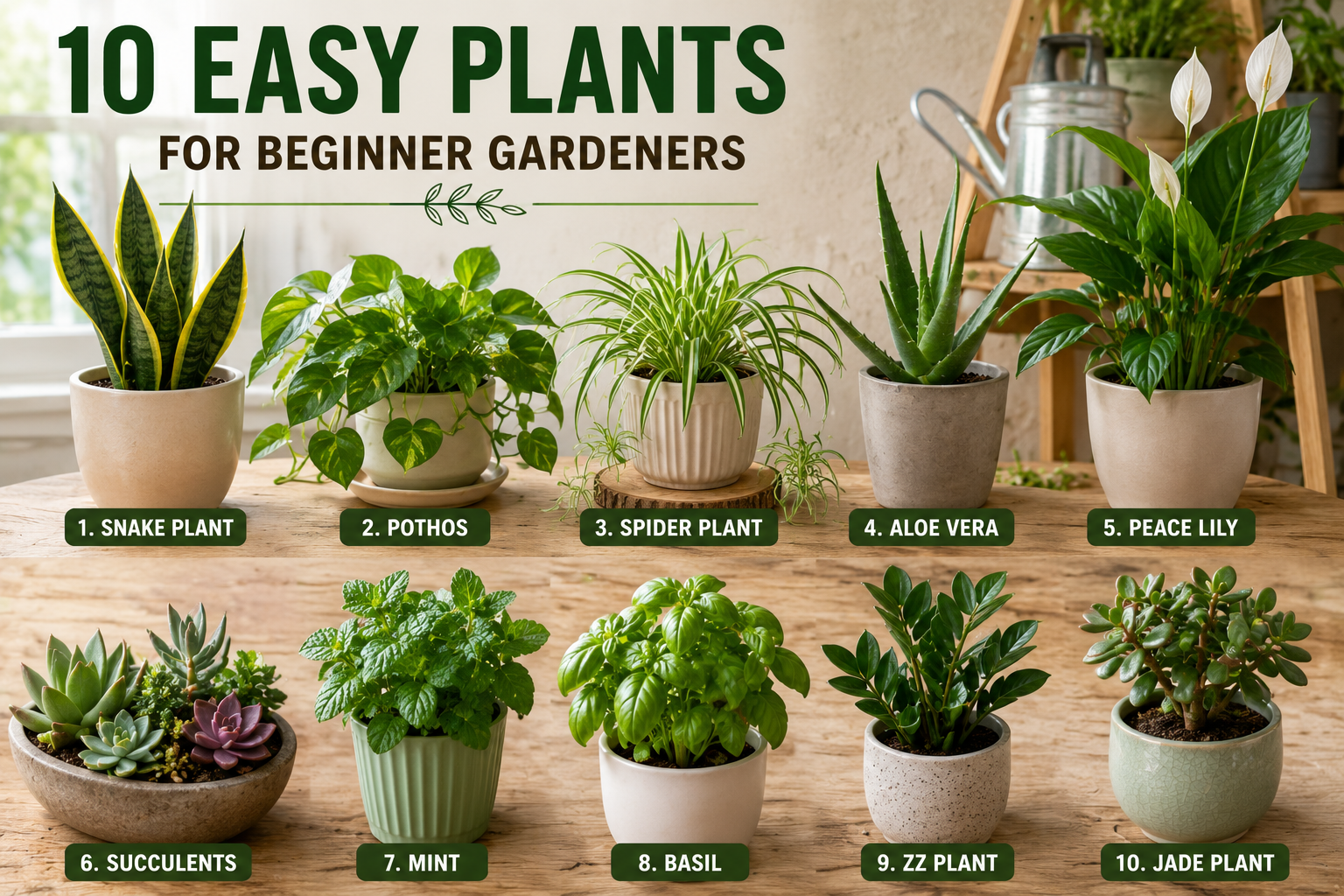
Starting a garden at home can feel overwhelming when you do not know where to begin. Many beginners accidentally choose plants that require advanced care, precise conditions, or constant maintenance — and the frustration of watching those plants decline can end a gardening journey before it properly begins. The truth is that the plant kingdom contains an extraordinary range of species that are genuinely forgiving, visually beautiful, and perfectly suited to the imperfect conditions and developing skills of someone just starting out. This guide introduces the ten best plants for beginner gardeners: resilient, rewarding, and reliable enough to help you build the confidence and observational skills that make everything else in gardening easier.
Why Starting With Easy Plants Makes All the Difference
Choosing beginner-friendly plants is not about settling for something less beautiful or less interesting — it is about giving yourself the best possible environment in which to develop the fundamental skills of plant care. When a plant is forgiving of the small watering inconsistencies, imperfect light positions, and occasional missed care sessions that are inevitable during the learning process, you have the space and freedom to observe, experiment, and understand rather than constantly firefighting problems that have escalated beyond manageable.
The practical skills that every experienced gardener possesses — reading soil moisture correctly, recognizing the early signs of stress, understanding how light changes affect growth, knowing when to water and when to wait — are developed through regular, attentive interaction with plants that communicate clearly and recover readily from minor mistakes. Easy plants are the best teachers available to a new gardener, and the confidence built through genuinely successful early experiences is the fuel that drives a lifetime of expanding horticultural ambition.
What makes a plant truly beginner-friendly
A genuinely beginner-friendly plant has three core qualities. First, it tolerates a range of watering frequencies rather than requiring precise timing — surviving both the occasional missed watering and the occasional accidental overwatering without permanent damage. Second, it adapts to varied light conditions rather than demanding a specific level of illumination, performing adequately in the range of light conditions most homes actually provide. Third, it communicates its needs visibly and early — drooping clearly when it needs water, changing color when light is insufficient — giving beginners the feedback they need to learn and adjust before damage becomes irreversible.
1. Snake Plant
The snake plant — botanically known as Dracaena trifasciata — is widely and justifiably regarded as the most forgiving houseplant available. Its upright, sword-shaped leaves in deep green with pale yellow margins add genuine architectural elegance to any indoor space, and it achieves this striking appearance while tolerating low light, irregular watering, dry apartment air, and occasional complete neglect with composure that no other commonly available houseplant can match. Water it once every two to three weeks in summer and once a month in winter, place it anywhere from a bright windowsill to a shaded corner, and it will grow steadily and look beautiful for years.
The snake plant is also one of the most studied houseplants for indoor air purification, with research identifying it as effective at filtering common volatile organic compounds from indoor air. For a beginner looking for a single first plant that combines genuine visual impact with virtually zero care demands, the snake plant is the most reliable recommendation available.
2. Pothos
Pothos is the other plant most universally recommended for beginners, and for good reason. Its heart-shaped leaves on trailing stems grow vigorously in almost any indoor light condition — from bright indirect light all the way down to quite dim interiors where few other plants would survive. It communicates its watering needs clearly by drooping softly when thirsty and recovering fully within hours of a thorough watering, making it one of the best plants available for developing an intuitive understanding of soil moisture and watering timing.
Beyond its forgiving nature, pothos is one of the most versatile and decoratively beautiful plants in the houseplant world. Positioned on a high shelf or in a hanging planter, its stems trail downward and fill vertical space with lush, cascading greenery that creates an impression of abundant plant life from a single pot. It propagates effortlessly in a glass of water — a stem cutting placed in water produces visible roots within two weeks — making it the most cost-effective plant in any collection over time.
3. Spider Plant
Spider plants are one of the classic beginner houseplants, and their enduring popularity reflects a genuine ease of care that more fashionable plants rarely match. Their graceful, arching green and white-striped leaves look beautiful in hanging baskets and on shelves where they have room to spread, and the small plantlets — called spiderettes — that cascade on long stems from mature plants are one of the most charming features of any houseplant, giving the collection an ongoing sense of natural productivity and life.
Spider plants tolerate a wide range of light conditions, prefer their soil to stay slightly moist but recover readily from drying out, and are almost never troubled by pests or disease under normal indoor conditions. They are also widely noted for their air-purifying qualities and are completely non-toxic to cats, dogs, and children — making them an excellent choice for family homes where pet and child safety is a consideration in plant selection.
4. Aloe Vera
Aloe vera is one of those plants that earns its place in a home on multiple levels simultaneously. Its sculptural, spiky rosette form adds a striking architectural quality to a sunny windowsill, its gel-filled leaves provide an immediately available natural treatment for minor burns and skin irritation, and its care requirements are as close to zero as any commonly available plant can get. Water it thoroughly every three to four weeks in summer and once a month or less in winter, give it the brightest spot you have available, and it will reward you with years of healthy, attractive growth that requires almost no intervention.
For beginners who travel frequently, work long hours, or simply have limited time for plant care, aloe vera is one of the most honest recommendations possible — a plant that genuinely thrives on the reduced attention that a busy lifestyle provides. Place it in a terracotta pot with well-draining cactus mix, give it a sunny south or west-facing windowsill, and water less than you think you need to. Those three steps are genuinely all it takes.
5. Peace Lily
The peace lily stands apart from most other beginner-friendly plants because it combines genuine ease of care with a genuinely elegant, refined appearance that more demanding plants would struggle to match. Its deep, glossy green foliage and elegant white flower spathes create a sophisticated display that looks equally at home in a living room, bedroom, or office, and it achieves this without requiring bright light — making it one of the finest options for rooms that receive only limited natural illumination.
Perhaps the peace lily’s greatest virtue for beginners is the clarity with which it communicates its watering needs. When the soil becomes too dry, the leaves droop dramatically and unmistakably — a clear, immediate signal that is visible from across the room. Within hours of thorough watering, the plant fully recovers its upright posture. This transparent feedback loop makes overwatering virtually impossible for attentive beginners and creates one of the most accessible learning experiences in plant care.
- Snake plant — tolerates low light, drought, and dry air, virtually indestructible
- Pothos — adapts to almost any light, trails beautifully, propagates effortlessly
- Spider plant — non-toxic, charming cascading offsets, handles varied conditions
- Aloe vera — needs almost no water, practical medicinal uses, loves sunny spots
- Peace lily — elegant flowers, tolerates low light, gives clear watering signals
6. Succulents
Succulents as a group represent one of the most accessible and visually diverse categories of plants available to beginners. Their thick, water-storing leaves and stems allow them to survive extended periods without watering, their extraordinary variety of forms — from the flat rosettes of Echeveria to the geometric stacked leaves of Crassula to the trailing strings of Senecio rowleyanus — provides endless visual interest in a small footprint, and their care requirements are simple enough to summarize in two sentences: give them as much light as you can, and water only when the soil is completely dry throughout.
For beginners in small apartments with a sunny windowsill, a collection of three to five small succulents in complementary terracotta pots creates an immediately beautiful display at minimal cost and with minimal ongoing care. The main care mistake to avoid is overwatering — succulents are killed by too much water far more often than by too little, and the well-intentioned impulse to water frequently is the most reliable way to ensure their decline.
7. Mint
Mint is the ideal first herb for beginner gardeners because it delivers the dual satisfaction of genuine ornamental beauty and practical daily usefulness simultaneously. Its vigorous growth — often visible within days of planting — provides the encouraging feedback of visible progress that motivates beginners through the early stages of their gardening learning curve. Its fresh, distinctive fragrance fills a kitchen or windowsill with a natural scent that no commercial air freshener can replicate. And its leaves, harvested regularly to encourage bushy new growth, provide fresh flavor for teas, drinks, salads, and countless recipes throughout the growing season.
Mint prefers consistently moist soil and performs well in partial sunlight — a morning sun position is ideal. Its one significant characteristic that beginners should understand from the start is its spreading habit: mint sends out underground runners that colonize surrounding soil aggressively, which makes it essential to grow in its own dedicated container rather than shared with other plants. In its own pot, mint is straightforward and productive. In a mixed planting, it quickly becomes a management problem.
8. Basil
Basil is the most rewarding culinary herb a beginner can grow, combining rapid growth from seed or young plant, intense kitchen utility, beautiful fresh fragrance, and genuine ornamental quality in a single, compact, low-cost plant. Placed on a bright kitchen windowsill near a south or east-facing window, a healthy basil plant provides a continuous supply of fresh leaves for cooking — a contribution to the kitchen that is disproportionately satisfying relative to the modest care it requires.
The key to keeping basil productive is regular harvesting. Pinching stems just above a pair of leaves — never removing more than a third of the plant at once — stimulates the production of new lateral shoots and keeps the plant in its bushy, productive vegetative phase. The moment flower buds appear at the growing tips, pinch them out immediately: a basil plant that has flowered redirects all its energy from leaf production to seed setting, and the remaining leaves become progressively smaller and less flavorful. With consistent harvesting and bud removal, a single basil plant produces abundant fresh leaves from late spring through to the first autumn frosts.
9. ZZ Plant
The ZZ plant — Zamioculcas zamiifolia — deserves its reputation as one of the most bulletproof houseplants available. Its deep, lustrous green leaflets grow on gracefully arching stems that give it an architectural elegance suited to modern and minimalist interiors, and it achieves this striking appearance while surviving conditions that would quickly kill most other decorative plants. Its underground rhizomes store enough water to sustain the plant for three to four weeks between waterings, and it tolerates the kind of dim light that most plants find deeply inadequate without the etiolation and decline that poor light typically causes.
For beginners who want a plant that will survive periods of inattention — extended trips, busy work periods, or simply the inconsistent schedules that modern life produces — the ZZ plant is the single most reliable choice available. Fertilize it twice a year, repot it every two to three years, water it monthly in winter and every two to three weeks in summer, and otherwise leave it entirely alone. It will reward this minimal intervention with years of steady, attractive growth that requires almost no active management.
10. Jade Plant
The jade plant — Crassula ovata — closes this list as one of the most enduring and characterful beginner plants available. Its thick, oval, deep green leaves on woody stems develop a genuinely tree-like, bonsai-esque form over time that becomes more beautiful and distinctive with each passing year. In the right conditions — a bright sunny position and a well-draining cactus mix with very infrequent watering — jade plants are extraordinarily long-lived, with some specimens reaching fifty years or more and developing into truly impressive specimens that become genuine family heirlooms.
For a beginner, the jade plant offers immediate ornamental appeal alongside an exceptionally low care burden. Its succulent leaves store water efficiently, its growth is slow and tidy, and its compact form makes it ideal for desks, windowsills, and shelves where space is limited. Place it in the brightest position available, use a terracotta pot with cactus potting mix, water only when the soil has been dry for several days, and allow it to grow slowly into the characterful specimen it will eventually become.
Setting Every Plant Up for Success From Day One
Choosing the right plant is the first decision — setting it up correctly is the second, and it is just as important for long-term success. For every plant on this list, the same three setup decisions determine how well it performs from the beginning. Use a pot with drainage holes — without drainage, even the most forgiving plants eventually succumb to waterlogging. Use a potting mix appropriate to the plant type — cactus mix for succulents and aloe, standard potting mix amended with perlite for everything else. And position each plant in a light level that genuinely meets its needs rather than the most convenient or decorative spot available.
These three decisions made correctly at the time of planting create the conditions for years of low-intervention success. Every one of the plants on this list is capable of thriving for a decade or more in appropriate conditions with basic attentive care — the key is getting the foundations right at the beginning rather than trying to compensate for wrong conditions with increased interventions later.
Common Mistakes to Avoid
- Overwatering out of enthusiasm — More plants on this list are killed by too much water than by any other cause. Always check the soil moisture before watering, and when in doubt, wait another two or three days before checking again.
- Placing plants in decoratively perfect but light-deficient positions — A beautiful dark corner is not a good home for most plants. Always confirm that a position receives adequate light for the specific plant before committing it to that location long-term.
- Buying too many plants simultaneously — Starting with five or more plants at once divides your attention and makes it harder to develop the close observational familiarity with each plant that good care requires. Begin with two or three and expand gradually.
- Using pots without drainage holes — No matter how careful your watering, a pot without drainage will eventually trap enough moisture at the root level to cause rot. Every pot needs drainage holes without exception.
- Abandoning gardening after a single plant failure — Every experienced gardener has lost plants, and continues to lose them occasionally. Plant failure is information — it tells you something about conditions, watering, or plant choice that success cannot — and the gardeners who persist through early setbacks invariably become the most knowledgeable and confident ones.
Frequently Asked Questions
Q: Which single plant is the absolute best starting point for a complete beginner?
A: The pothos and the snake plant share the top recommendation for most beginners. The pothos is ideal if you want fast, visible growth and the satisfaction of a plant that fills space quickly with lush, trailing greenery. The snake plant is the better choice if you want something architecturally striking that tolerates the widest possible range of conditions and the most irregular care schedule. Both are available cheaply, grow readily in typical indoor conditions, and provide the clear, honest feedback about their needs that makes them the best possible teachers for someone developing their plant care instincts.
Q: Can I keep all ten of these plants together in the same room?
A: Yes, provided the room has a range of light levels to accommodate the different needs of the plants on this list. Sun-loving plants — aloe vera, succulents, basil, and jade plant — need a position near the brightest window available. Shade-tolerant plants — snake plant, ZZ plant, and peace lily — can be positioned further from the window where light is lower. Pothos, spider plants, and mint fall in the middle range and perform well in most indoor light conditions. Grouping plants with similar watering needs together also simplifies your care routine significantly.
Q: How long before I am ready to move on to more challenging plants?
A: There is no fixed timeline — readiness is a matter of observational confidence rather than elapsed time. When you can accurately assess the soil moisture of each plant in your collection by feel alone, when you recognize the early signs of stress in a plant before they become obvious, when your watering routine feels intuitive rather than uncertain, and when your existing plants are consistently healthy and producing new growth, you are ready to expand into more demanding varieties. For most attentive beginners, this confidence develops within one full growing season of consistent, engaged care.