
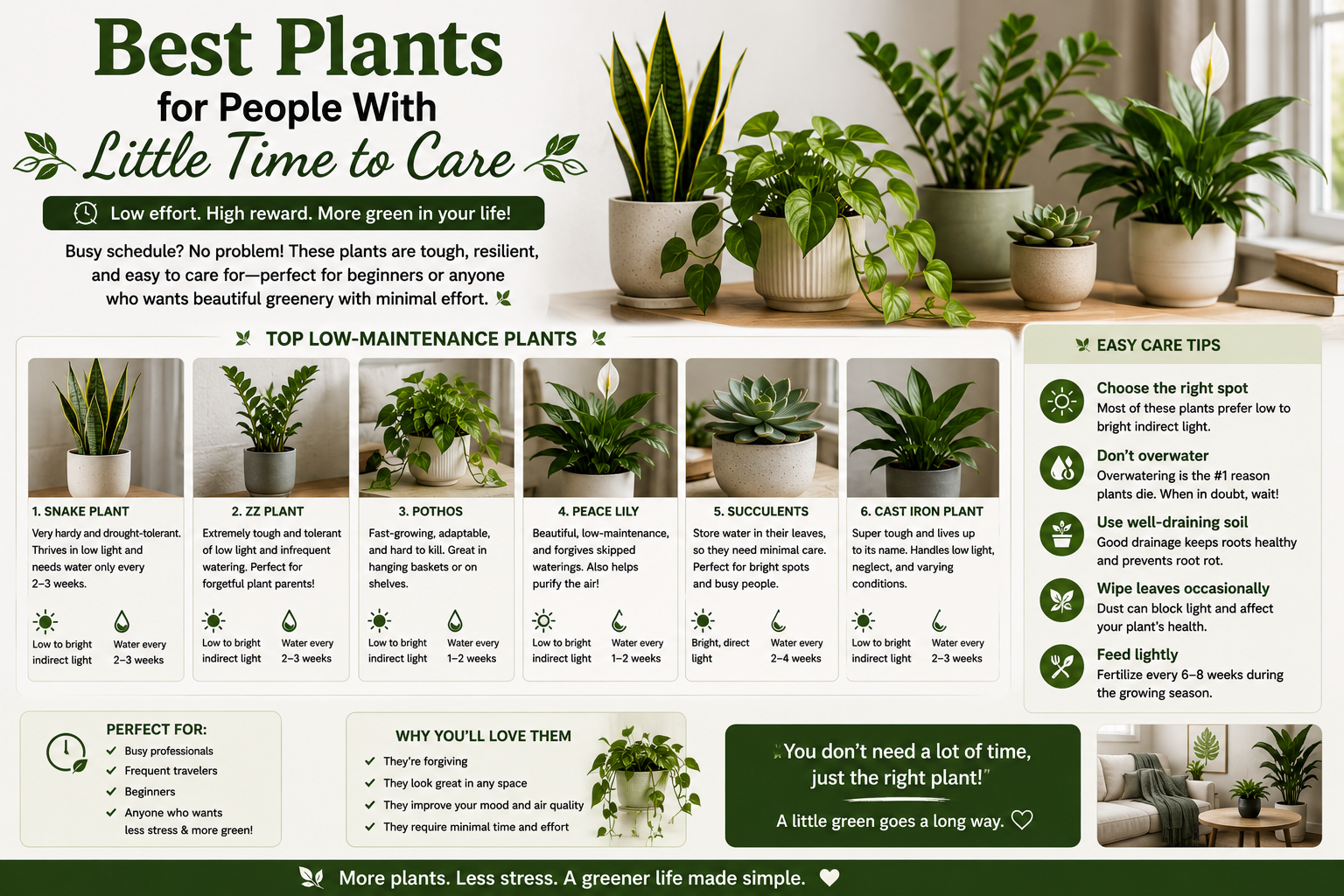
Not everyone who loves plants has the time to devote to their care that a demanding plant collection requires. Life is full — work, family, travel, and the hundred other demands on modern attention leave many plant lovers feeling guilty about the specimens wilting quietly on their windowsills. The solution is not to give up on plants but to choose plants that are honestly, genuinely matched to the time and attention you can realistically offer. There is a remarkable range of beautiful, rewarding plants that thrive on minimal intervention, and building your collection around these varieties transforms plant ownership from a source of stress into a source of quiet, uncomplicated pleasure.
The Characteristics of Truly Low-Care Plants
A genuinely low-care plant has specific biological characteristics that make it forgiving of the irregular watering, occasional neglect, and imperfect conditions that busy plant owners inevitably provide. The most reliably easy plants share several key traits: they store water in leaves, stems, or roots, allowing them to survive missed watering sessions without distress. They have low nutrient requirements, meaning they perform well in depleted soil without regular feeding. They tolerate a wide range of light conditions rather than demanding a precise level of illumination. And they grow slowly, which means they rarely become root-bound or require regular pruning to maintain their shape.
When assessing whether a plant is truly suitable for a low-care lifestyle, look beyond the general easy care label that appears on many plant tags — this designation is relative and means different things for different plants. Instead, look specifically for plants described as drought tolerant, slow-growing, and adaptable to varying light conditions. These three characteristics together are the most reliable indicators of a plant that will genuinely thrive with the limited attention a busy person can provide.
Setting realistic expectations
Even the most forgiving low-care plant has a baseline of needs that must be met for it to survive and look attractive. No plant can go entirely without water indefinitely. No plant can grow in complete darkness. Setting realistic expectations about what low-care actually means prevents disappointment and helps you provide the minimum necessary care consistently. For most of the plants in this article, that minimum consists of watering once every one to four weeks depending on the variety and season, placing the plant near a window with some natural light, and occasionally wiping leaves or removing dead growth — genuinely achievable for almost anyone.
The Best Plants for Busy People
The ZZ plant is the single best recommendation for someone who wants beautiful greenery with minimal effort. Its deep, glossy green leaflets grow on gracefully arching stems that look architectural and intentional in any interior style. Underground rhizomes store enough water to sustain the plant for three to four weeks between waterings, and it tolerates dim light that would cause most plants to decline rapidly. Fertilize it twice a year, repot it every two to three years, and do virtually nothing else — the ZZ plant will reward you with steady, reliable beauty that requires almost no maintenance whatsoever.
The snake plant deserves its reputation as the most forgiving houseplant in existence. It tolerates low light, irregular watering, dry indoor air, and occasional complete neglect with remarkable equanimity. Its upright, architectural foliage comes in dozens of beautiful varieties and adds a strong vertical design element to any room. Water once every two to three weeks in summer, once a month in winter, and otherwise leave it entirely alone.
- ZZ plant — tolerates drought and low light, virtually indestructible, beautiful glossy foliage
- Snake plant — survives almost any condition, strong architectural form, dozens of varieties
- Pothos — fast-growing but completely unfussy, tolerates almost any light level
- Aloe vera — needs watering only every three to four weeks, useful medicinal plant
- Spider plant — nearly impossible to kill, produces charming cascading offsets naturally
- Cacti — need watering just once a month in summer, almost nothing in winter
- Chinese evergreen — tolerates low light and irregular watering, beautiful patterned foliage
- Cast iron plant — tolerates cold, drought, and deep shade with extraordinary resilience
Creating a Low-Maintenance Plant Setup
Choosing the right plants is only half of creating a genuinely low-maintenance plant collection. The other half is setting up each plant in conditions that minimize the amount of intervention it needs from you. The right pot, the right soil, and the right location work together to create a self-regulating environment that stretches the time between necessary care sessions as long as possible.
Self-watering pots are one of the most useful tools for busy plant owners. These pots have a built-in water reservoir at the base that plants draw from through capillary action, effectively watering themselves for one to two weeks between refills. For a busy person who travels regularly or simply forgets to water, self-watering pots extend the window of neglect that plants can safely tolerate without stress.
Simplifying Your Watering Routine
For busy plant owners, the goal of watering management is not to water perfectly but to water sufficiently and consistently enough that plants remain healthy between sessions. Bottom-watering — placing pots in a tray of water for twenty to thirty minutes and allowing them to draw up moisture from below — is one of the most time-efficient watering methods available. You can set multiple pots in a large tray simultaneously, attend to other tasks while they soak, and then remove them all at once when the top inch of soil feels moist.
Grouping plants together in one area of your home rather than distributing them across multiple rooms also simplifies maintenance enormously. When all your plants are in one place, a single care session covers the entire collection rather than requiring you to move through several rooms. Grouping plants also raises local humidity through collective transpiration, which benefits moisture-loving varieties and reduces the stress of dry indoor air on the entire collection.
Common Mistakes to Avoid
- Choosing plants based on current trends rather than actual care requirements — Fiddle-leaf figs, calatheas, and maidenhair ferns are beautiful but none of them are forgiving of irregular attention. Research care requirements before buying.
- Overwatering out of guilt after a period of neglect — If you have forgotten to water for two weeks, check the soil first — a drought-tolerant plant may be perfectly fine and need no immediate watering.
- Keeping plants that consistently struggle despite your best efforts — If a plant repeatedly declines and requires more intervention than your lifestyle allows, replace it with a variety that genuinely suits your level of availability.
- Placing low-care plants in locations that increase their care needs — A drought-tolerant plant in a small terracotta pot on a sunny south-facing windowsill will need watering every day regardless of its natural tolerance.
- Never fertilizing because the plant looks fine — Low-care plants still benefit from occasional feeding. A single liquid fertilizer application in spring and one in early summer is all most need to remain healthy throughout the season.
Frequently Asked Questions
Q: What is the absolute minimum care any plant needs to survive?
A: At an absolute minimum, any living plant needs some light and some water. For the most drought-tolerant plants like cacti and ZZ plants, this minimum is a spot with any natural light source and watering once every three to four weeks in summer. The threshold of minimum care for these varieties is genuinely very low and achievable by virtually anyone.
Q: Can I go on a two-week vacation without arranging plant care?
A: With the right plants, yes. ZZ plants, snake plants, cacti, succulents, and cast iron plants can all survive two weeks without watering provided they are given a thorough drink before you leave and are not sitting in a very hot, sunny spot that accelerates moisture loss.
Q: Are there any plants that genuinely need almost no attention at all?
A: The ZZ plant and cast iron plant come closest to genuinely minimal care requirements. Both tolerate several weeks without water, grow in very low light, need fertilizing only once or twice a year, and require repotting only once every two to three years. Air plants require no soil at all and need only a brief soak in water once a week, making them extraordinarily simple for anyone who wants living plants with almost no conventional care routine.