
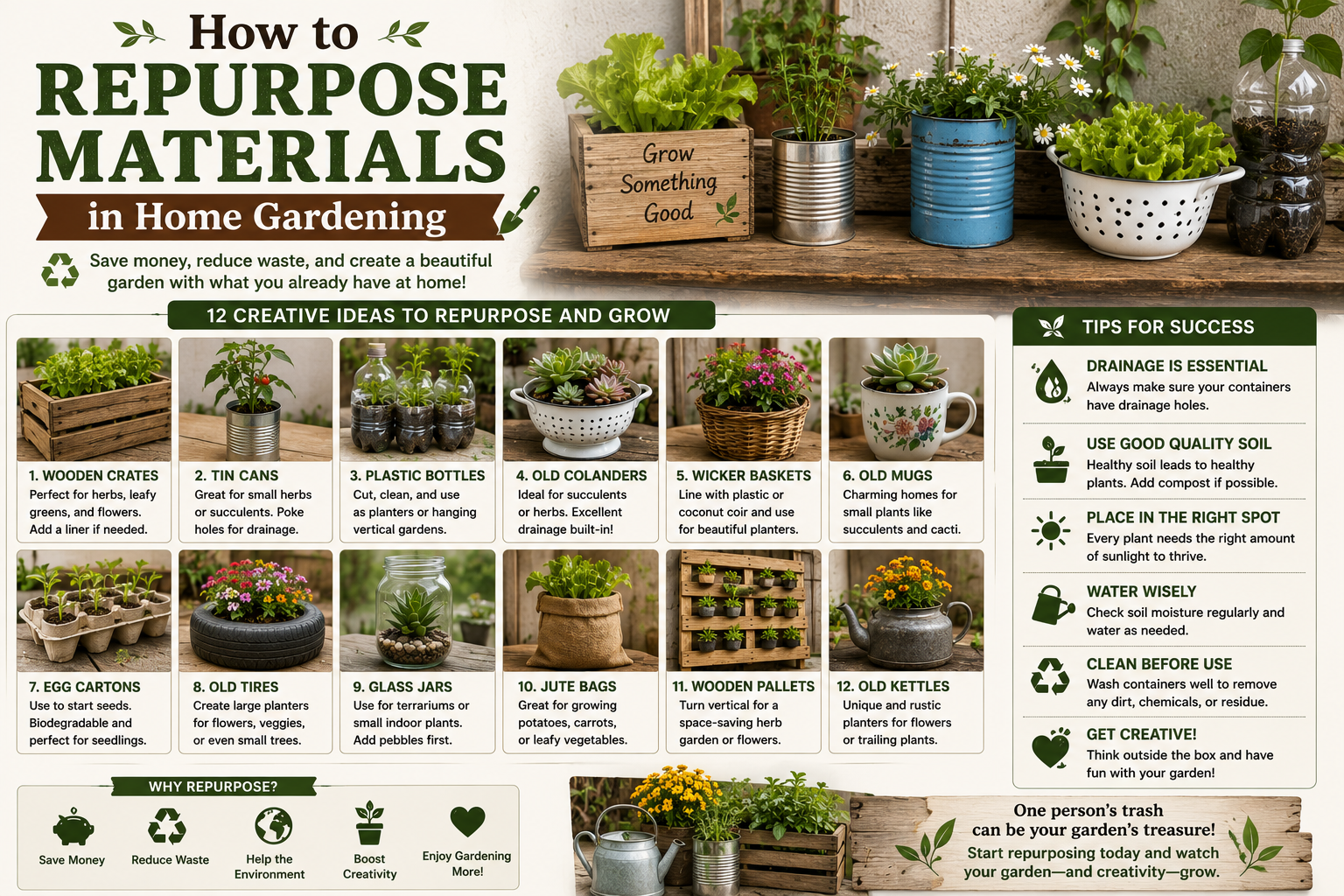
Home gardening does not have to be an expensive pursuit, and some of the most creative and characterful gardens in the world have been built almost entirely from repurposed and recycled materials. Looking at everyday objects with fresh eyes — seeing a colander as a drainage-perfect planter, a wooden pallet as the skeleton of a vertical herb garden, or a cracked teapot as a quirky container for a trailing succulent — is one of the most satisfying and sustainable approaches to garden making. Repurposing materials saves money, reduces waste, and adds an irreplaceable sense of personality and ingenuity to any growing space.
The Environmental and Creative Case for Repurposing
Every year, enormous quantities of perfectly useful materials end up in landfill because people cannot immediately see another use for them. Gardening offers a creative framework for reimagining these materials as useful, beautiful objects with a second life. A chipped enamel colander becomes a characterful planter with built-in drainage. An old wine crate becomes a raised bed. A cracked ceramic bowl becomes a small succulent garden. Glass jars become propagation vessels. The creative act of finding these new uses is genuinely enjoyable, and the results are almost always more characterful and unique than anything you could buy from a garden center.
Beyond the creative satisfaction, repurposing materials in gardening is a meaningfully sustainable practice. Manufacturing new garden pots, planters, and structures consumes energy and resources. Repurposing existing materials bypasses this entirely and gives objects a useful extended life. When gardeners approach their growing spaces with a repurposing mindset, the cumulative environmental impact is significant — and the gardens that result are more interesting, more personal, and more original than those assembled from identical off-the-shelf components.
What makes a good repurposed container
Almost any container can become a planter provided it meets three basic requirements. First, it must be possible to create drainage holes in the base or sides — without drainage, even the most beautiful repurposed container will eventually kill any plant growing in it through waterlogging. Second, it must be made from a material that will not leach harmful chemicals into the soil at levels that would damage plants or create food safety concerns for edible crops. Third, it must be robust enough to hold soil and withstand the moisture and temperature variations of gardening use without collapsing or disintegrating rapidly.
Kitchen and Household Items as Planters
The kitchen is one of the richest sources of repurposable gardening containers. Colanders and sieves make excellent planters because their built-in perforations provide outstanding drainage and airflow around roots — line them with coco coir fibre or moss to retain soil while still allowing free drainage. Old pots and pans make charming, whimsical planters for herbs and small flowering plants. Tin cans in various sizes, washed thoroughly and punctured at the base with a nail and hammer, create a cohesive set of small herb planters when lined up on a windowsill — their industrial simplicity suits modern and industrial interior styles beautifully.
Wooden wine crates and fruit boxes can be lined with plastic sheeting punctured for drainage and filled with potting mix to create compact raised beds for strawberries, salad leaves, or herbs. Glass jars, while not ideal for most plants due to their lack of drainage, are perfect for water propagation — placing cuttings of pothos, tradescantia, or mint in water-filled jars on a windowsill creates a beautiful, living display while the cuttings develop roots before being potted up.
- Colanders and sieves — excellent drainage, great for herbs and strawberries
- Tin cans — perfect for small herbs, line up for a cohesive windowsill display
- Wooden wine crates — ideal for shallow-rooted salads and herbs when lined
- Glass jars — perfect propagation vessels for water-rooting cuttings
- Old boots and bags — quirky outdoor planters with strong visual character
- Teapots and mugs — charming small planters for succulents and cacti
- Vintage tins — weatherproof and characterful, great for outdoor herb displays
Repurposing Wood and Pallets
Wood is one of the most versatile and widely available materials for repurposed garden projects. Wooden shipping pallets are perhaps the most famous repurposed gardening material, used to create vertical herb gardens, raised beds, compost bins, potting benches, and decorative fencing. Before using pallets in the garden, check for a heat-treatment stamp — look for the letters HT on the pallet end. Heat-treated pallets are safe for gardening use. Pallets marked MB have been treated with methyl bromide, a fumigant harmful to plants and soil life, and should not be used in the garden.
Beyond pallets, reclaimed timber boards, old fence posts, driftwood, and fallen branches can all be incorporated into garden structures with creativity and basic woodworking skill. A simple raised bed can be constructed from reclaimed railway sleepers or scaffold boards at a fraction of the cost of purpose-made raised bed kits. Old wooden ladders make beautiful display structures for small pots and trailing plants when leaned against a wall. Sections of log or branch can be hollowed out with a chisel to create rustic, natural-looking planters that decompose slowly and enrich the soil around them as they do.
Recycling Garden Waste Into Resources
Repurposing in the garden extends beyond containers and structures to encompass the organic waste that every garden produces. Fallen leaves, spent plant material, vegetable peelings, coffee grounds, eggshells, and garden trimmings can all be diverted from the waste stream and returned to the garden as valuable resources. Composting is the most fundamental of these practices — a simple compost heap or bin converts organic waste into rich, free soil amendment that improves every bed and pot it is added to.
Cardboard and newspaper, stripped of any plastic tape or staples, make excellent mulching materials when laid between plants in borders — they suppress weeds, retain moisture, and decompose into the soil within a single season, improving its structure as they break down. Even the water drained from cooking vegetables or washing rice provides a mild nutrient boost when used to water plants, diverting it from the drain and returning small amounts of mineral nutrition to the garden.
Common Mistakes to Avoid
- Using treated or chemically contaminated materials near edible plants — Pressure-treated timber, certain metals, and chemically treated containers can leach harmful compounds into soil. Always research the material before using it as a planter for vegetables, herbs, or fruit.
- Forgetting to add drainage to repurposed containers — Every container needs drainage holes regardless of how creative or beautiful it is. Drill, punch, or pierce the base of any container before planting.
- Using rotted or structurally compromised wood for raised beds — Wood that is already beginning to decompose will not provide a stable structure and may introduce fungal pathogens to the soil. Use timber that is sound and solid even if it is reclaimed.
- Adding uncomposted kitchen waste directly to pots — Fresh organic waste added directly to container soil creates pest problems and unpleasant odors. Compost it first or make a liquid feed rather than applying it raw.
- Overlooking the aesthetic coherence of repurposed elements — A random collection of mismatched repurposed containers can look chaotic rather than creative. Unify the display through consistent paint color, material type, or arrangement style to give it visual coherence.
Frequently Asked Questions
Q: Can I use old plastic food containers as plant pots?
A: Yes, for most ornamental plants. Clean food-grade plastic containers are safe for growing ornamental plants and many edible plants. Punch drainage holes in the base before use, and be aware that thin plastic degrades relatively quickly when exposed to outdoor sunlight. For long-term outdoor use, thicker or UV-stabilized plastic containers will last significantly longer.
Q: How do I make drainage holes in ceramic or terracotta containers?
A: Use a masonry or diamond-tipped drill bit. Mark the center of where you want the hole, fill a small ball of modeling clay around the mark to hold a few drops of water as a lubricant, and drill slowly at low speed with gentle pressure. The water prevents the bit from overheating and reduces the risk of cracking. Work gradually through the material rather than pushing hard.
Q: Are there any materials I should absolutely avoid using as planters?
A: Avoid containers that previously held non-food chemicals, paints, solvents, or pesticides — residue from these substances can persist and leach into soil. Avoid lead-containing materials found in some old painted containers and certain alloys. For edible plants specifically, avoid galvanized metal containers, as zinc can leach into soil at levels that may affect plant health when consumed in high concentrations.