
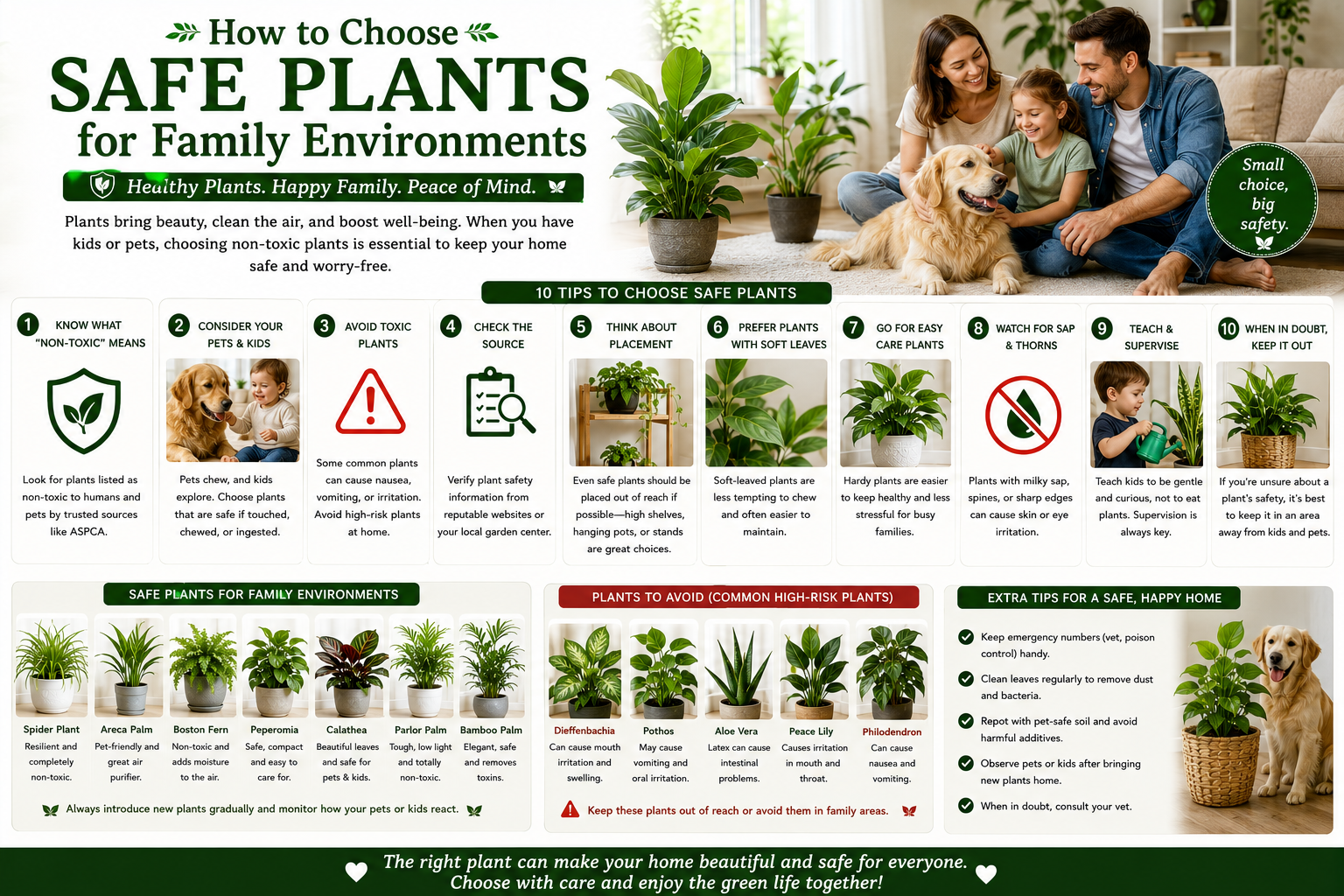
Bringing plants into a home shared with young children and pets introduces a consideration that plant lovers without dependents rarely need to think about: toxicity. A significant number of popular and widely available houseplants contain compounds that are harmful — sometimes seriously so — when ingested by children or animals who may be attracted to their colorful foliage, interesting textures, or tempting berries. Choosing plants that are genuinely safe for all members of the household, or positioning potentially toxic plants in accessible locations, is a straightforward precaution that allows everyone in the family to enjoy a beautiful plant-filled home without risk.
Understanding Plant Toxicity
Plant toxicity exists on a spectrum from plants that cause mild, temporary irritation if touched or ingested to those that cause serious systemic harm requiring immediate medical or veterinary attention. Most commonly kept houseplants fall into the mild to moderate category — they contain calcium oxalate crystals, irritating saps, or mildly toxic alkaloids that cause oral irritation, excessive salivation, vomiting, or skin irritation if contacted or eaten in typical quantities, but are unlikely to cause lasting harm in otherwise healthy adults. However, children and small pets, with their significantly lower body weight and different metabolic processes, can react more seriously to the same plant compounds that cause only mild symptoms in adults.
Dogs and cats are the household companions most frequently affected by plant ingestion, both because they explore with their mouths more readily than most humans and because the metabolic differences between species mean that some compounds harmless to humans are genuinely dangerous to animals. Lilies in particular are well-documented as severely toxic to cats — even small amounts of pollen transferred from a lily onto a cat’s coat and ingested during grooming can cause acute kidney failure. Understanding the specific risks that different plant species present to the specific animals and children in your home allows you to make informed, proportionate decisions about which plants to keep and how to position them.
The difference between toxic and harmful
Not every plant that appears on a toxicity list poses a genuinely serious threat to children or pets in realistic quantities of exposure. Context matters enormously — a plant that requires a child to eat several large handfuls of leaves to produce serious symptoms presents a very different practical risk from one where a single leaf causes dangerous toxicity. The most important considerations are the specific mechanism of harm, the quantity required to cause serious symptoms, and the age, size, and behavior of the child or animal in question. Very young children who mouth everything they encounter, teething puppies who chew indiscriminately, and cats who may groom pollen from their coats all represent higher-risk scenarios than older children who understand not to eat plants and well-trained adult dogs.
Truly Safe Plants for Homes With Children and Pets
The good news is that many of the most beautiful, easy-care, and popular houseplants are genuinely non-toxic to children and pets. Spider plants are universally recognized as safe and have the additional advantage of being nearly impossible to kill, producing cascading offsets that children find charming and can handle without concern. Boston ferns are non-toxic and add lush, beautiful foliage to any space while presenting no risk to curious small hands or paws. African violets are safe, produce beautiful flowers, and are compact enough for shelves and windowsills where children rarely have easy access.
Orchids — specifically Phalaenopsis, the most widely available type — are non-toxic and among the most beautiful of all commonly available houseplants, making them an outstanding choice for family homes. Peperomias, of which there are hundreds of varieties in a remarkable range of forms and colors, are universally non-toxic and provide excellent visual variety without any safety concerns. Bromeliads are similarly safe and bring an exotic, architectural quality to family spaces that is genuinely striking.
- Spider plant — non-toxic to children, cats, and dogs, nearly impossible to kill
- Boston fern — completely safe for all household members, beautiful hanging display
- African violet — non-toxic, produces beautiful flowers, stays compact on shelves
- Orchid — non-toxic, extraordinarily beautiful, long-lasting blooms
- Peperomia — safe for children and pets, enormous variety of forms and colors
- Bromeliad — non-toxic, architectural, colorful, low-maintenance
- Calathea — non-toxic, stunning foliage patterns, suitable for shadier family spaces
- Parlor palm — completely safe, elegant, tolerates indoor conditions well
Managing Plants That Are Toxic but Beloved
If you already have plants in your home that appear on toxicity lists — pothos, philodendrons, peace lilies, and many others are popular and beautiful but contain compounds that cause oral irritation — there is no need to immediately remove them. The practical risk they present can be managed through thoughtful positioning rather than elimination. Place toxic plants in locations that are genuinely inaccessible to children and pets: on high shelves, in rooms that are closed when children or animals are unsupervised, on surfaces above jumping height for cats, or in hanging planters positioned well above reach. Monitor small children and pets in rooms with plants initially to assess their interest in them, and respond to any persistent nibbling behavior with repositioning rather than assuming a one-time interaction will not be repeated.
Common Mistakes to Avoid
- Assuming all houseplants are either toxic or safe without checking — Toxicity varies enormously between plant species. Check each plant individually using a reliable reference rather than assuming all plants in a room are equally safe or equally hazardous.
- Removing all plants from a family home out of excessive caution — The benefits of indoor plants for family wellbeing are significant and well-documented. The risk from common houseplants in most family environments, managed with appropriate positioning, is low enough that removing all plants is a disproportionate response.
- Relying on online toxicity lists without verifying their accuracy — Plant toxicity information online varies significantly in accuracy and specificity. For the most reliable information, consult the ASPCA’s comprehensive animal poison control database for pet-related concerns and poison control resources for child-related concerns.
- Positioning toxic plants at pet height with trailing stems that touch the floor — A trailing pothos on a high shelf becomes an accessible plant if its stems trail down to a surface that a cat or dog can reach. Trim trailing stems or reposition plants so that no foliage is accessible from below.
- Not teaching children about plant safety as they grow — As children develop past the age of indiscriminate mouthing, education about not eating plants becomes an effective complementary safety measure. A child old enough to understand the instruction should be taught clearly that plants are not food and should not be tasted without an adult’s explicit confirmation that they are edible.
Frequently Asked Questions
Q: Is pothos safe for cats and dogs?
A: Pothos contains calcium oxalate crystals that cause oral irritation, excessive drooling, and vomiting if ingested by cats or dogs. While it is unlikely to cause life-threatening harm in typical quantities, it should be considered toxic to pets and positioned out of reach of animals that are inclined to chew on plants. It is equally unsuitable for young children who might mouth the leaves.
Q: What are the most dangerous plants to keep in a home with cats?
A: True lilies — including Easter lily, tiger lily, Asiatic lily, and daylily — are the most seriously dangerous plants for cats and should not be kept in any home with cats. Even small exposures to pollen can cause acute kidney failure. Other seriously hazardous plants for cats include sago palm, cyclamen, azalea, rhododendron, and oleander. The ASPCA maintains a comprehensive and regularly updated list of toxic plants for cats that is the most reliable reference for specific plant-by-plant guidance.
Q: My child touched a toxic plant — what should I do?
A: For most mildly toxic houseplants, skin contact without ingestion causes at most mild irritation that resolves with washing. Rinse the affected area thoroughly with soap and water. If any plant material was ingested, contact your local poison control center immediately with the name of the plant and an estimate of how much was consumed. Do not induce vomiting without medical guidance, as this is not always the appropriate response and depends on the specific plant and quantity involved.