
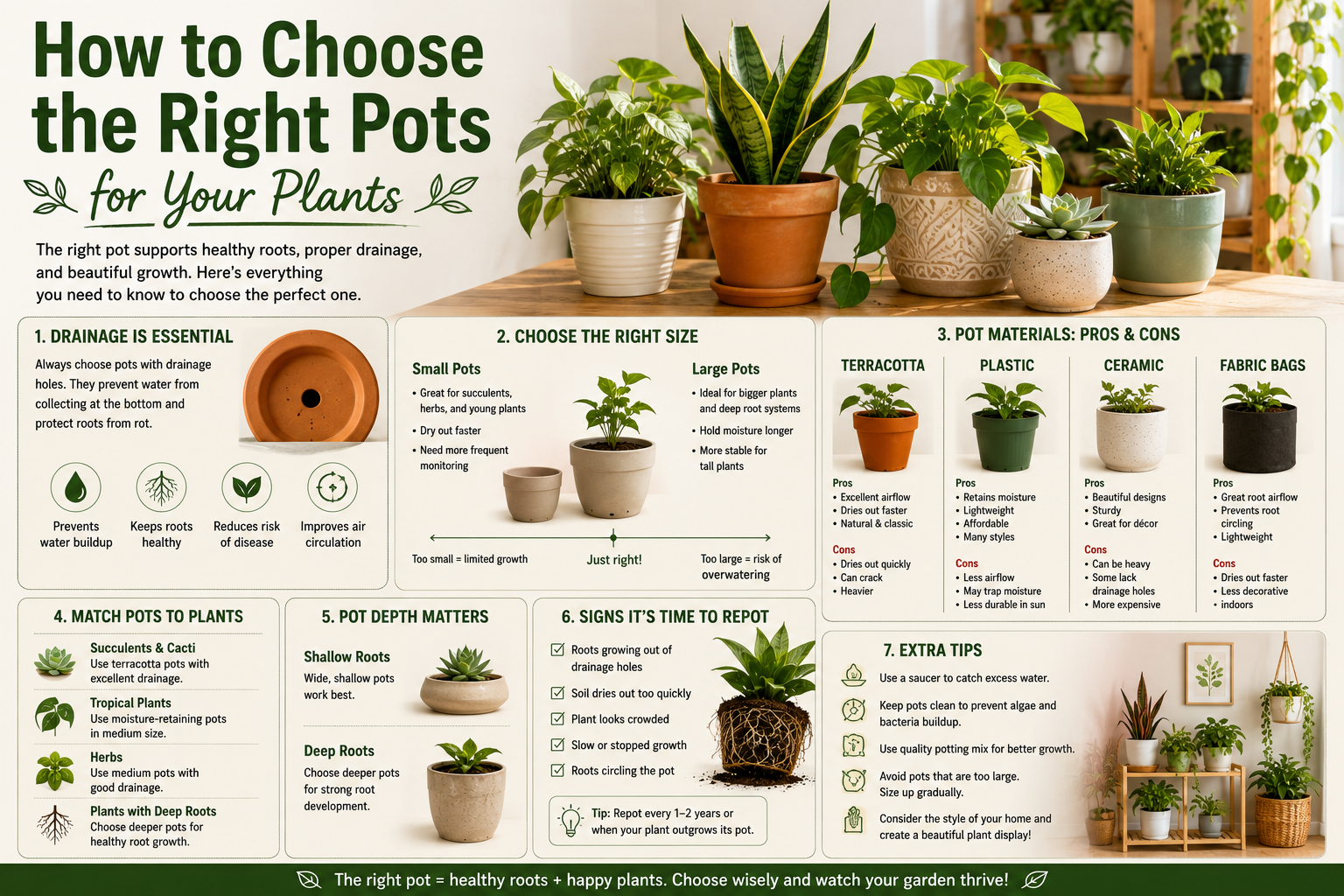
Choosing a pot for your plant seems, at first glance, like a purely aesthetic decision — a matter of matching colors, finding a style that suits your interior, and picking whatever looks most attractive on the shelf. In reality, the container a plant lives in is one of the most consequential care decisions you make, directly influencing root health, moisture levels, drainage efficiency, temperature regulation, and how often you need to water. Getting it right from the beginning creates the physical conditions that allow a plant to thrive for years. Getting it wrong can undermine even the most attentive care routine, producing persistent problems that trace back not to how you water or feed but to the container the plant lives in.
Why the Right Pot Makes Such a Significant Difference
A plant spends its entire life inside its container, and the properties of that container determine almost everything about the growing environment that surrounds its root system. A pot that retains too much moisture creates conditions where roots suffocate in saturated soil, leading to the root rot that silently kills plants before any visible above-ground symptoms develop. A pot that drains too rapidly for a moisture-loving plant forces constant watering and creates drought stress between sessions. A pot that is too large holds excess soil volume that stays wet far longer than the small root system can process, while a pot that is too small restricts root expansion and causes the plant to become root-bound within months.
Understanding these dynamics transforms pot selection from a decorative choice into a genuinely horticultural one — and it dramatically improves the long-term performance of every plant in your collection. The most beautiful pot in the garden center is worth nothing if its material, size, or drainage properties are wrong for the plant growing in it.
The one feature no pot should ever lack
Drainage holes are the single non-negotiable feature of any pot used as a permanent home for a living plant. Without drainage, excess water has nowhere to go after watering, and it accumulates at the base of the container where roots eventually reach it and begin to rot. No matter how carefully you water, no matter how drought-tolerant the plant, the absence of drainage holes creates conditions that will eventually damage or kill the roots growing in that container. If you love a decorative pot that has no drainage holes, use it as a cachepot — an outer decorative sleeve — and place the plant inside a plain nursery pot with drainage that fits neatly inside. Water the inner pot, allow it to drain fully over a sink, and return it to its decorative cover. This approach gives you the aesthetic you want without sacrificing the drainage function every plant depends on.
Understanding Pot Materials and Their Properties
The material a pot is made from determines how quickly the soil inside it dries between waterings — a variable that directly affects how often you need to water, how much margin for error your watering routine has, and which plant types will perform best in that container. There is no universally superior pot material; each has genuine strengths and specific applications where it performs best, and matching material to plant type and watering habit is one of the most effective ways to simplify your ongoing plant care.
Terracotta is the material with the longest horticultural history and the most consistent performance across a wide range of plant types. Its porous clay walls allow both moisture and air to pass through, which means soil dries faster than in non-porous containers and roots have continuous access to oxygen through the pot walls as well as through the drainage holes. This makes terracotta the ideal material for drought-tolerant plants — succulents, cacti, Mediterranean herbs, and most plants that are prone to root rot from excess moisture — and also for any plant owner who tends to water more frequently than strictly necessary, as the faster drying rate provides a natural buffer against overwatering. The trade-off is that terracotta requires more frequent watering for moisture-loving plants, is heavier than plastic alternatives, and can crack in freezing temperatures when left outdoors with wet soil.
Plastic, ceramic, and fabric options compared
Plastic pots retain moisture significantly longer than terracotta because their non-porous walls prevent lateral evaporation and limit the plant’s water loss to the drainage holes and soil surface alone. This moisture-retaining property makes plastic an excellent choice for tropical foliage plants, ferns, peace lilies, calatheas, and other moisture-loving species that would dry out too quickly in terracotta. Plastic is also lighter, more affordable, and more forgiving of frequent watering — qualities that make it particularly practical for beginner gardeners building their first collections. Ceramic pots, whether glazed or unglazed, fall between terracotta and plastic in their moisture retention. Glazed ceramic is close to plastic in its non-porous properties and suits moisture-loving plants well, while unglazed ceramic behaves more similarly to terracotta. Fabric grow bags have earned a dedicated following among vegetable and herb growers for their extraordinary root aeration — the air-pruning effect of fabric walls prevents the root circling that occurs in rigid containers and promotes a dense, branching root system that supports vigorous above-ground growth.
Choosing the Right Pot Size
Pot size is perhaps the most commonly misunderstood aspect of container selection, with two opposing mistakes made in roughly equal measure. The first is choosing a pot that is too small for the plant’s root system, which creates root-bound conditions that restrict water and nutrient uptake and cause the stalled growth, rapid soil drying, and roots emerging from drainage holes that indicate a plant that has outgrown its home. The second — and arguably more harmful — mistake is choosing a pot that is too large, under the assumption that more space is always better. An oversized pot holds far more soil than the plant’s root system can draw moisture from, leaving large volumes of wet soil sitting around a small root mass and creating exactly the saturated conditions that lead to root rot.
The practical guideline for pot sizing is straightforward: choose a pot that allows approximately two to five centimeters of space between the outer edge of the root ball and the inner wall of the pot on all sides. This gives roots room to expand without surrounding them with excess soil volume they cannot efficiently process. When repotting a plant that has outgrown its current container, move up only one pot size at a time — typically two to four centimeters larger in diameter — rather than jumping to a dramatically larger container in an attempt to reduce future repotting frequency.
Matching Pot Type to Plant Type
The most reliable approach to pot selection is to start with the plant’s needs rather than with the pot’s appearance. Different plant categories have genuinely different container requirements, and matching these requirements correctly from the start creates a self-regulating growing environment that requires less intervention from you rather than more.
Succulents and cacti need fast-draining soil in pots that accelerate drying between waterings — terracotta in a small to medium size with a cactus potting mix is the classic and most consistently successful combination for these plants. Tropical foliage plants like pothos, philodendrons, peace lilies, and rubber plants prefer containers that retain moderate moisture — plastic or glazed ceramic in a size appropriate to their current root ball suits them well. Herbs grown for culinary use benefit from containers that balance drainage with moisture retention, placed in the brightest available position — medium terracotta or plastic pots both work, with the choice depending on how consistently you are able to water. Deep-rooted plants like snake plants, larger dracaenas, and most vegetables need pots with sufficient depth for their root systems — choosing a pot that is wide but shallow for a deep-rooted plant restricts its development just as effectively as choosing one that is too small in diameter.
- Succulents and cacti — small to medium terracotta with cactus mix, excellent drainage essential
- Tropical foliage plants — plastic or glazed ceramic, moderate moisture retention, size matched to root ball
- Mediterranean herbs — terracotta with good drainage, positioned in maximum available sunlight
- Moisture-loving plants — plastic or ceramic, avoid terracotta which dries too quickly for their needs
- Deep-rooted plants — tall, deep containers that accommodate root expansion without circling
- Vegetables and productive plants — fabric grow bags or large plastic containers for maximum root aeration
Decorative Pots Without Sacrificing Plant Health
The tension between choosing pots that look beautiful and choosing pots that function correctly for plant health is entirely resolvable, and understanding how to resolve it removes one of the most common sources of frustration in indoor plant care. The cachepot system — using a functional inner nursery pot with drainage inside a beautiful outer decorative container — gives you complete freedom in your decorative choices without compromising drainage. Nearly any decorative vessel can serve as a cachepot: ceramic urns, wicker baskets, vintage tins, stone troughs, wooden boxes. The plant lives in a practical inner pot and the decorative outer vessel provides the aesthetic without influencing the growing conditions.
When styling plants decoratively throughout a home, visual cohesion in pot choice creates a sense of intentional design that makes even a modest plant collection look carefully curated. Choose two or three complementary materials and stick to them throughout a room — all terracotta, all matte white ceramic, or a combination of natural terracotta and woven basket cachepots creates a unified aesthetic that feels designed rather than accumulated. Vary the sizes of containers deliberately, from large statement pots on the floor through medium containers on surfaces to small pots for trailing plants in hanging positions, to create the layered, varied composition that makes a plant display visually compelling from every angle.
Knowing When to Repot
Even the best-chosen pot eventually needs to be replaced as the plant inside it grows. Recognizing when a plant has outgrown its container and responding promptly with a move to the next appropriate size is one of the most impactful regular maintenance interventions available in plant care. A root-bound plant — one whose roots have filled the available pot space and are circling, emerging from drainage holes, or visibly crowding the soil surface — cannot grow at its natural rate regardless of how well light, watering, and feeding are managed, because the physical constriction of its root system limits every other aspect of its performance.
The clearest signs that a plant needs repotting are roots emerging in quantity from the drainage holes, roots circling visibly at the soil surface, soil that dries out completely within twenty-four hours of thorough watering, and growth that has stalled entirely during the active growing season. Spring is the ideal time to repot, as plants entering their natural growth surge have the energy to recover quickly from the disturbance and explore their new growing space with maximum vigor. Avoid repotting in autumn or winter when reduced metabolic activity makes recovery from root disturbance slow and potentially stressful.
Common Mistakes to Avoid
- Choosing pots without drainage holes for living plants — Drainage is non-negotiable for root health. Use any pot you love as a decorative cachepot over a functional inner pot with drainage, but never plant directly into a container with no way for excess water to escape.
- Selecting pots that are much larger than the current root ball — Oversized pots hold excess moist soil around small root systems and create ideal conditions for root rot. Move up only one size at a time when repotting.
- Using the same pot material for all plant types — Terracotta is ideal for drought-tolerant plants but dries too quickly for moisture-loving species. Plastic retains moisture well for tropicals but can cause problems for succulents. Match material to plant type rather than choosing one material for everything.
- Never cleaning or maintaining pots between uses — Pots accumulate mineral salt deposits, algae, and potentially pathogenic residue over time. Wash reused pots thoroughly with hot water and a dilute bleach solution before planting a new specimen to prevent the transfer of disease or pests from a previous plant.
- Leaving root-bound plants in the same container for years — A severely root-bound plant is under constant physical and physiological stress. Check drainage holes annually and repot promptly when roots are clearly constrained, rather than waiting until the plant shows serious decline symptoms.
Frequently Asked Questions
Q: Can I drill drainage holes in a pot that does not have any?
A: Yes, and for pots you genuinely love it is almost always worth the effort. Ceramic and terracotta pots can be drilled with a diamond-tipped or masonry drill bit — work slowly at low speed with a few drops of water at the drilling point to cool the bit and prevent cracking. Plastic pots are even easier to modify with a standard drill bit or a heated skewer. The alternative cachepot approach — using the pot as a decorative outer sleeve over an inner drainage pot — is equally effective and requires no tools.
Q: How do I know when a pot is the right size for my plant?
A: Remove the plant from its current container and look at the root ball directly. A well-sized new pot allows roughly two to five centimeters of space between the outer edge of the root ball and the inner wall of the pot on all sides — enough room for the roots to expand without being surrounded by excess soil volume. If the roots are tightly circling or have filled the current pot completely, the plant is ready to move up one size. If there is still significant space between the roots and the pot walls, the current pot remains appropriate.
Q: Is it better to have one large pot or several smaller ones for multiple plants?
A: Individual pots for each plant are almost always the better choice, because they allow you to match each pot’s material, size, and drainage properties to the specific needs of the plant growing in it. A shared container forces all plants in it to receive identical watering — which is a serious problem if you are combining plants with different moisture requirements, as the watering frequency appropriate for one will be too much or too little for another. If you want the aesthetic of multiple plants in a single container, choose plants with genuinely identical care needs and be prepared to monitor the arrangement closely for any signs of stress in the less-suited members of the combination.