
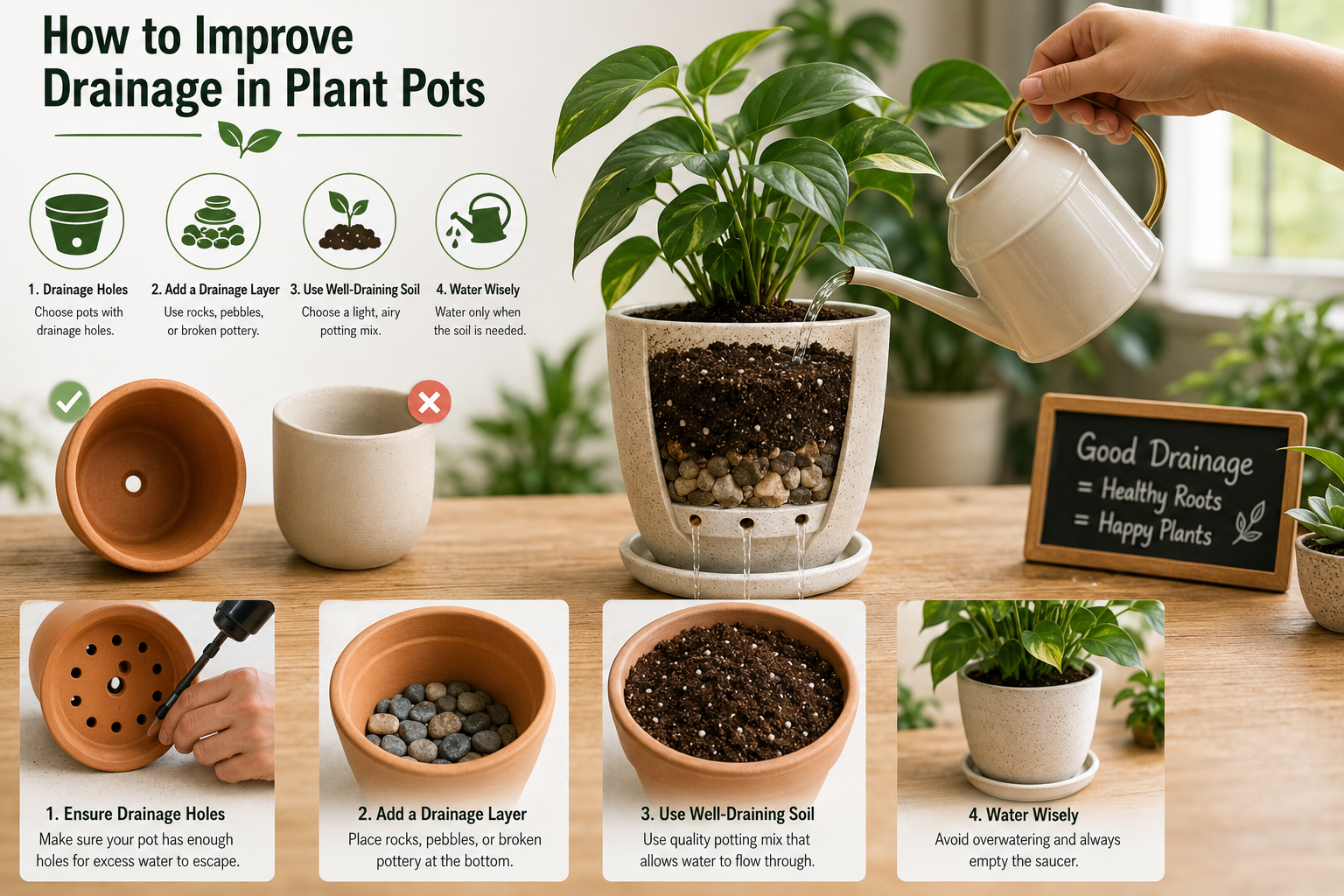
Poor drainage is one of the most underestimated problems in plant care, and it is responsible for more plant deaths than almost any other single factor. When water cannot escape a pot efficiently, it accumulates around the roots, cutting off their oxygen supply and creating the perfect conditions for root rot and fungal disease. The encouraging news is that drainage problems are entirely preventable and, in most cases, easy to fix once you understand what causes them and what practical steps you can take to correct them.
Why Drainage Matters So Much for Plant Health
Plant roots need two things to function properly: water and oxygen. When soil becomes waterlogged, the tiny air pockets between soil particles fill with water, leaving no room for the oxygen that roots depend on for cellular respiration. Without oxygen, roots cannot absorb water or nutrients efficiently — a cruel irony that means a plant sitting in a pool of water is effectively dying of thirst and starvation at the same time. Within days of waterlogging, roots begin to suffocate, and within a week or two, fungal pathogens move in and begin the process of rot.
Good drainage solves this problem entirely by ensuring that excess water moves through the soil quickly and exits through the bottom of the pot, leaving the soil moist but never saturated. The roots stay hydrated between waterings while always having access to the oxygen they need. The difference in plant health between a pot with excellent drainage and one with poor drainage is dramatic and becomes visible within weeks of making improvements.
Signs that your pot has a drainage problem
There are several reliable indicators that your plant is suffering from inadequate drainage. Soil that remains visibly wet for more than three or four days after watering is a clear warning sign. A sour or musty smell coming from the pot indicates that anaerobic bacteria are active in waterlogged soil. Leaves that yellow and droop despite regular watering often point to roots that are struggling in saturated conditions. If you remove the plant from its pot and find roots that are brown, mushy, or slimy rather than firm and white, drainage has already caused root damage that needs to be addressed immediately.
Choosing the Right Pot From the Start
The single most impactful decision you can make for drainage is choosing a pot with adequate drainage holes. This sounds obvious, but the marketplace is filled with beautiful decorative pots that have no holes at all, and many plant owners sacrifice function for aesthetics without realizing the consequences. Every pot that will be used as a permanent home for a plant must have at least one drainage hole at its base, and larger pots benefit from multiple holes to ensure water can escape quickly across the entire root zone.
The material of the pot also significantly affects how quickly soil dries between waterings. Terracotta pots are porous and allow moisture to evaporate through their walls as well as through the drainage holes, making them ideal for plants that prefer drier conditions such as succulents, cacti, Mediterranean herbs, and many tropical plants with thick, fleshy roots. Plastic and glazed ceramic pots retain moisture much longer because their walls are non-porous, which suits moisture-loving plants like ferns, calatheas, and peace lilies but can cause problems for plants that prefer to dry out between waterings.
What to do with decorative pots without holes
If you love the look of a decorative pot that has no drainage holes, the best approach is to use it as a cachepot — an outer decorative cover — and place your plant inside a plain nursery pot with drainage holes that fits neatly inside. This gives you the aesthetic you want while maintaining proper drainage function. After watering, simply remove the inner nursery pot, allow it to drain fully over a sink, and then return it to the decorative outer pot. Never allow water to collect in the bottom of a cachepot, as the roots will eventually reach down into that standing water and begin to rot.
Improving the Potting Mix for Better Drainage
Even a pot with perfect drainage holes will have drainage problems if the potting mix it contains retains too much moisture. Standard all-purpose potting mixes are formulated to hold moisture for a relatively long time, which suits a wide range of plants but can be problematic for succulents, cacti, orchids, and many Mediterranean plants that evolved in fast-draining, mineral-rich soils with very little organic matter.
Improving the drainage of a potting mix is straightforward and inexpensive. The most common amendment is perlite — small, lightweight white particles of volcanic glass that create large air pockets in the soil, dramatically improving both drainage and aeration. For most houseplants that prefer good drainage, mixing standard potting soil with twenty to thirty percent perlite by volume creates an excellent general-purpose medium. For succulents, cacti, and other highly drought-tolerant plants, increase the perlite ratio to forty or fifty percent, or use a dedicated cactus and succulent mix.
- Perlite — lightweight volcanic glass that improves drainage and aeration, suitable for almost all plants
- Coarse horticultural grit or sand — adds weight and excellent drainage, ideal for succulents and cacti
- Bark chips or orchid bark — creates large air pockets, essential for orchids and epiphytic plants
- Pumice — similar to perlite but heavier and longer-lasting, excellent for drought-tolerant plants
- Coarse coconut coir — improves aeration while retaining some moisture, good for tropical plants
- Activated charcoal — improves drainage in terrariums and closed containers while neutralizing odors
The Drainage Layer Debate: Gravel at the Bottom
For many years, the standard advice for improving pot drainage was to place a layer of gravel, pebbles, or broken pottery shards at the bottom of the pot before adding soil. The logic seemed intuitive — a coarse layer at the base would allow water to pass through quickly and collect below the roots. However, this practice has been largely debunked by horticultural science, and understanding why helps you make better decisions about your pots.
The problem with a gravel layer is related to a concept called the perched water table. Water moving downward through soil does not flow freely into a coarser layer below — instead, it accumulates at the boundary between the two different textures until the finer soil above becomes saturated enough to push the water through. In practical terms, this means a gravel layer at the bottom of a pot actually raises the level of saturated soil, bringing it closer to the roots rather than keeping it away from them. The most effective approach is simply to use a well-draining potting mix throughout the entire pot with good drainage holes at the base.
What actually works at the bottom of the pot
While gravel layers are counterproductive, placing a small piece of mesh, a coffee filter, or a fragment of broken terracotta over the drainage holes before filling the pot with soil is genuinely useful. This prevents fine potting mix from washing out through the holes each time you water while still allowing water to drain freely. It is a small step that keeps your surfaces clean and ensures your drainage holes remain unblocked over time.
Repotting to Fix Compacted, Poorly Draining Soil
Over time, potting mix breaks down and compacts, losing the structure that allows water to move through it freely. Organic matter decomposes, perlite particles break down, and the soil gradually becomes denser and less porous. A pot that drained well when first planted may drain very slowly two or three years later simply because the potting mix has aged and compacted. If your plant is in old potting mix and you are struggling with slow drainage, a complete repot with fresh soil is the most effective solution.
When repotting to improve drainage, take the opportunity to examine the roots thoroughly, remove any that appear rotted or dead, and refresh the entire potting mix rather than simply topping it up. Ensure the new pot has adequate drainage holes, mix fresh potting soil with the appropriate amount of perlite for your specific plant, and water lightly after repotting to help the roots settle into their new medium. Most plants will show noticeable improvement in their overall health within two to four weeks of being moved to fresh, well-draining soil.
Common Mistakes to Avoid
- Using saucers that hold standing water under the pot — Empty saucers after every watering session. Roots will grow down into standing water over time and begin to rot.
- Assuming a pot drains well just because it has holes — Holes can become blocked by compacted soil or root growth. Check periodically that water flows freely through them.
- Adding gravel to the bottom of the pot — As explained above, this raises the saturated zone rather than lowering it. Skip the gravel and improve the potting mix instead.
- Choosing pots that are far too large — Oversized pots hold far more soil than the roots can draw moisture from, leaving large areas of wet soil sitting around a small root system and dramatically increasing the risk of rot.
- Never refreshing old potting mix — Soil older than two years in a pot has typically lost most of its structure and drainage capacity. Repot regularly with fresh mix to maintain good drainage over time.
Frequently Asked Questions
Q: Can I drill drainage holes in a pot that does not have any?
A: Yes, and it is usually straightforward. Ceramic and terracotta pots can be drilled with a masonry or diamond-tipped drill bit — work slowly with gentle pressure and keep the area cool with a little water to prevent cracking. Plastic pots are even easier and can be pierced with a heated skewer or standard drill bit. Adding drainage holes to a pot you love is almost always preferable to growing a plant in a pot without them.
Q: How do I know if my potting mix drains well enough?
A: After watering thoroughly, observe how long the soil takes to stop dripping from the drainage holes and how many days pass before the top inch of soil feels dry. In a well-draining mix, water should flow through within a minute or two of watering, and the surface should feel dry within two to three days in average indoor conditions. If water pools on the surface before being absorbed, or if the soil still feels wet after five or more days, the mix needs more drainage amendment.
Q: Is it possible for a pot to drain too well?
A: Yes, for moisture-loving plants. If your fern, calathea, or peace lily is wilting between waterings even when you water frequently, the potting mix may be draining too fast to keep the roots adequately hydrated. In this case, reduce the perlite ratio in your mix, switch to a plastic pot that retains moisture longer, or add a small amount of coco coir to help the soil hold more water between sessions.