
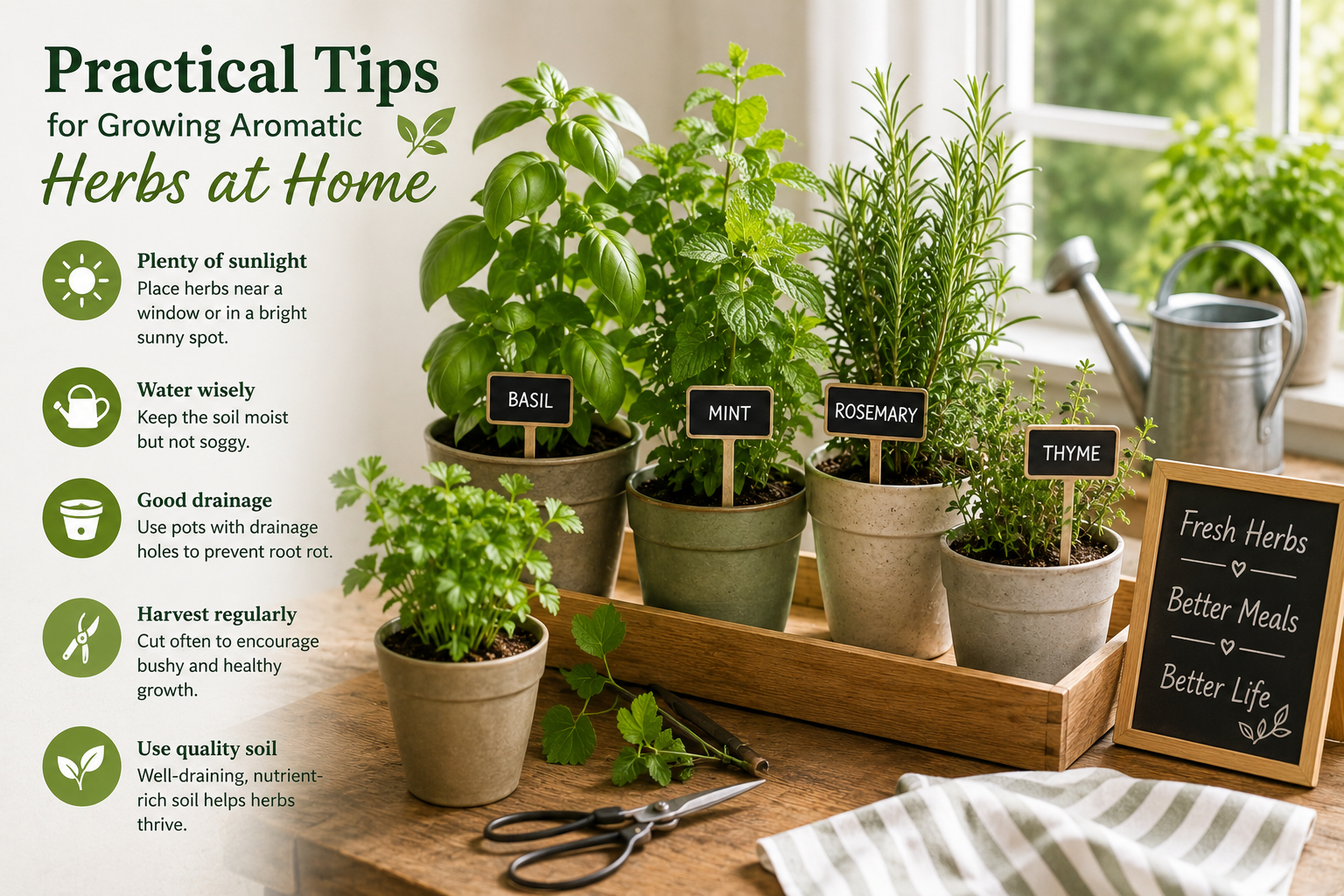
Growing aromatic herbs at home is one of the most satisfying and practical things a plant lover can do. Unlike purely decorative plants, herbs reward you with something tangible every single week — fresh flavors for your cooking, natural fragrances for your living space, and the quiet pleasure of harvesting something you grew yourself. Whether you have a sprawling garden, a sunny balcony, or nothing more than a kitchen windowsill, there is always room for at least a few herb pots, and the learning curve is gentler than most people expect.
Choosing the Right Herbs to Start With
Not all herbs are equally forgiving for beginners, and starting with the wrong varieties can lead to frustration before you even get going. The smartest approach is to begin with herbs that are naturally vigorous, tolerant of imperfect conditions, and useful enough in the kitchen that you will actually harvest them regularly. Regular harvesting, as you will discover, is one of the most important factors in keeping herb plants healthy and productive over the long term.
Basil, mint, rosemary, thyme, chives, parsley, and oregano are the ideal starting points for most home herb growers. Each of these varieties is widely available, relatively inexpensive to buy as young plants, and capable of producing generous harvests throughout the growing season with nothing more than basic care. As your confidence grows, you can branch out into more demanding herbs like cilantro, tarragon, lemongrass, and bay laurel, each of which has its own quirks and rewards.
Matching herbs to your available conditions
Before choosing which herbs to grow, take an honest look at the light available in your home. Mediterranean herbs such as rosemary, thyme, oregano, sage, and lavender evolved in hot, dry, sun-drenched environments and genuinely need at least six hours of direct sunlight per day to thrive. If your home does not have a south-facing window or a sunny outdoor space, these herbs will struggle no matter how well you care for them in every other respect. For lower-light situations, mint, parsley, chives, and lemon balm are much more tolerant of indirect light and will perform reasonably well even in a north-facing kitchen window.
Getting Soil and Containers Right
Herbs are remarkably unfussy about their containers, but they are very particular about two things: drainage and pot size. Almost all culinary herbs, and especially Mediterranean varieties, have an absolute intolerance for waterlogged soil. Their roots evolved in dry, rocky, mineral-rich soils where water drains away rapidly after rain. Recreating these fast-draining conditions indoors is the single most important factor in growing healthy, long-lived herb plants.
Use a potting mix specifically formulated for herbs, or create your own by combining standard multipurpose potting compost with thirty to forty percent perlite or coarse horticultural grit. This mixture drains quickly, never becomes waterlogged, and provides the airy root environment that Mediterranean herbs in particular demand. For mint and parsley, which prefer slightly more moisture, a standard potting mix with a smaller addition of perlite works well.
Pot size and material for herbs
Terracotta pots are the ideal choice for most herbs. Their porous walls allow excess moisture to evaporate naturally, dramatically reducing the risk of overwatering, and their weight provides stability for larger, bushier plants like rosemary and sage. Choose pots that are proportionate to the plant — a pot that is too large holds more soil than the roots can draw moisture from, leading to soggy conditions that rot herb roots quickly. A diameter of fifteen to twenty centimeters is appropriate for most individual herb plants, while a wider, shallower trough pot works beautifully for growing several different herbs side by side.
Light: The Non-Negotiable Requirement
If there is one thing that separates thriving herb plants from struggling ones, it is light. Herbs grown in insufficient light become pale, leggy, and sparse — they stretch toward whatever light they can find, producing long, weak stems with small, widely spaced leaves that have little of the intense flavor and fragrance you are growing them for. The aromatic oils that give herbs their distinctive character are produced in response to bright light and moderate stress, which is why herbs grown outdoors in full sun are almost always more flavorful than those grown indoors.
Position your herb pots in the brightest spot available to you. A south or west-facing windowsill is ideal for most herbs, providing several hours of direct sunlight each day. If your brightest window receives fewer than four hours of direct sun, supplement with a small LED grow light positioned close above the plants and running for twelve to fourteen hours per day. The difference in growth rate and flavor intensity between herbs grown under a grow light and those struggling in low natural light is immediately noticeable.
Watering Herbs Without Overwatering Them
The most common way that home herb growers kill their plants is through overwatering, and it is an easy trap to fall into because herbs that are overwatered often look similar to herbs that need water — both droop and look unhappy. The critical difference is in the soil. Before watering any herb, press a finger into the top inch of the potting mix. If it feels at all moist, wait another day or two. If it feels dry, water thoroughly until it drains from the bottom of the pot, then allow it to drain completely before returning the pot to its saucer.
Never leave herbs sitting in a saucer full of water. Even a centimeter of standing water beneath the pot creates a reservoir of moisture that roots will grow down into, leading to rot at the root tips within days. Empty saucers after every watering without exception. In practice, most Mediterranean herbs in a well-draining mix indoors need watering no more than once or twice a week in summer and once every ten to fourteen days in winter. Mint and parsley will need water more frequently, but even they should never sit in soggy soil.
- Rosemary and thyme — water only when the top two inches of soil are completely dry, roughly every ten to fourteen days indoors
- Basil — prefers consistently moist but never waterlogged soil, check every two to three days
- Mint — enjoys more moisture than most herbs, water when the top inch is dry
- Chives and parsley — keep soil evenly moist but well-drained, water every three to four days
- Oregano and sage — highly drought tolerant, water only when soil is thoroughly dry throughout
- Cilantro — prefers consistent moisture and cool conditions, check soil daily in warm weather
Harvesting to Keep Plants Productive
One of the most counterintuitive things about growing herbs is that the more you harvest, the better they grow. Regular harvesting stimulates plants to produce new shoots and bushy, compact growth. Leaving herbs to grow unpruned, on the other hand, encourages them to put energy into flowering and seed production rather than the leafy growth you want. Once most herbs flower, their leaf production slows dramatically and the flavor of the remaining leaves often becomes bitter or diminished.
Harvest herbs by snipping stems just above a leaf node — the point where a pair of leaves meets the stem. Never remove more than one third of the plant at a single harvest, as taking too much at once stresses the plant and slows recovery. For basil, pinch out any flower buds the moment you see them developing at the tips of stems to keep the plant in its vegetative, leafy phase for as long as possible. For rosemary and thyme, harvest the soft new growth at the tips of stems rather than cutting into old woody growth, which recovers much more slowly.
When and how to prune for long-term productivity
Beyond regular harvesting, most herb plants benefit from a more deliberate pruning session two or three times during the growing season. Cut the plant back by roughly one third of its total height, shaping it into a compact, bushy form and removing any stems that are becoming woody, crossing, or crowding the center of the plant. This hard pruning session encourages a flush of fresh, flavorful new growth and keeps the plant from becoming leggy and open over time. Always prune in the morning when the plant’s essential oils are most concentrated, and avoid heavy pruning in the weeks before or after repotting.
Feeding Herbs for Sustained Growth
Herbs growing in pots need supplemental feeding because the nutrients in potting mix become depleted within a few months of planting. However, herbs respond to fertilizer differently from most houseplants — too much nitrogen produces lush, abundant growth but dramatically dilutes the aromatic oils that give herbs their flavor and fragrance. The goal is to feed enough to sustain healthy, productive growth without pushing the plant into the rank, flavorless growth that excess nitrogen encourages.
Use a balanced liquid fertilizer diluted to half the recommended strength, applied once every three to four weeks during the active growing season of spring and summer. Alternatively, incorporate a small amount of slow-release granular fertilizer into the potting mix at planting time, which will feed the plant gradually over several months without the risk of overfeeding. Stop all fertilizing in autumn and winter when herb plants naturally slow their growth and require little additional nutrition.
Common Mistakes to Avoid
- Buying herbs in full flower from the supermarket and expecting them to last — Supermarket herb pots are typically grown quickly under optimal commercial conditions and are not designed for long-term home growing. Pot them on into larger containers with better-draining soil and cut them back by a third immediately to encourage fresh growth.
- Growing Mediterranean herbs in low light — Rosemary, thyme, oregano, and sage need direct sunlight to thrive. Placing them in a dim spot produces weak, flavorless plants that are highly susceptible to disease.
- Watering on a fixed schedule rather than checking the soil — Herb water needs vary enormously by season, pot size, and variety. Always check the soil before watering rather than following a rigid timetable.
- Never harvesting or pruning — Unpruned herbs become leggy, flower quickly, and lose their flavor. Regular harvesting is maintenance, not indulgence.
- Growing incompatible herbs together in one pot — Mint and rosemary, for example, have completely opposite watering needs. Group herbs with similar requirements together and keep moisture-lovers separate from drought-tolerant varieties.
Frequently Asked Questions
Q: Why does my basil keep wilting even when I water it regularly?
A: Basil wilting despite regular watering is almost always caused by one of two things: cold temperatures or overwatering leading to root rot. Basil is extremely cold-sensitive and will wilt dramatically if exposed to temperatures below fifteen degrees Celsius, even briefly. Check that it is not near a cold window or air conditioning vent. If temperatures are fine, examine the roots for signs of rot and repot into fresh, well-draining soil if needed.
Q: Can I grow herbs indoors year-round?
A: Yes, with adequate light. Most herbs can be grown indoors throughout the year provided they receive sufficient light — either from a very bright south-facing window or supplemented with a grow light. Growth will naturally slow in winter, but most common culinary herbs will continue to produce harvestable growth year-round under the right conditions. Basil is the exception, as it genuinely struggles in the low light and cool temperatures of winter and is best treated as a seasonal plant.
Q: How do I stop mint from taking over my other plants?
A: Mint is famously invasive and will spread aggressively through any shared container, crowding out neighboring plants. The simplest solution is to always grow mint in its own dedicated pot, kept separate from your other herbs. If you want to include mint in a mixed herb planter, sink the entire mint pot into the planter soil rather than planting it directly — this contains the roots and prevents them from spreading into neighboring plants.