
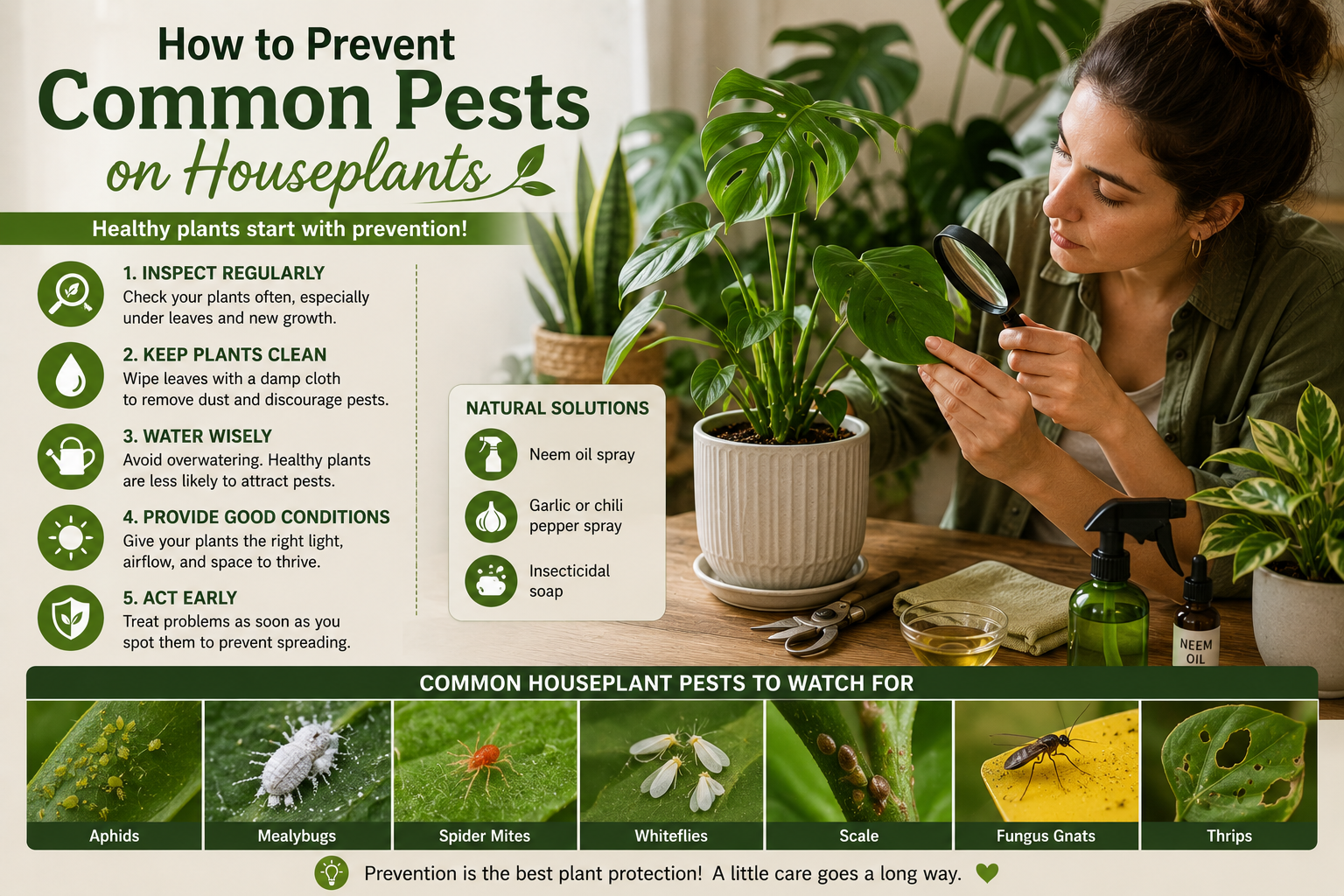
Discovering pests on your houseplants is one of the most disheartening experiences in plant care. You have invested time, attention, and genuine care into your plants, and finding tiny insects quietly undermining all of that work can feel both frustrating and overwhelming. The encouraging truth is that houseplant pest problems are almost always preventable with the right habits, and even established infestations can be treated effectively once you know what you are dealing with. Understanding the most common houseplant pests, how they arrive, and what makes your plants vulnerable to them is the foundation of a pest-free plant collection.
Why Houseplants Get Pests
Pests do not appear out of nowhere — they arrive in your home through specific routes and thrive under specific conditions. The most common entry points are new plants brought home from nurseries or garden centers, cut flowers from florists, soil bags that have been stored improperly, and windows or doors left open in warm weather. A single infested plant introduced into a collection of healthy ones can spread pests to every plant in the room within weeks if not caught quickly, which is why quarantine procedures for new plants are one of the most important preventive habits you can adopt.
Certain environmental conditions also make plants significantly more susceptible to pest attack. Stressed plants — those dealing with overwatering, underwatering, poor light, or root problems — are far more vulnerable to pest infestation than vigorous, healthy specimens. Dry indoor air is a particular risk factor for spider mites, which thrive in warm, arid conditions. Overly moist soil attracts fungus gnats. Keeping your plants healthy and your growing environment well-managed is your most powerful long-term pest prevention strategy.
The most common houseplant pests and how to identify them
Spider mites are among the most widespread houseplant pests, particularly in dry indoor environments during winter. They are tiny and typically reveal their presence through fine webbing between leaves and stems, combined with a stippled or dusty appearance on the upper leaf surface. Mealybugs appear as white cottony clusters in leaf joints and along the undersides of leaves. Scale insects look like small brown bumps attached to stems and leaf undersides, easily mistaken for natural plant features until you notice the plant declining around them.
Quarantine Every New Plant Without Exception
The single most effective pest prevention measure available to any houseplant owner is quarantining every new plant for two to four weeks before introducing it to your existing collection. Place new arrivals in a separate room, away from all your other plants, and inspect them thoroughly twice a week during the quarantine period. Check the undersides of every leaf, examine stem joints and the soil surface, and look for any signs of pest activity or unusual markings. If the plant remains clean throughout the quarantine period, it is safe to introduce to your collection.
This one habit alone prevents the vast majority of houseplant pest infestations. Most plant owners who struggle repeatedly with pests have a collection that lacks this protective barrier — every new plant goes straight onto the shelf next to existing ones, and any pests it carries immediately have access to every plant in the room.
Regular Inspection: Catching Problems Before They Escalate
Even with perfect quarantine habits, pests can occasionally establish themselves through other routes. Regular, thorough inspection of your entire plant collection is the practice that catches these cases before they become serious. Set aside a few minutes during your weekly plant care routine specifically for pest inspection, and do it systematically rather than casually glancing at the tops of leaves as you pass by.
Turn leaves over and examine their undersides, which is where the majority of houseplant pests prefer to feed and hide. Look closely at stem joints, the base of leaf clusters, and the soil surface. Use a magnifying glass if needed. Pay particular attention to plants that are already under any kind of stress, as these are the most likely first targets for opportunistic pests.
- Spider mites — fine webbing and stippled leaf surfaces, worst in dry conditions
- Mealybugs — white cottony clusters in leaf joints and stem crevices
- Scale insects — small brown bumps on stems and leaf undersides
- Fungus gnats — tiny flies around soil surface, larvae damage roots in moist compost
- Aphids — soft-bodied insects clustering on new growth and flower buds
- Thrips — tiny fast-moving insects causing silvery streaking on leaf surfaces
- Whitefly — small white flying insects that rise in clouds when plants are disturbed
Creating an Environment That Discourages Pests
Many troublesome houseplant pests have specific environmental preferences you can work against. Spider mites thrive in hot, dry conditions — raising humidity around your plants makes the environment significantly less attractive to them. Fungus gnats breed exclusively in moist soil — allowing the top inch or two of soil to dry thoroughly between waterings eliminates the conditions they need to reproduce. Good air circulation around your plants discourages the fungal diseases and moisture-loving pests that thrive in still, humid microclimates between densely packed leaves.
Keeping your plants clean is another powerful environmental measure. Wipe leaves regularly with a damp cloth, remove dead leaves and debris from the soil surface promptly, and keep the area around your plants tidy. A clean growing environment is a less hospitable one for the pests you want to keep out.
Using neem oil as a preventive treatment
Neem oil, derived from the seeds of the neem tree, is one of the most versatile and plant-safe pest deterrents available. A diluted neem oil spray applied to all leaf surfaces, including the undersides, every two to four weeks during the growing season creates a protective coating that deters a broad range of common pests from establishing on your plants. It is non-toxic to humans, pets, and beneficial insects when used correctly, making it an ideal preventive treatment for an indoor plant collection.
Common Mistakes to Avoid
- Skipping quarantine for new plants — This single omission is responsible for the majority of houseplant pest infestations. Never skip it, regardless of how healthy the new plant appears.
- Treating only once and assuming the problem is solved — Most pest treatments do not kill eggs. Repeat treatments every five to seven days for three to four weeks to break the reproductive cycle completely.
- Using chemical pesticides as a first resort — Strong chemical pesticides kill beneficial insects alongside pests. Start with the gentlest effective treatment — manual removal, insecticidal soap, or neem oil — and escalate only if these fail.
- Ignoring the soil as a pest habitat — Many pest species spend part of their life cycle in the soil. Treat the growing medium as well as the plant when dealing with fungus gnats and root mealybugs.
- Keeping heavily infested plants at the expense of the collection — If a plant has a severe, persistent infestation that puts the rest of your collection at risk, the most responsible decision is to discard it.
Frequently Asked Questions
Q: How do I get rid of fungus gnats permanently?
A: Allow the top two inches of soil to dry completely between waterings — this breaks the reproductive cycle by eliminating the moist conditions larvae need. Yellow sticky traps catch adult flies and reduce their numbers quickly. For severe infestations, a soil drench of Bacillus thuringiensis var. israelensis eliminates larvae within the soil effectively and is harmless to plants and people.
Q: Are there plants that naturally repel pests?
A: Several plants produce compounds that deter certain pest species. Lavender, basil, mint, and rosemary all have strong fragrances that repel aphids and other soft-bodied insects. Marigolds planted among vegetables are well-documented as deterrents for a range of common garden pests.
Q: Can I use dish soap to treat houseplant pests?
A: A very dilute solution of plain dish soap and water can be effective against soft-bodied pests when applied directly. However, dish soap can damage leaf surfaces if used too frequently or in too concentrated a form. Purpose-made insecticidal soap is a safer and more reliable alternative specifically formulated to kill pests without harming plant tissue.