
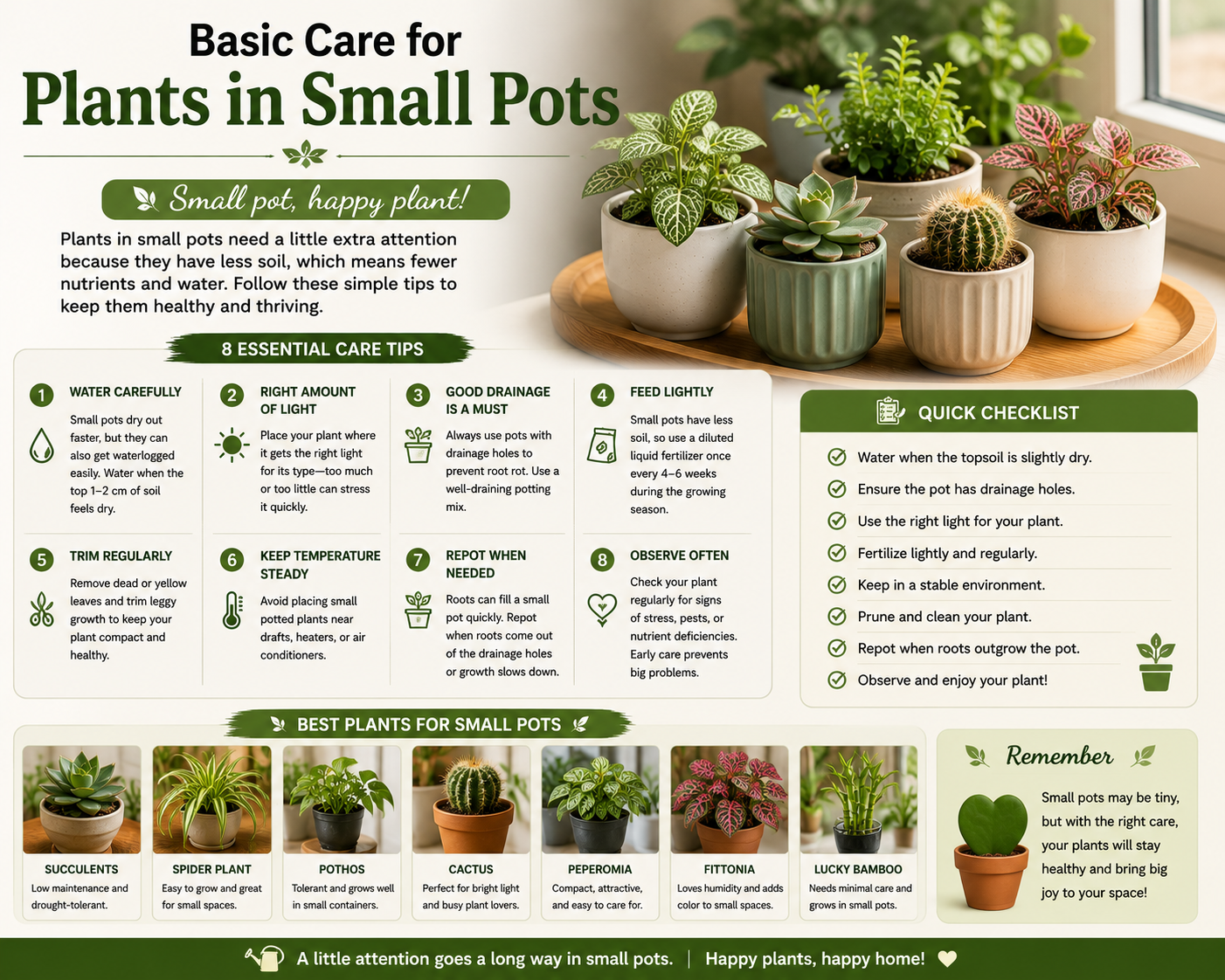
Small pots are everywhere in home gardening — on windowsills, bathroom shelves, kitchen counters, and office desks. They are charming, space-efficient, and perfect for growing compact plants in limited spaces. But small pots also present a set of care challenges that are significantly different from those of larger containers, and many plant owners find that their small-pot plants struggle despite receiving exactly the same care as their larger counterparts. Understanding the specific dynamics of small container growing is the key to keeping these compact plants thriving.
Why Small Pots Behave Differently
The fundamental difference between a small pot and a large one is the ratio of root volume to soil volume. In a small pot, roots fill the available space quickly and have limited access to water and nutrient reserves. The small amount of soil dries out far more rapidly than soil in a larger container, and temperature fluctuations affect the roots more dramatically because there is less thermal mass to buffer against heat and cold. These characteristics create an environment that demands more frequent attention and more precise care than larger pots typically require.
Small pots also become root-bound more quickly. As a plant grows, its roots extend and eventually fill the entire pot, leaving no room for further expansion. A root-bound plant will show it through slowed growth, rapid drying of the soil after watering, roots emerging from the drainage holes, and a visible network of fine roots at the soil surface. Recognizing and responding to these signs promptly is one of the most important skills in small-pot plant care.
Matching plant size to pot size
The most common reason small-pot plants struggle is a mismatch between the size of the plant and the size of the pot. As a general principle, choose a pot that allows roughly two to five centimeters of space between the edge of the root ball and the inner wall of the pot on all sides. This gives the roots room to expand without sitting in an excess of soil that holds more moisture than they can draw from — which is the primary cause of overwatering in small containers.
Watering Small Pots Correctly
Watering small pots correctly is both more critical and more challenging than watering larger containers. The limited soil volume means there is very little buffer between adequately watered and overwatered or underwatered, and the margin for error is correspondingly narrow. Small pots also dry out much faster than large ones, which means that checking soil moisture frequently — daily during hot weather — is not optional but essential.
When you water a small pot, water it thoroughly despite its size. Pour water slowly and steadily until it flows freely from the drainage holes at the base, ensuring the entire root ball is evenly moistened. Then allow the pot to drain completely before returning it to its saucer — never leave a small pot sitting in standing water, as the proportionally large volume of water relative to the small soil amount creates waterlogging conditions very quickly.
- Check soil moisture in small pots daily in summer, every two to three days in winter
- Water thoroughly each time rather than applying small amounts frequently
- Always empty saucers after watering to prevent root-damaging waterlogging
- Use pots with drainage holes without exception
- Consider bottom-watering for very small pots by placing them in a shallow tray of water for twenty minutes
Feeding Plants in Small Containers
The limited soil volume in small pots means nutrients are depleted more rapidly than in larger containers, and each watering session leaches a proportionally larger fraction of the available nutrients through the drainage holes. Plants in small pots therefore need more frequent fertilizing than those in larger containers. During the active growing season of spring and summer, apply a balanced liquid fertilizer every two weeks to small-pot plants — more frequently than the monthly schedule that works well for most large-container plants.
Choose liquid fertilizers over slow-release granules for small pots. Granules work well in the larger soil volumes of big containers but can create uneven nutrient availability in the small amount of soil in a compact pot. Liquid feeds are absorbed immediately and allow you to adjust the dose and frequency precisely in response to how your plant is growing.
Repotting Small-Pot Plants at the Right Time
Because root space is so limited in small containers, knowing when and how to repot is particularly important. The signs that a plant has outgrown its small pot are reliable and easy to read: roots emerging from the drainage holes, roots circling visibly at the soil surface, soil that dries out within twenty-four hours of thorough watering, and stunted or completely stopped growth during the active growing season all indicate it is time to move up to the next pot size.
When repotting, choose a new pot only one size larger — typically two to four centimeters wider in diameter. Going significantly larger in one step is counterproductive in small containers, as excess soil retains moisture the limited root system cannot draw from, increasing the risk of root rot. Use fresh potting mix and water thoroughly after repotting to help the roots settle into their new environment.
Common Mistakes to Avoid
- Watering small pots too infrequently because they look small — Small pots dry out faster than large ones, not slower. Frequency of checking and watering needs to increase as pot size decreases.
- Using pots without drainage holes — In any pot, drainage holes are essential. In small pots, the problem is even more acute because the ratio of potential standing water to soil volume is higher.
- Leaving root-bound plants in small pots indefinitely — A severely root-bound plant cannot grow or absorb nutrients efficiently. Repot promptly when the signs are clear.
- Using heavy moisture-retaining potting mix in small containers — A rich, moisture-retentive mix holds far too much water in small pot volumes. Use a well-draining potting mix amended with perlite.
- Placing small pots in extreme temperature locations — On a south-facing windowsill in summer, small pots can heat to temperatures that damage roots within hours. Move vulnerable small-pot plants away from direct intense sun during the hottest part of the day.
Frequently Asked Questions
Q: How do I know if my small pot has enough drainage?
A: After watering thoroughly, observe how long it takes for water to stop dripping from the drainage holes. In a well-draining small pot, water should flow through within one to two minutes and stop dripping within five to ten minutes. If water pools on the surface before being absorbed, the mix needs more drainage amendment.
Q: Can I grow any plant in a small pot, or are some plants unsuitable?
A: Some plants are simply unsuited to small containers because their root systems require significantly more space. Large shrubs, trees, most vegetables, and any plant described as vigorous will be perpetually unhappy in small pots. Compact, slow-growing varieties specifically bred for container growing are always the best choice — look for words like dwarf, compact, or patio in variety descriptions.
Q: Is it better to have one large plant or several small plants in small pots?
A: Both approaches have merit. A single plant per small pot gives each plant the best growing conditions with no competition for water, nutrients, or root space. Multiple plants in a shared container creates a more lush display but requires more careful management. If combining plants in one small pot, choose varieties with very similar care needs and be prepared to water and feed more frequently than you would with single-plant containers.