
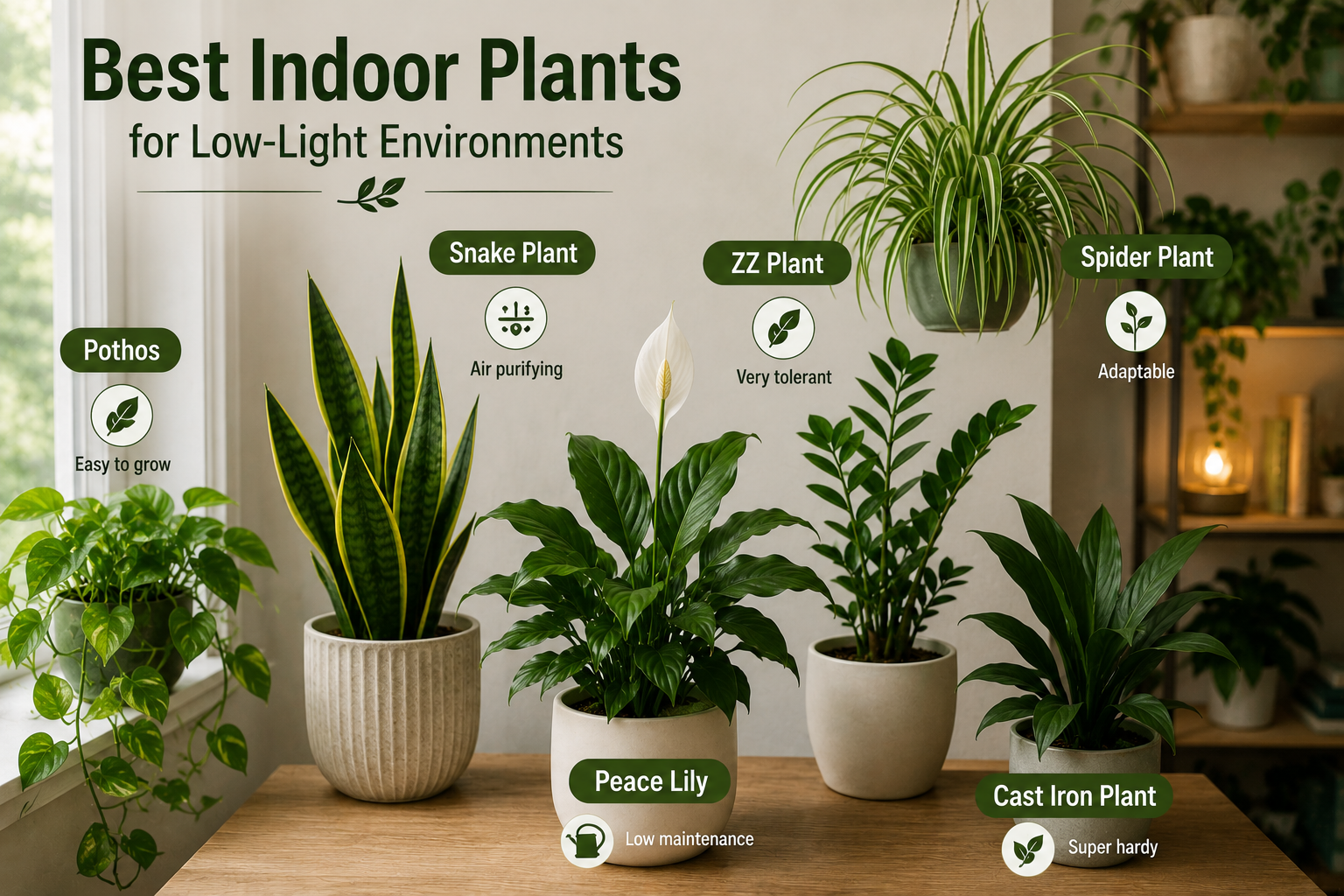
One of the most common frustrations among plant lovers is living in a home that simply does not get much natural light. Dark apartments, north-facing rooms, and spaces surrounded by other buildings can make it feel like growing plants indoors is an impossible ambition. The good news is that nature has already solved this problem for you. A remarkable number of plants have evolved specifically to thrive in low-light conditions, growing naturally on forest floors and in dense jungle canopies where direct sunlight rarely reaches. These plants are not just survivors — many of them are genuinely beautiful, and some of the most elegant and popular houseplants in the world belong to this category.
What Low Light Actually Means
Before choosing plants for a dim space, it helps to understand what low light actually means in practical terms, because the phrase is often misunderstood. Low light does not mean no light. Every plant needs some light to photosynthesize and survive, and a completely dark room with no windows will eventually kill even the most shade-tolerant species. What low light describes is an environment where no direct sunlight enters, where the space feels dim to the human eye, and where a piece of white paper held up at midday produces only a faint or barely visible shadow.
In practical terms, low-light conditions are found in rooms with north-facing windows, in spaces where windows are partially blocked by buildings or trees outside, in areas more than two meters from any window, and in hallways or interior rooms with no windows at all. For spaces with absolutely no natural light, supplementing with a grow light is necessary regardless of how shade-tolerant your chosen plants are — but for rooms with at least some ambient natural light, a well-chosen selection of low-light plants will thrive with minimal intervention.
The difference between low light and no light
It is worth being honest about the limits of even the most shade-tolerant plants. A ZZ plant or a cast iron plant can survive in very dim conditions, but it will grow extremely slowly and may not produce new leaves for months at a time. If you want plants that actively grow, look lush, and produce new foliage regularly, even low-light spaces benefit from being as close to a window as possible — even a north-facing one. Positioning plants within one to two meters of a window, even when that window receives no direct sun, makes a noticeable difference in growth rate and overall plant vitality.
The Best Low-Light Plants for Any Home
The snake plant, or Dracaena trifasciata, is the undisputed champion of low-light indoor gardening. Its upright, sword-shaped leaves in deep green with pale yellow margins are architectural and striking, and the plant is almost aggressively tolerant of neglect, poor light, irregular watering, and dry indoor air. It grows slowly in low light but remains healthy and attractive indefinitely, making it the ideal choice for hallways, offices, and any room where conditions are less than ideal. Water it once every two to three weeks in summer and once a month in winter, and it will ask nothing more of you.
The ZZ plant is equally remarkable. Its deep green, waxy leaflets grow on gracefully arching stems and store water in underground rhizomes that allow the plant to survive extended periods of drought and low light simultaneously. It is one of very few plants that genuinely tolerates both neglect and darkness, making it the top recommendation for rooms with limited windows. The pothos is another outstanding performer — its heart-shaped leaves trail beautifully from shelves and hanging baskets, and it adapts to an extraordinarily wide range of light conditions, from bright indirect light all the way down to quite dim interiors.
- Snake plant — architectural, nearly indestructible, filters indoor air effectively
- ZZ plant — stores water underground, tolerates very low light and drought simultaneously
- Pothos — fast-growing, trails beautifully, adapts to almost any light level
- Peace lily — produces elegant white blooms even in low light, prefers shade
- Cast iron plant — lives up to its name, tolerates cold, low light, and irregular watering
- Chinese evergreen — stunning patterned foliage, thrives in dim conditions
- Heartleaf philodendron — vigorous trailing growth, tolerates low light well
- Dracaena marginata — slim, elegant stems with colorful leaf margins, very adaptable
Caring for Low-Light Plants Correctly
Plants growing in low light have slower metabolisms than those in bright conditions. They photosynthesize less, grow more slowly, and consume water and nutrients at a reduced rate. This has direct implications for how you care for them — and the most important implication is that they need significantly less water than you might expect. Overwatering is even more dangerous for low-light plants than for plants in bright conditions, because slow growth means slow water consumption, and soil that might dry out in three days near a sunny window could stay moist for a week or more in a dim corner.
Always check the soil moisture before watering low-light plants, and err firmly on the side of underwatering rather than overwatering. Most low-light houseplants will tolerate being slightly too dry far better than being slightly too wet. Reduce watering frequency in winter when light levels drop further and growth slows almost completely. Fertilize sparingly — once in spring and once in early summer is typically sufficient for most low-light plants, as their reduced growth rate means they have limited capacity to use additional nutrients.
Cleaning leaves to maximize light absorption
In low-light environments, every photon of available light matters. Dust accumulation on leaf surfaces acts as a physical barrier that reduces the amount of light reaching the chlorophyll-containing cells inside the leaf, further limiting a plant’s already-reduced capacity to photosynthesize. Make a habit of wiping the leaves of your low-light plants with a soft damp cloth every few weeks. For plants with many small leaves that are difficult to wipe individually, a gentle shower under lukewarm water rinses the foliage clean and gives the plant a noticeable boost in low-light conditions.
Enhancing Low-Light Spaces for Better Plant Growth
Even when you choose the right plants for a dim space, a few simple environmental improvements can make a meaningful difference in how those plants perform. Painting walls white or a light neutral color reflects available light around the room more effectively than dark walls, increasing ambient brightness without any additional light source. Positioning a mirror on the wall opposite a window bounces natural light deeper into the room and can significantly brighten an area that would otherwise be too dark for comfortable plant growth.
If you want to grow a wider variety of plants in a low-light space, a dedicated grow light is the most reliable solution. Modern LED grow lights designed for plants are energy-efficient, available in a range of sizes and styles, and effective enough to allow almost any plant to grow in even a windowless room. Position the light between twenty and sixty centimeters above the plants and run it for twelve to sixteen hours per day on a timer. Within a few weeks, you will notice a marked improvement in growth rate, leaf color, and overall plant vitality.
Common Mistakes to Avoid
- Choosing plants based on appearance rather than light requirements — Always check a plant’s light needs before buying. A beautiful fiddle-leaf fig will decline rapidly in low light no matter how much you love the look of it.
- Watering low-light plants as frequently as bright-light plants — Reduced light means reduced growth and reduced water consumption. Always check the soil before watering and expect to water significantly less often than you would in a brighter spot.
- Placing plants in completely windowless rooms without grow lights — Even the most shade-tolerant plants need some light source. A windowless room requires a grow light to sustain plant life long-term.
- Fertilizing heavily to compensate for low light — Extra fertilizer cannot replace light. Over-fertilizing a low-light plant pushes it to produce growth it cannot sustain and causes salt buildup in the soil that damages roots.
- Never rotating the plant — Even in low light, plants grow toward their light source and become lopsided over time. Rotate pots a quarter turn every few weeks to encourage even, balanced growth.
Frequently Asked Questions
Q: Can any plant truly survive in a room with no windows?
A: No plant can survive indefinitely in complete darkness. However, with a quality LED grow light running for twelve to sixteen hours per day, virtually any plant can thrive in a windowless room. Snake plants, pothos, and ZZ plants are the most forgiving choices for these conditions and will perform well even with a basic grow light setup.
Q: My low-light plant has stopped producing new leaves. Is something wrong?
A: Extremely slow or paused growth is normal for low-light plants, particularly in winter. If the existing leaves remain healthy and green, the plant is likely simply in a resting phase. Ensure it is positioned as close to a window as possible, clean the leaves to maximize light absorption, and wait for the longer days of spring to naturally stimulate new growth.
Q: Will a low-light plant survive if I move it to a brighter spot?
A: Yes, and most low-light plants will actually grow faster and more vigorously in brighter indirect light. The key is to avoid sudden exposure to direct sunlight, which can scorch leaves that have adapted to dim conditions. Move the plant gradually closer to the light source over the course of two to three weeks to allow it to adjust without stress.