
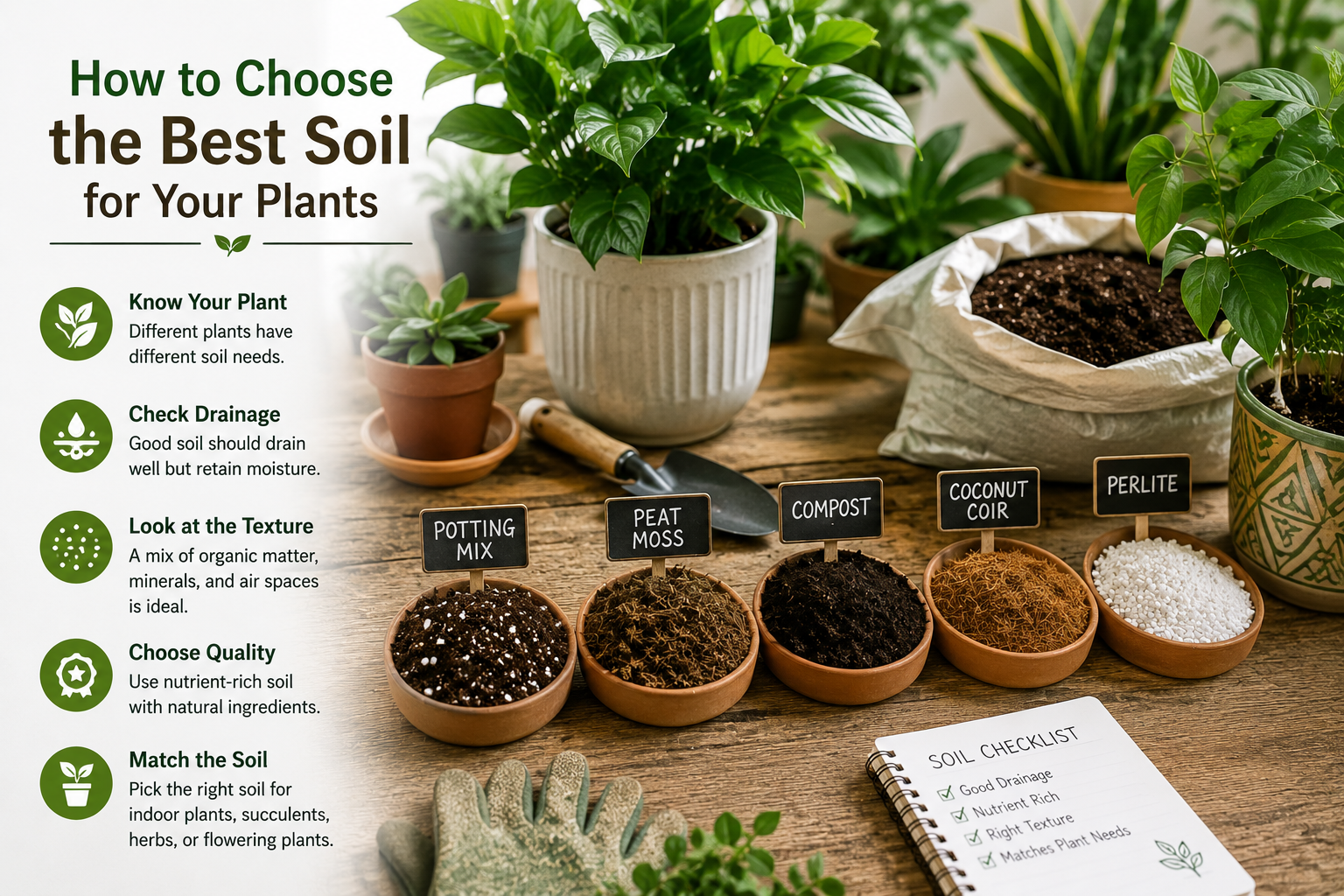
Soil is the foundation of every healthy plant, yet it is one of the most overlooked aspects of plant care. Most people grab whatever bag of potting mix is closest on the shelf without giving it a second thought, only to wonder later why their plants are not performing as expected. The truth is that soil choice makes an enormous difference in how well a plant grows, how often you need to water, how effectively roots absorb nutrients, and how resilient the plant becomes over time. Understanding what different soils offer — and what each of your plants actually needs — is one of the most valuable investments you can make as a plant owner.
Why Soil Choice Matters More Than Most People Realize
Soil does far more than simply hold a plant upright. It is a dynamic medium that regulates moisture availability, provides a reservoir of nutrients, supports the microbial communities that make those nutrients accessible to roots, and determines how much oxygen reaches the root zone. A soil that is too dense suffocates roots and holds excess moisture that leads to rot. A soil that is too coarse drains so quickly that roots cannot absorb adequate water between irrigations. The ideal soil for any given plant strikes a precise balance between moisture retention and drainage, and that balance differs significantly from one plant type to another.
The other critical function of soil is pH — the measure of how acidic or alkaline the growing medium is. Most common houseplants and garden plants prefer a slightly acidic to neutral pH range of around 6.0 to 7.0, where the broadest range of nutrients remains chemically available to roots. Outside this range, certain nutrients become locked in forms that roots cannot absorb, leading to deficiency symptoms even when those nutrients are technically present in the soil. Choosing a quality potting mix formulated for your plant type helps ensure that pH is within the appropriate range from the start.
Understanding what is actually in potting soil
Most commercial potting mixes are blends of several different ingredients, each contributing specific properties to the overall medium. Peat moss or coco coir provides the bulk of the mix and retains moisture while remaining relatively lightweight. Perlite or vermiculite adds drainage and aeration. Bark chips improve structure and slow decomposition. Wetting agents help the mix absorb water evenly. Slow-release fertilizer granules provide an initial nutrient supply. Reading the ingredient list on a bag of potting mix before buying it tells you a great deal about how it will perform and whether it is appropriate for the plants you intend to grow.
All-Purpose Potting Mix: What It Is Good For
A standard all-purpose potting mix is formulated to provide adequate moisture retention, reasonable drainage, and a moderate nutrient supply for a broad range of common plants. It works well for most tropical foliage houseplants, flowering annuals, vegetables grown in containers, and many herbs. If you are growing pothos, philodendrons, peace lilies, snake plants, rubber plants, or most leafy greens, a quality all-purpose potting mix is a perfectly appropriate starting point.
The key word, however, is starting point. Even with all-purpose mix, most experienced plant growers add a proportion of perlite to improve drainage and aeration, typically in a ratio of around seventy percent potting mix to thirty percent perlite. This simple modification improves root health for almost all plant types and dramatically reduces the risk of overwatering, which is particularly valuable for anyone who tends to water on a schedule rather than by checking soil moisture each time.
Specialist Mixes for Specific Plant Types
While an all-purpose mix works for many plants, certain plant groups have such specific soil requirements that using a standard mix puts them at a significant disadvantage from day one. Investing in the right specialist mix for these plants is not an extravagance — it is the difference between a plant that thrives and one that slowly declines despite your best efforts at watering and feeding.
Cactus and succulent mix is formulated with a very high proportion of grit, sand, and perlite, creating an extremely fast-draining medium that mimics the dry, rocky soils these plants evolved in. Using a standard potting mix for succulents and cacti retains far too much moisture around their roots and almost invariably leads to rot over time. Orchid mix is another specialist product, typically made entirely from bark chips, perlite, and sometimes sphagnum moss — a chunky, open medium that allows the aerial roots of epiphytic orchids to breathe and dry out rapidly between waterings exactly as they would in their natural tree-canopy habitat.
- All-purpose potting mix — suitable for most tropical foliage plants, flowering houseplants, and vegetables
- Cactus and succulent mix — fast-draining and gritty, essential for drought-tolerant desert plants
- Orchid bark mix — chunky and open, designed for epiphytic plants with aerial roots
- Ericaceous compost — acidic mix for acid-loving plants like blueberries, azaleas, and camellias
- Seed and cutting compost — fine-textured, low-nutrient mix for germinating seeds and rooting cuttings
- Aquatic compost — heavy, clay-based mix designed for water garden and pond plants
- Raised bed and vegetable mix — nutrient-rich blend formulated for heavy-feeding edible plants
Key Amendments That Improve Any Soil
Even the best commercial potting mix benefits from the right amendments. Learning which amendments to add and in what proportions gives you the ability to fine-tune any soil for any plant rather than relying entirely on what comes out of the bag. This level of control is what separates plant owners who consistently grow thriving specimens from those who struggle with the same recurring problems despite following general care advice.
Perlite is the most universally useful amendment, improving drainage and aeration in virtually any mix without affecting pH or nutrient content. Worm castings are an exceptional organic amendment that adds slow-release nutrients, beneficial microorganisms, and improved moisture retention to any potting mix — adding ten to twenty percent worm castings to a standard potting mix creates a noticeably richer growing medium that plants respond to with vigorous growth. Horticultural charcoal improves drainage, neutralizes odors in enclosed growing environments, and provides a small amount of potassium to the root zone.
When to add sand and when to avoid it
Coarse horticultural sand is a useful drainage amendment for succulents, cacti, and Mediterranean herbs when added in significant quantities. However, a common mistake is adding a small amount of fine builder’s sand to a standard potting mix in the hope of improving drainage. Fine sand added in small proportions actually makes drainage worse rather than better, because the tiny sand particles fill the air pockets between the larger soil particles, creating a denser, more compacted medium. If you use sand as a drainage amendment, use coarse horticultural grit rather than fine sand, and add it in a proportion of at least thirty to forty percent of the total mix volume to have any meaningful positive effect.
Signs That Your Soil Is Not Right for Your Plant
Your plant will tell you fairly quickly when the soil it is growing in is not meeting its needs. Learning to recognize these soil-related symptoms helps you intervene before permanent damage occurs. Soil that stays wet for more than four or five days after watering, water that pools on the surface rather than being absorbed immediately, and a sour or unpleasant smell rising from the pot are all signs that the mix is too dense and moisture-retentive for the plant growing in it. Conversely, soil that dries out completely within twenty-four hours of watering, water that runs straight through the pot without being absorbed by the root zone, and a plant that wilts rapidly between waterings suggest a mix that is draining too freely and not retaining enough moisture.
White crusty deposits forming on the soil surface or on the outside of terracotta pots indicate a buildup of mineral salts from tap water and fertilizer residue — a sign that the soil has been in the pot for too long and needs refreshing. Soil that has compacted into a hard, dense mass that pulls away from the edges of the pot has lost its structure entirely and needs to be replaced with fresh potting mix to restore healthy root function.
How Often to Replace Your Potting Mix
Potting mix does not last indefinitely. Over time, the organic components break down and decompose, the physical structure collapses, nutrients are depleted, and the medium gradually loses its ability to drain and aerate effectively. Most potting mixes perform well for one to two years before needing replacement, though plants in fast-growth phases or heavy feeders may exhaust a mix more quickly than slow-growing plants in small pots.
The best time to refresh potting mix is in spring, when plants are entering their active growing season and are best positioned to recover quickly from the disturbance of repotting. You do not always need to move a plant into a larger pot — if the current pot size is still appropriate, simply remove the plant, shake off as much of the old soil as possible without damaging the roots, and repot into the same container with fresh potting mix. This soil refresh alone, without any change in pot size, is often enough to reinvigorate a plant that has been looking tired and slow-growing.
Common Mistakes to Avoid
- Using garden soil in pots — Garden soil compacts severely in containers, drains poorly, and often introduces pests, diseases, and weed seeds. Always use a purpose-made potting mix for container growing.
- Reusing old potting mix without amendment — Old mix that has already grown one plant is depleted of nutrients and may harbor pathogens. If reusing it, sterilize it first and incorporate fresh compost and slow-release fertilizer before planting again.
- Using the same mix for all plant types — A single all-purpose mix is not appropriate for every plant. Succulents, orchids, and acid-loving plants all need specialist mixes that meet their specific requirements.
- Overfilling pots with soil — Leave at least two to three centimeters between the soil surface and the rim of the pot to allow for effective watering without overflow.
- Ignoring the expiry date on bagged potting mix — Potting mix that has been stored for a long time, particularly in warm conditions, loses structure, beneficial microbial activity, and nutrient content. Buy fresh mix from a store with high turnover for the best results.
Frequently Asked Questions
Q: Can I make my own potting mix at home?
A: Yes, and many experienced growers prefer homemade mixes because they can tailor the ingredients precisely to their plants’ needs. A reliable all-purpose homemade mix can be made by combining equal parts good quality compost, perlite, and coco coir. For succulents, replace the coco coir with coarse horticultural grit and increase the perlite proportion. Homemade mixes are often more cost-effective for growers with large collections and give you complete control over every ingredient.
Q: Is coco coir better than peat moss as a base ingredient?
A: Coco coir and peat moss perform similarly as base ingredients in potting mixes, but coco coir has significant environmental advantages. Peat moss is harvested from ancient peat bogs that take thousands of years to form and are important carbon sinks, making its extraction ecologically damaging. Coco coir is a byproduct of the coconut industry and is entirely renewable. From a plant performance perspective, coco coir has excellent water retention and drainage balance, resists compaction slightly better than peat, and has a near-neutral pH that suits most plants very well.
Q: My plant looks healthy but is not growing. Could the soil be the problem?
A: Possibly. A plant that maintains its appearance but shows no new growth over an extended period may be growing in soil that is nutrient-depleted, too compacted for roots to expand into, or simply too old to support active growth effectively. Try refreshing the potting mix with a repot into fresh soil, adding a dose of balanced liquid fertilizer at the start of the growing season, and ensuring the pot size is appropriate — a plant that is significantly root-bound will often stall in growth until it is given more room to expand.