
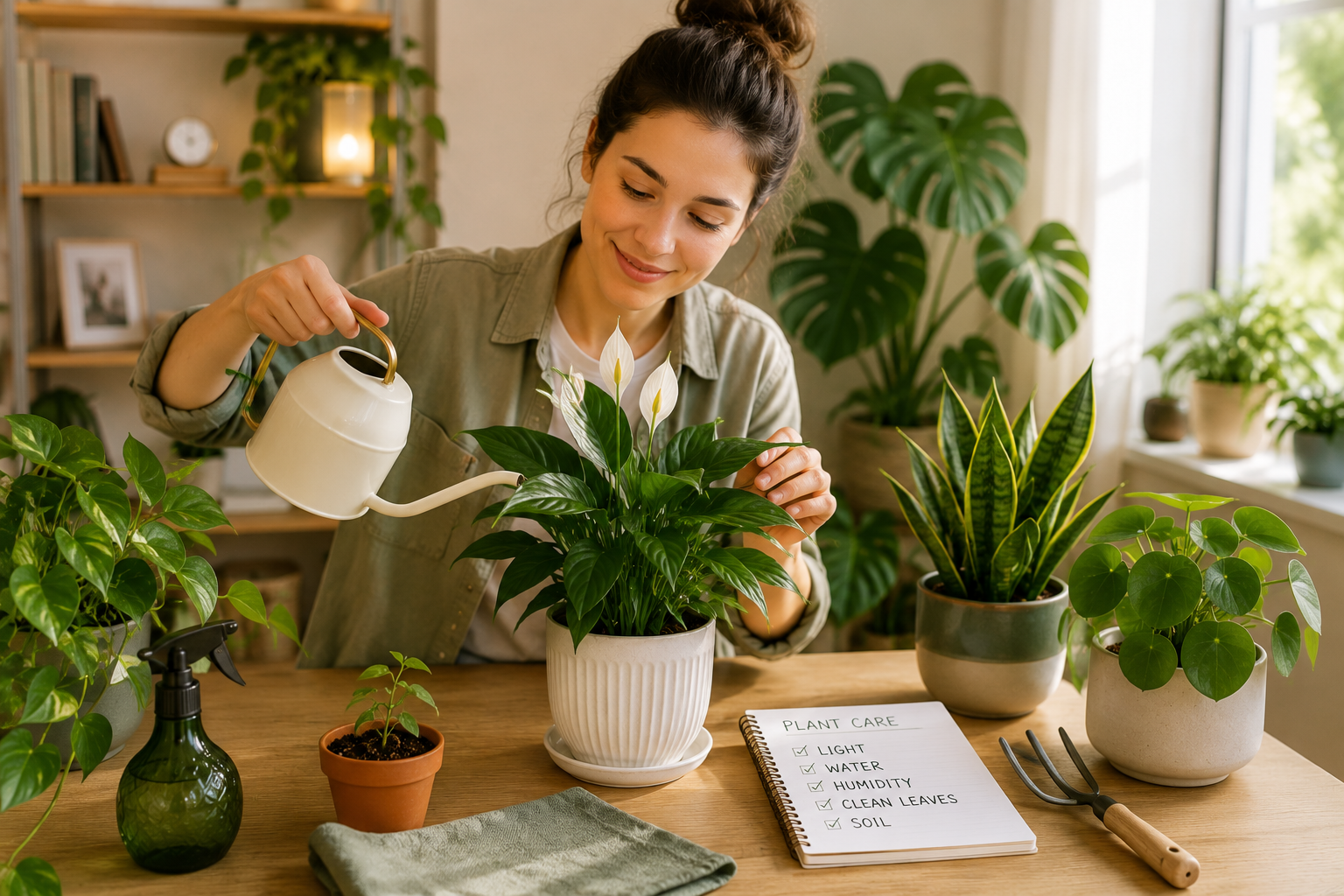
Indoor plants have the remarkable ability to transform any living space into something warmer, calmer, and more alive. But bringing a plant home is only the beginning. Giving it the right care is what determines whether it will thrive for years or slowly decline over weeks. The good news is that caring for indoor plants properly is not complicated — it simply requires understanding a few fundamental principles and applying them consistently.
Start by Getting to Know Each Plant Individually
One of the most important things you can do when you bring a new plant home is to research its specific needs before placing it anywhere. Not all plants want the same amount of light, water, or humidity, and treating every plant the same way is the most common reason indoor plants struggle. A plant label or a quick search will tell you whether your new plant prefers bright light or shade, dry soil or consistent moisture, and whether it comes from a tropical rainforest or an arid desert — each of these backgrounds dictates exactly what kind of care it expects from you.
Once you understand a plant’s native environment, mimicking those conditions indoors becomes much more intuitive. A plant from the humid tropics will want a spot with indirect light, regular watering, and occasional misting. A plant from a dry, sunny climate will want as much light as you can give it, infrequent watering, and a fast-draining potting mix. This individual approach transforms plant care from guesswork into a logical, satisfying practice.
Building a simple plant profile for each one
Consider keeping a brief note for each plant in your home — even just a few lines on your phone. Write down its common and botanical name, its preferred light level, how often you typically water it, when you last repotted it, and any issues you have noticed. After a few months, these small records become an invaluable personalized guide that removes all the uncertainty from your routine and helps you spot patterns in how each plant behaves across different seasons.
Getting Light Right Inside Your Home
Light is the single most important variable in indoor plant care, and it is also the one most commonly underestimated. The human eye adapts to low light so effectively that a room that feels bright to you can be profoundly dark from a plant’s perspective. A spot just a few feet away from a window can receive ten times less light than the windowsill itself, which is why plant placement matters so much more than most people realize.
As a general rule, place sun-loving plants such as succulents, cacti, herbs, and crotons as close to your brightest windows as possible. Give medium-light plants like pothos, peace lilies, and Chinese evergreens a spot a few feet back from the window where they receive bright ambient light without direct sun. Reserve your darkest corners for truly low-light champions like the cast iron plant, ZZ plant, or snake plant, which can tolerate significantly reduced light without serious decline.
When natural light is not enough
If your home genuinely lacks sufficient natural light — a common situation in apartments with north-facing windows or spaces surrounded by other buildings — a grow light is a practical and effective solution. Modern LED grow lights are energy-efficient, affordable, and designed to blend discreetly with home interiors. Position a grow light roughly thirty to sixty centimeters above your plants and run it for twelve to sixteen hours per day to simulate a full day of natural light. This simple addition can make it possible to grow thriving plants in virtually any corner of your home.
Watering Indoor Plants the Right Way
Watering is the aspect of indoor plant care that trips up the greatest number of people, and the mistake is almost always the same: watering too often rather than too little. Overwatering causes root rot, a condition where the roots suffocate in saturated soil and begin to decay. Root rot is silent — the plant continues to look fine above the soil surface while its foundation is being destroyed below — which is why it so frequently goes undetected until serious damage has been done.
The most reliable way to water correctly is to check the soil moisture before every watering session. Push your finger or a wooden chopstick an inch or two into the soil. If it comes out with damp soil clinging to it, the plant does not need water yet. If it comes out clean and dry, water the plant thoroughly, soaking the entire root ball until water flows freely from the drainage holes at the bottom of the pot. Then wait, check again in a few days, and repeat the process only when the soil has dried to the appropriate level for that particular plant.
Water quality and temperature matter more than you think
Tap water in many areas contains chlorine, fluoride, and other minerals that can build up in the soil over time and cause leaf tip browning, particularly in sensitive plants like spider plants, dracaenas, and peace lilies. If you notice white crusty deposits on your soil surface or brown tips appearing on otherwise healthy leaves, your water quality may be the culprit. The simplest fix is to fill your watering can the night before and let it sit uncovered overnight — this allows chlorine to dissipate naturally. Alternatively, collect and use rainwater, which most houseplants find ideal. Always use water at room temperature, as cold water can shock tropical plant roots and cause temporary wilting.
Humidity, Temperature, and Air Circulation
Most popular indoor plants come from tropical or subtropical regions where humidity levels are significantly higher than the average home, particularly during winter when central heating actively dries out the air. Low humidity manifests in plants as brown leaf tips, crispy leaf edges, flower drop in orchids and gardenias, and general lackluster growth. Addressing humidity is one of the most impactful improvements you can make to your indoor plant care routine.
The most effective ways to raise humidity around your plants include grouping them together so they share the moisture they release through their leaves, placing pots on a tray filled with pebbles and water so the evaporating moisture rises around the plant, or running a small humidifier nearby during dry winter months. Regular misting can help temporarily but evaporates too quickly to make a lasting difference on its own. Kitchens and bathrooms are naturally humid and often excellent locations for moisture-loving tropical plants.
Keeping temperatures stable
Most indoor plants are comfortable in the same temperature range that humans prefer — roughly eighteen to twenty-four degrees Celsius. What they cannot tolerate are sudden temperature swings. Keep plants away from cold drafts near single-pane windows in winter, and away from heating vents that blast warm, dry air directly onto their foliage. Air conditioning units present the same problem in summer. Consistent, moderate temperatures produce the steadiest, healthiest growth in virtually all common indoor plants.
Feeding Indoor Plants for Strong, Healthy Growth
Indoor plants rely entirely on you for their nutrients because the limited soil in a pot cannot regenerate minerals the way natural ground does. A plant that is never fed will gradually exhaust the nutrients in its potting mix and begin to show the signs of deficiency — pale, yellowing leaves, slow growth, and a general lack of vitality. A simple, consistent fertilizing routine prevents all of this and keeps your plants looking their best throughout the growing season.
Use a balanced liquid fertilizer diluted to half the recommended strength during spring and summer, applying it once every two to four weeks depending on how actively the plant is growing. A fertilizer labeled with equal or near-equal NPK numbers — such as 10-10-10 or 20-20-20 — provides a broad base of nutrients suitable for most foliage plants. For flowering plants, switch to a formula higher in phosphorus during the budding season to encourage blooms. Stop fertilizing entirely in autumn and winter when most plants slow down or go dormant.
Common Mistakes to Avoid
- Watering on a fixed schedule regardless of soil moisture — Always check the soil first. Seasons, temperature, and pot size all affect how quickly soil dries out.
- Placing plants in spots chosen for decoration rather than light — A beautiful dark corner is not a good home for a plant that needs light. Always prioritize the plant’s needs over the room’s aesthetics.
- Using pots without drainage holes — No matter how carefully you water, a pot without drainage will eventually trap enough water to rot the roots. Always use pots with holes, or a nursery pot inside a decorative cover pot.
- Ignoring the signs of stress — Yellowing leaves, wilting, leaf drop, and brown tips are all messages from your plant. Learning to read these signals early prevents small problems from becoming irreversible ones.
- Fertilizing in winter — Feeding a dormant plant pushes it to grow when it naturally wants to rest, weakening it and making it more susceptible to pests and disease.
Frequently Asked Questions
Q: How do I know if my indoor plant is getting enough light?
A: A plant receiving insufficient light will show it through slow or stopped growth, pale or washed-out leaf color, leggy stems that stretch toward the nearest light source, and lower leaves that drop prematurely. If you notice any of these signs, move the plant progressively closer to a window over the course of a week or two to avoid shocking it with a sudden change.
Q: My plant’s leaves are turning yellow. What should I do?
A: Yellowing leaves are most commonly caused by overwatering, but they can also indicate underwatering, insufficient light, nutrient deficiency, or natural aging of older lower leaves. Check the soil moisture first — if it is wet and has been for several days, hold off on watering and improve drainage. If the soil is bone dry, give the plant a thorough drink. Identifying the cause before acting prevents you from making the problem worse.
Q: How often should I repot my indoor plants?
A: Most indoor plants need repotting every one to two years, or when roots begin growing out of the drainage holes or circling visibly around the inside of the pot. Spring is the ideal time to repot, as plants are entering their active growing season and will recover from the disturbance quickly. Always choose a new pot just one size larger than the current one — going too large traps excess moisture and can cause root rot.