
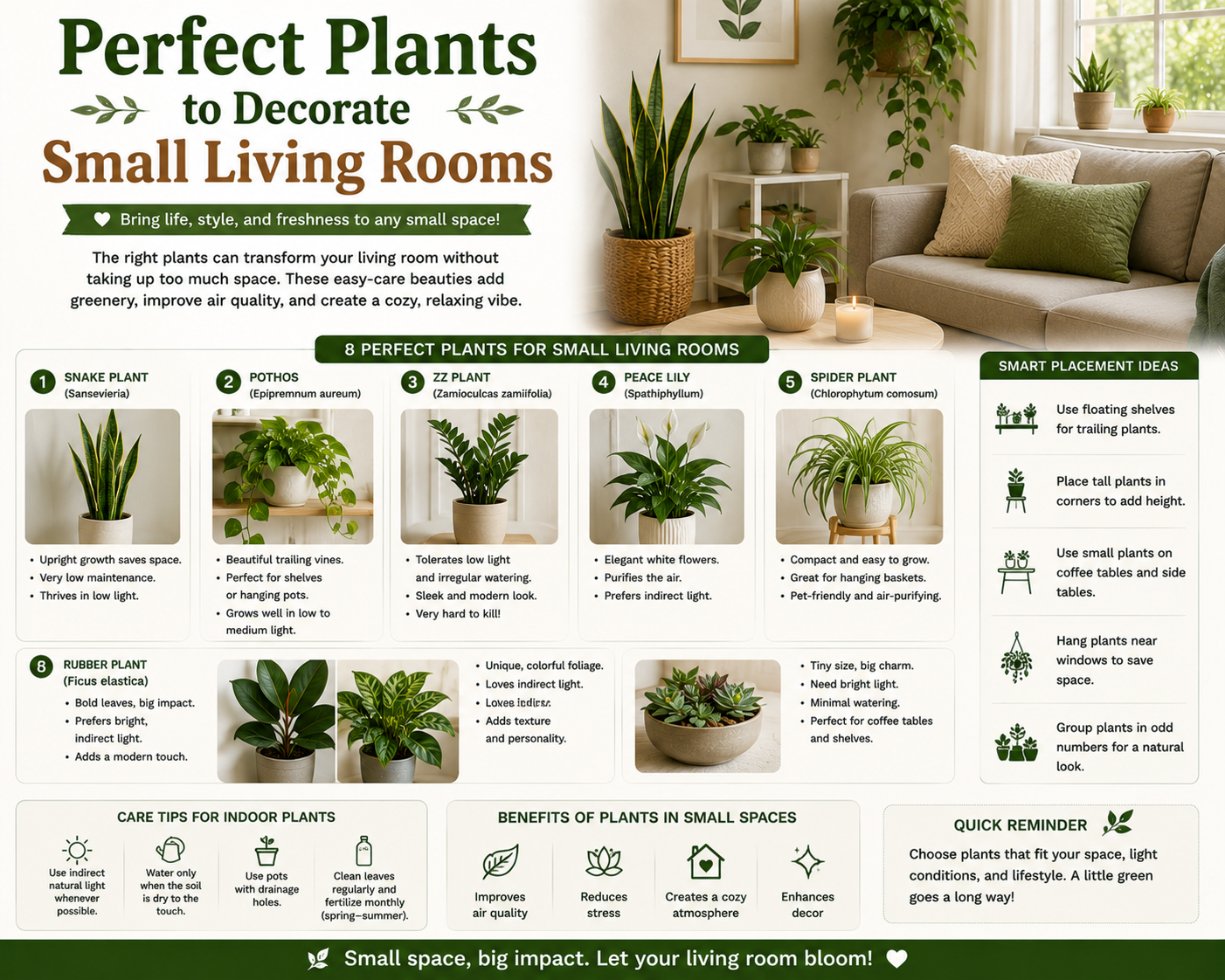
A small living room presents a genuine design challenge: the space is limited, every element competes for visual attention, and the wrong plant choices can make a compact room feel more crowded and claustrophobic rather than warmer and more alive. But the right plants, chosen thoughtfully and positioned with intention, have the opposite effect — they add life, color, and a sense of organic abundance to small spaces without consuming valuable floor area or visually overwhelming the room. The key is understanding which plant forms, sizes, and arrangements work with a small room’s proportions rather than against them.
Understanding Scale and Proportion in Small Spaces
Scale is the most important principle to understand when decorating a small living room with plants. In a small space, the relationship between the size of the plant, the size of the pot, and the dimensions of the room is more critical than in a large open-plan space where scale mismatches are more easily absorbed. A single enormous plant can look dramatic and beautiful in a large living room but dominating and claustrophobic in a small one. Conversely, a collection of tiny plants scattered randomly around a small room creates visual clutter that makes the space feel busier and smaller rather than fresher and more alive.
The most effective approach for small living rooms is a deliberate hierarchy of scale: one or two plants that are large enough to make a statement but appropriately sized for the room’s dimensions, combined with a small number of medium and compact plants that complement the statement pieces without competing with them. This hierarchy creates visual order and a sense of intentional composition that makes even a modest collection feel curated and considered rather than random.
Using vertical space to maximize plant presence
In a small living room where floor space is at a premium, vertical space is your most valuable and underused resource. Tall, narrow plants that grow upward rather than outward add significant plant presence to a room without consuming the floor space that wider, spreading varieties require. Wall-mounted shelves at varying heights, floor-to-ceiling plant stands, and hanging planters suspended from ceiling hooks or wall brackets all allow you to create an abundant plant display in a small room while keeping the floor clear and maintaining the sense of open, navigable space that small rooms depend on.
The Best Plants for Small Living Rooms
The snake plant is perhaps the single most versatile plant for small living rooms. Its upright, sword-shaped leaves grow strictly vertically, making it one of the narrowest plants available relative to its height. It adds strong architectural presence and considerable visual impact without spreading into the room or competing for floor space, and its tolerance of low light and irregular watering makes it as practical as it is beautiful. Varieties like Dracaena trifasciata ‘Laurentii’ with yellow-edged leaves or ‘Moonshine’ with silvery-grey foliage offer beautiful color variation alongside the classic form.
The pothos is equally valuable in small spaces for entirely different reasons. Its trailing stems and heart-shaped leaves create lush, abundant greenery from a compact pot positioned on a high shelf, cabinet top, or hanging planter — the foliage cascades downward, filling vertical space with organic beauty while the pot itself takes up minimal surface area. A single large pothos in a hanging planter positioned near a window fills an entire corner of a small living room with life and movement while claiming almost no floor space at all.
- Snake plant — tall, narrow, architectural, tolerates low light, perfect for tight corners
- Pothos — trailing, abundant foliage from a compact pot, ideal for shelves and hangers
- ZZ plant — glossy, architectural, stays compact, thrives in low light conditions
- Peace lily — elegant, blooms in shade, stays compact, air purifying
- Rubber plant — striking large leaves, can be kept compact with pruning, slow growing
- String of pearls — extraordinary visual impact from a small hanging pot, minimal space requirement
- Chinese evergreen — beautiful patterned leaves, compact growth, tolerates low light
Positioning Plants to Make a Small Room Feel Larger
Strategic plant placement can actively create the impression of a larger, more open space in a small living room. Positioning a tall plant in a corner where two walls meet draws the eye upward toward the ceiling, making the ceiling feel higher and the room proportionally more spacious. A plant with large, glossy leaves positioned near a mirror reflects both the plant and the light it is associated with, creating the visual impression of double the greenery in a larger, brighter space. Trailing plants hung near windows fill the upper portion of the room with movement and color while keeping the sightlines at eye level and below open and uncluttered.
Avoid placing large, bushy plants in the center of the room or directly in front of seating, where they obstruct sightlines and make the space feel divided and cramped. Reserve the central floor area of a small living room for furniture and movement, and use plants at the periphery — in corners, on shelves, at the edges of windowsills — where they add richness to the room’s boundaries without consuming its usable space.
Pot and Container Choices for Small Spaces
In a small living room, the visual consistency of your plant containers contributes significantly to whether the overall effect feels curated or cluttered. Choosing pots in a limited, cohesive palette — two or three complementary materials or colors — creates visual unity that makes even a modest collection feel intentionally designed. Matte ceramic in soft neutral tones, natural terracotta, or simple white ceramic all work well in most small living room color schemes without competing with the furniture or architecture of the room.
Avoid the temptation to use pots that are too large for the plants they contain — oversized pots in a small room amplify the sense of mass and weight that makes the space feel smaller. Choose pots that are proportionate to both the plant and the surface they sit on, and remember that a well-chosen small pot on a plant stand can have more visual impact than a large pot on the floor simply by virtue of its elevated position bringing it into the natural sightline.
Common Mistakes to Avoid
- Choosing wide, spreading plants that consume valuable floor space — In a small living room, every square foot of floor space matters. Choose tall, narrow, or hanging plants that add vertical presence without spreading outward.
- Using too many small plants rather than a few well-chosen larger ones — Many tiny plants scattered around a small room create visual noise. A few considered, appropriately sized specimens have far more impact and create a more spacious feeling.
- Ignoring light requirements when positioning plants for decorative effect — A plant placed in a decoratively perfect position that has inadequate light will slowly decline regardless of how well you care for it in other respects. Always confirm that a position has sufficient light before committing a plant to it.
- Choosing fast-growing plants that will quickly outgrow a small space — In a small living room, a plant that doubles in size within a year becomes a management problem rather than a decorative asset. Choose slow-growing varieties or species that respond well to regular pruning to maintain a compact size.
- Overcrowding plants in a small space for instant lushness — Overcrowding restricts airflow around plants, encourages pest and disease problems, and makes the room feel cluttered. Leave appropriate space between plants and resist the urge to fill every surface immediately.
Frequently Asked Questions
Q: What is the best single plant to make an impact in a very small living room?
A: A large, well-grown snake plant in a beautiful statement pot positioned in a corner is arguably the single most impactful choice for a small living room. It adds significant height and architectural presence, tolerates the variable light conditions of most living rooms, requires minimal care, and stays naturally narrow — all qualities that make it ideal for small spaces where one plant needs to do a lot of visual work.
Q: Can hanging plants make a small room feel larger or smaller?
A: Hanging plants generally make small rooms feel larger and more abundant rather than smaller, because they fill vertical space and draw the eye upward without consuming any floor area. The key is positioning — hanging plants near windows frame the light source beautifully. Too many hanging plants at the same height creates a low visual ceiling that can actually make a room feel smaller. Vary the hanging heights and keep the number moderate.
Q: How do I prevent plants from making a small living room look messy?
A: Cohesion is the answer. Choose plants that share a similar aesthetic language — all tropical foliage, all succulents, all architectural forms — rather than a random mix of unrelated styles. Use containers in a consistent material or color palette. Prune regularly to maintain tidy, intentional shapes. Remove dead or yellowing leaves promptly. A small, well-maintained, cohesive plant collection always looks more deliberate and elegant than a large, diverse, and casually maintained one.