
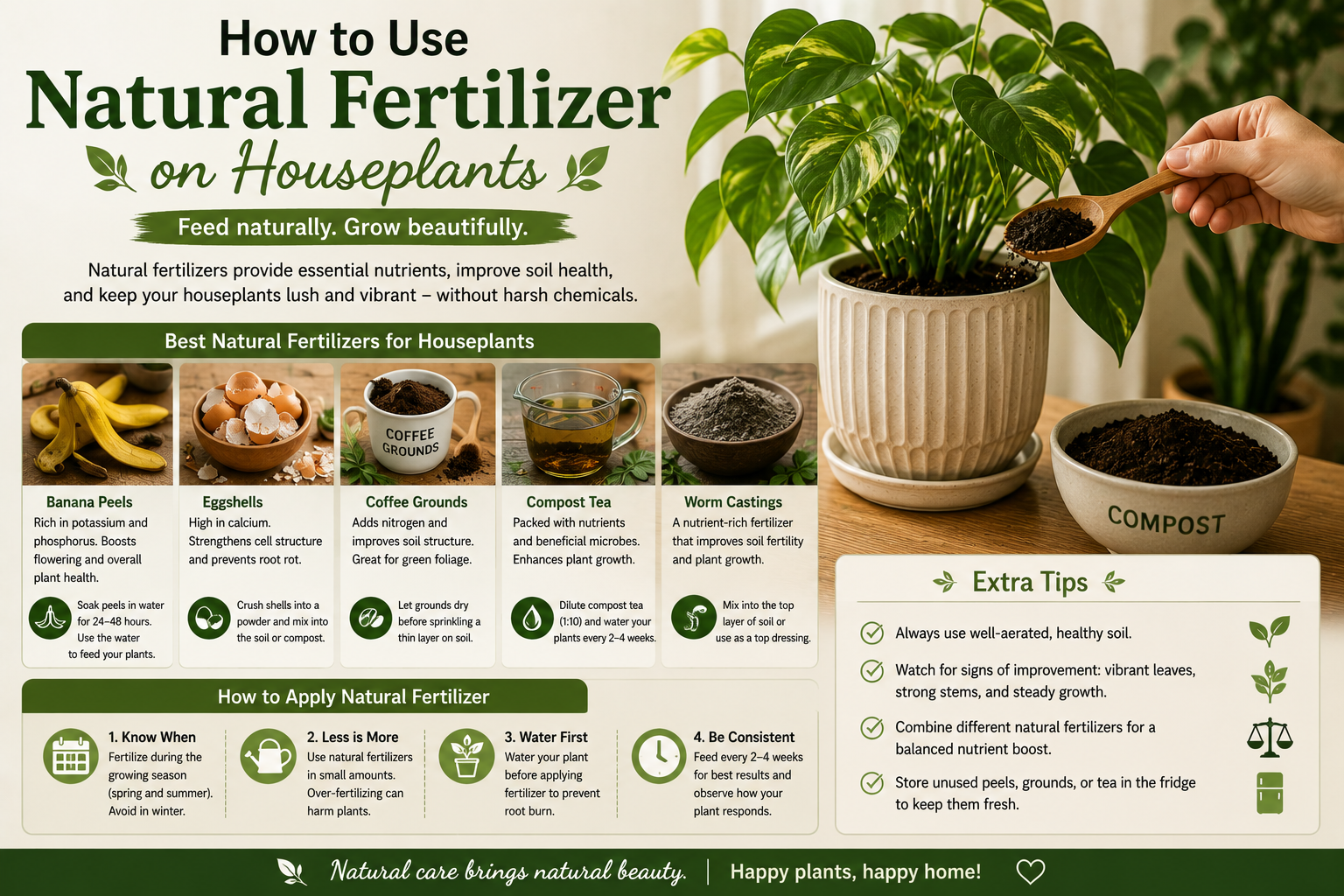
Natural fertilizers are one of the best-kept secrets in houseplant care. While synthetic fertilizers have their place, natural alternatives offer a gentler, more sustainable approach to feeding your plants — one that nourishes not just the plants themselves but the entire living ecosystem of the soil they grow in. Whether you are motivated by environmental concerns, a desire to avoid chemicals in your home, or simply curiosity about what your kitchen and garden waste can do for your plants, natural fertilizers are worth understanding thoroughly.
Why Natural Fertilizers Work So Well
Synthetic fertilizers deliver nutrients to plants in immediately soluble forms that roots can absorb directly. This produces fast, visible results but also carries risks — the concentration of salts can burn roots if overapplied, and repeated use without organic matter input gradually degrades soil structure and the microbial communities that make nutrients naturally available to plants over time.
Natural fertilizers work differently. Most release their nutrients slowly as they break down, providing a steady, moderate supply that feeds plants continuously over weeks or months rather than in a single concentrated dose. This slow-release mechanism makes them almost impossible to overapply and dramatically reduces the risk of burning roots or foliage. Many natural fertilizers also actively improve soil structure and feed the beneficial bacteria and fungi that create a thriving root environment in which plants genuinely flourish.
Understanding NPK in natural fertilizers
All fertilizers, natural or synthetic, are assessed by their NPK ratio — the proportion of nitrogen, phosphorus, and potassium they contain. Nitrogen drives leafy, green growth. Phosphorus supports root development and flowering. Potassium improves overall plant health, disease resistance, and stress tolerance. Natural fertilizers tend to have lower NPK numbers than synthetic ones, which means they need to be applied in larger quantities or more frequently to deliver the same total nutrient dose — but that lower concentration is part of what makes them so safe and forgiving to use.
The Best Natural Fertilizers for Houseplants
Worm castings are widely considered the finest natural fertilizer available for houseplants. Also known as vermicompost, they contain an extraordinary range of nutrients, beneficial microorganisms, plant growth hormones, and humic acids that improve both soil structure and plant vitality. They are gentle enough to apply directly to the soil surface of any houseplant without risk of burning. Add a generous handful to the top of each pot every two to three months throughout the growing season.
Compost tea — made by steeping finished compost in water for twenty-four to forty-eight hours, then straining and using the liquid to water plants — delivers a broad spectrum of nutrients and beneficial microorganisms in a form that roots absorb immediately. Banana peel fertilizer, made by soaking banana peels in water for several days, provides a significant boost of potassium — particularly useful for flowering houseplants during the budding stage.
- Worm castings — the gold standard of natural fertilizers, safe for all plants, improves soil biology
- Compost tea — broad-spectrum liquid feed made from steeping finished compost in water
- Banana peel fertilizer — high in potassium, excellent for flowering plants
- Diluted coffee grounds — mild nitrogen boost, slightly acidic, good for acid-loving plants
- Eggshell water — rich in calcium, beneficial for plants prone to deficiencies
- Diluted fish emulsion — high in nitrogen, fast-acting for leafy growth
- Nettle tea — high in nitrogen and iron, excellent general-purpose plant tonic
How to Make Natural Fertilizers at Home
One of the most appealing aspects of natural fertilizers is that many can be made at home from materials that would otherwise be thrown away. Banana peel fertilizer requires nothing more than saving banana skins and soaking them in water for three to five days to create a potassium-rich liquid feed, or drying and grinding them into a powder to mix directly into potting soil. Eggshell calcium is equally simple — save eggshells, rinse them, dry them thoroughly, and steep in water for a calcium-rich liquid feed.
Compost tea is one of the most powerful homemade feeds you can produce. Fill a bucket with one part finished compost and five parts water, stir vigorously, and allow it to steep for twenty-four to forty-eight hours. Strain the liquid, dilute to the color of weak tea if it appears too dark, and use it to water your plants immediately. The remaining solid compost can be added directly to pot soil or garden beds as a mulch.
How Often to Apply Natural Fertilizers
Because natural fertilizers release nutrients slowly and gently, they can be applied more frequently than synthetic fertilizers without risk of overfertilizing. Liquid natural fertilizers such as compost tea and banana peel water can replace plain watering sessions every two to four weeks throughout spring and summer. Solid amendments such as worm castings can be top-dressed onto the soil surface every six to eight weeks, where they will slowly release nutrients with each subsequent watering.
As with all fertilizers, reduce or stop feeding in autumn and winter when most houseplants enter a period of slower growth or dormancy. Natural fertilizers are gentle, but applying them to dormant plants still introduces nutrients that cannot be used effectively and may disrupt the natural rest cycle that prepares plants for vigorous growth the following spring.
Common Mistakes to Avoid
- Applying coffee grounds directly and thickly to soil — Undiluted coffee grounds applied in quantity make soil water-repellent and can introduce excessive acidity. Use sparingly or diluted in water.
- Using uncomposted kitchen scraps directly in pots — Fresh scraps applied directly to pot soil attract pests and can introduce pathogens. Compost them first or make a liquid feed by steeping them in water.
- Expecting results as fast as synthetic fertilizers — Natural fertilizers work slowly and gently. The results build steadily over weeks and months rather than appearing dramatically within days.
- Fertilizing stressed or sick plants — A plant dealing with root rot or pest damage cannot use fertilizer effectively. Address the underlying problem first, then resume feeding once the plant has recovered.
- Fermenting liquid feeds for too long — Banana peel water and compost tea can become anaerobic and develop harmful compounds if left too long. Make and use them within forty-eight to seventy-two hours.
Frequently Asked Questions
Q: Can I use cooking water from vegetables to feed my plants?
A: Yes, unsalted cooking water from boiling or steaming vegetables contains small amounts of nutrients that leached from the vegetables during cooking. Allow it to cool completely to room temperature before using it to water your plants, and ensure it contains no salt, butter, oil, or other additives that would harm roots.
Q: Are natural fertilizers safe for all houseplants?
A: Most natural fertilizers are gentle enough for all common houseplants when used appropriately. The exception is coffee grounds and other acidic amendments, which should be used sparingly on plants that prefer neutral to alkaline soil conditions. Worm castings are the most universally safe natural fertilizer and can be applied to virtually any plant without concern.
Q: How do I know if my natural fertilizer is working?
A: Look for new growth at the tips of stems and the emergence of fresh leaves — these are the clearest indicators that a plant is receiving adequate nutrition. Deeper, richer green color in existing leaves, stronger stems, and increased overall vigor are also positive signs. Because natural fertilizers work slowly, allow four to six weeks of consistent application before assessing results.